
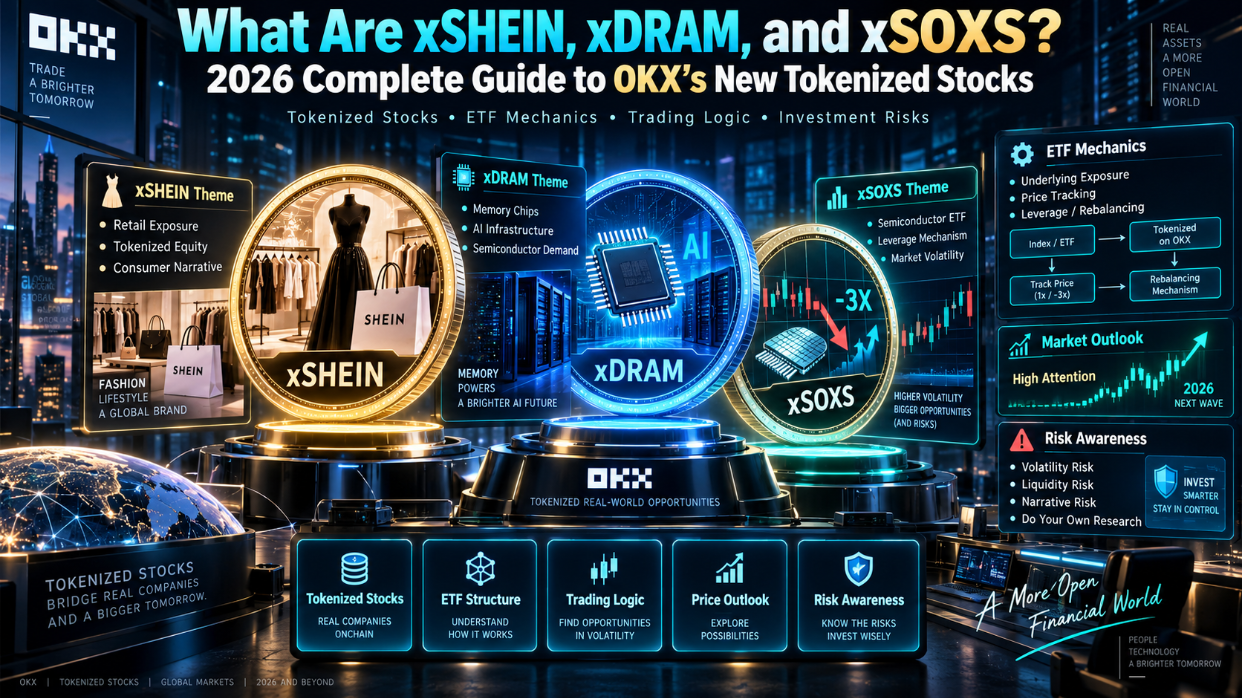
On September 7, 2026, OKX announced a new batch of Unified Tokenized Stocks, scheduled to open USDT spot trading for xSHEIN, xDRAM, and xSOXS on September 8. Though all three fall under the "unified tokenized stocks" umbrella, their underlying assets are fundamentally different:
- xSHEIN tracks the single-company stock exposure of SHEIN, which just listed in Hong Kong.
- xDRAM tracks the Roundhill Memory ETF – a basket investment in HBM, DRAM, and NAND industries.
- xSOXS tracks the daily –3x inverse semiconductor ETF, making it a short-term bearish or hedging tool.
These are not ordinary crypto project coins, nor are they OKX-issued company stocks. What users buy is primarily price exposure to the underlying stock or ETF – you do not become a shareholder of the underlying company and typically have no voting rights. The real risks go beyond price volatility: they include issuer risk, custody risk, liquidity risk, premiums/discounts during market closures, corporate actions, and regional compliance restrictions.
Data & Risk Disclaimer: This article was updated on September 8, 2026. OKX’s announcement lists the spot opening times for xSHEIN, xDRAM, and xSOXS as 15:00, 16:00, and 17:30 (UTC+8) on September 8, respectively. Actual availability depends on your region and the platform interface. This article is for informational and educational purposes only and does not constitute trading advice. Tokenized securities and leveraged ETFs may result in partial or total loss of principal.
Key Takeaways – 7 Things to Know Before Trading
- xSHEIN, xDRAM, and xSOXS are OKX unified ticker names, not on-chain tokens issued by OKX themselves.
- The current products are primarily supported by xStocks, issued by Backed Assets (JE) Limited. OKX acts as the distribution and trading venue.
- xStocks are tracker certificates that provide economic exposure – they do not equal direct stock ownership and generally carry no shareholder voting rights.
- xSHEIN = single share of SHEIN; xDRAM = Memory industry ETF; xSOXS = daily –3x inverse ETF.
- OKX displays positions in "shares" , but the conversion ratio between on-chain tokens and share equivalents may change dynamically due to corporate actions like dividends and stock splits.
- Secondary market trading is 24/7, but the underlying securities markets and primary creations/redemptions are not – significant price deviations can occur on weekends.
- Among the three, xSOXS is the most structurally complex: on top of tokenization risks, it adds leverage, daily reset, and compounding path dependency.
1. They Look Alike – But the Underlying Investment Logic Is Completely Different

This table alone shows why you cannot use the same strategy for all three. Analyzing xSHEIN requires researching SHEIN; xDRAM requires studying the global memory industry; xSOXS requires understanding not just semiconductor direction but also the daily leveraged mechanism.
Tokenization changes how the asset enters your crypto account and on-chain wallet – it does not change the economic laws of the underlying asset.
2. What Are OKX Unified Tokenized Stocks?
2.1 Roles of OKX, xStocks, and the Underlying Assets
According to OKX's Unified Tokenized Stocks explanation, OKX provides unified position units, USDT order books, and trading services. The current underlying is primarily supported by xStocks. The on-chain products are issued by third-party issuers; OKX is not the issuer of the underlying tokens.
The chain of responsibility is:
Underlying stock or ETF → Custody and collateral arrangement → Backed Assets issues xStocks → OKX converts to unified "share" units → Users trade via USDT.
xStocks documentation states that the issuer is Backed Assets (JE) Limited, a special-purpose entity based in Jersey. Each xStock is separately collateralized by its corresponding underlying asset, held with regulated custodians and brokers in segregated accounts. The so-called "1:1 backing" is a description of the product's asset structure – not a risk-free guarantee.
2.2 Why the "x" Is Sometimes Before, Sometimes After the Ticker
OKX uses the unified naming convention of a lowercase "x" before the stock code – e.g., xAAPL, xSHEIN, xDRAM. On-chain xStocks, however, often use the ticker with an "x" after – e.g., AAPLx, DRAMx, SOXSx.
This distinction comes from the two-layer product structure:
- OKX in-house tickers represent unified trading and accounting assets.
- On-chain tickers represent the specific issuer's tokens.
- In the future, the same underlying may be supported by multiple issuer versions, and OKX can consolidate them under one in-house ticker.
- When withdrawing, the actual issuer token you receive depends on product rules and availability.
So, seeing xSHEIN does not mean that an identical on-chain ticker necessarily exists. Always verify the network, contract, conversion ratio, and final token received before withdrawing.
2.3 Does Buying a Tokenized Stock Equal Buying the Actual Stock?
No. xStocks official documentation defines the product as a bearer debt instrument and tracker certificate: holders receive economic price exposure to the underlying stock or ETF, but they are not direct shareholders of the underlying company and typically have no voting rights.
"Backed by underlying assets" and "owning underlying stock" are two different things – the former addresses collateral, the latter addresses legal shareholder status and rights. Investors must not conflate the two.
3. Why 1 On-Chain Token ≠ 1 Share Forever
OKX uses share-based accounting – the user interface displays positions and quotes in "shares." However, on-chain tokens are subject to a dynamic multiplier that reflects dividends, stock splits, and reverse splits. Thus:
OKX Displayed Shares = On-Chain Token Amount × Current Shares per Token
For example, if the multiplier becomes 1.0026, one token may correspond to roughly 1.0026 shares of economic exposure. When depositing, OKX converts tokens into "shares"; when withdrawing, it converts "shares" back to tokens.
This design has three practical implications:
- The deposited amount may not equal the credited share count.
- Withdrawing one share may not yield exactly one token.
- Checking only the ticker and token quantity is insufficient – you must also verify the multiplier.
4. xSHEIN – What It Is and Why It Carries Unique IPO Price-Discovery Risks
4.1 Which Stock Does xSHEIN Track?
xSHEIN tracks the price exposure of SHEIN stock. SHEIN's investor relations page confirms the company completed its IPO on the Hong Kong Stock Exchange on September 1, 2026, under the stock code 0625. OKX plans to open xSHEIN/USDT on September 8 – only about one week after the underlying stock's listing.
So xSHEIN is not a "SHEIN Coin" and does not require researching token unlocks, burns, or community governance. It is first and foremost a newly listed single-stock exposure.
4.2 7 Key Fundamentals to Watch for xSHEIN
- IPO Valuation – With limited public trading history, the market must re-assess growth rates, margins, and fair value.
- Revenue Growth – Can SHEIN continue expanding at its current scale? This matters more than one-off promotional data.
- Profitability & Cash Flow – If high growth relies on continuous subsidies, marketing, and logistics spending, valuation logic will differ from stable, profitable companies.
- U.S. De Minimis & Cross-Border Trade Policy – Changes in small-package tariff rules, customs duties, and clearance processes can affect price competitiveness and fulfillment costs.
- European Regulation – Product safety, consumer protection, environmental requirements, and small-package tax regimes.
- Competition – Temu, Amazon, and other fast-fashion platforms – customer acquisition costs, repurchase rates, and supply chain efficiency determine growth quality.
- Post-IPO Supply – Lock-up expirations, early shareholder exits, and new share issuances may impact price.
For formal research, prioritize SHEIN's prospectus, HKEX announcements, and company financial reports – not just crypto exchange charts.
4.3 Bull, Base, and Bear Scenarios for xSHEIN
- Bull Case: Revenue re-accelerates, margins improve, regulatory costs stay manageable, and the IPO valuation gains market acceptance.
- Base Case: Growth slows but profitability stabilizes; price gradually discovers value through earnings releases.
- Bear Case: Trade policy tightens, competition intensifies, growth or profits miss expectations, and early shareholder supply compresses valuation.
5. xDRAM – Why It Is Not a "DRAM Company"
5.1 The Underlying Is the Roundhill Memory ETF
xDRAM tracks the Roundhill Memory ETF, whose traditional-market ticker is DRAM. This is not a single company called "DRAM" but an actively managed ETF focused on the global memory industry.
According to Roundhill official materials, the ETF began trading on April 2, 2026, with an expense ratio of 0.65%. Core exposures include Micron, Samsung, SK Hynix, SanDisk, and Kioxia, covering HBM, DRAM, NAND, SSDs, and other storage segments. The fund may also use total return swaps, so it should not be simplified as an equal-weighted basket of five stocks – actual holdings and weights change.
5.2 Why Does the AI Era Need a Dedicated Memory ETF?
The larger the AI model, the more data GPU clusters must exchange and read. As compute speeds increase, memory bandwidth can become the new bottleneck:
AI CapEx increases → GPU clusters and servers expand → HBM capacity per GPU rises → HBM/DRAM demand grows → inventories decline, memory prices improve → semiconductor manufacturers' earnings change → DRAM ETF performance → xDRAM price.
This gives xDRAM a "pick-and-shovel" attribute for AI infrastructure, but it is not a pure HBM ETF. NAND, HDDs, SSDs, non-memory businesses, derivatives positions, and regional markets all affect the portfolio.
5.3 Why the Memory Cycle Matters More Than "NVIDIA Going Up"
The memory industry has high fixed costs and volatile product prices. A typical cycle runs:
Demand increases → inventories fall → prices rise → profits improve → manufacturers expand production → supply increases → prices fall → inventories rise → capex cuts → cycle resets.
Thus, xDRAM investors should continuously track:
- DRAM spot and contract prices.
- HBM orders, pricing, capacity, and yields.
- Micron's gross margins.
- SK Hynix's HBM capacity and market share.
- Samsung's HBM certification progress.
- AI data center CapEx.
- Inventory days of major manufacturers.
- ETF holdings, NAV, and premium/discount.
AI may raise the long-term demand floor, but it does not eliminate capacity, inventory, and price cycles.
5.4 Bull, Base, and Bear Scenarios for xDRAM
- Bull Case: Persistent HBM shortages, rising DRAM prices, expanding AI CapEx, and upward earnings revisions for manufacturers.
- Base Case: AI demand grows but supply increases in tandem; the ETF relies on earnings growth rather than rapid multiple expansion.
- Bear Case: AI investment decelerates, inventories rebound, over-expansion leads to memory price declines.
6. xSOXS – Why It Has the Highest Structural Risk Among the Three
6.1 What Does "Daily –3x" Actually Mean?
xSOXS tracks the Direxion Daily Semiconductor Bear 3X Shares. Direxion's objective is to deliver, before fees, –300% of the single-day performance of the NYSE Semiconductor Index.
- If the index rises 3% on a day, SOXS aims to fall ~9%.
- If the index falls 3%, SOXS aims to rise ~9%.
This is a single-day target – it does not guarantee that over a week, month, or year the return will equal –3× the index's cumulative return.
Direxion official materials explicitly state that SOXS is an actively managed short-term tool and is not suitable for investors who do not understand leveraged risks.
6.2 Why Can SOXS Lose Money Even If the Index Returns to Its Starting Point?
Assume the semiconductor index starts at 100:
- Day 1: Index falls 10% – from 100 to 90. SOXS (simplified) rises 30% – from 100 to 130.
- Day 2: Index rises 11.11% – from 90 back to 100. SOXS falls about 33.33% – from 130 to 86.67.
After two days, the index is roughly back to its starting point, but SOXS is down ~13.33%. This is not a product "error" – it happens because the fund resets its –3× exposure daily using the new net asset value. The result depends on the price path – this is Daily Reset, Compounding, and Path Dependency.
The more frequent the oscillations, the higher the volatility, and the longer the holding period, the more likely the actual cumulative return will deviate from "end-point index change × –3."
6.3 Why Does SOXS Frequently Reverse Split?
In a long-term upward semiconductor environment, inverse ETFs may suffer continuous erosion, causing the unit price to drop. Direxion implemented a 1-for-10 reverse split on SOXS on July 15, 2026: 10 old shares merged into 1 new share, with the unit price theoretically multiplied by 10. Total investment value at the time of the split remains unchanged (in principle).
A reverse split does not suddenly make holders profitable, nor does it eliminate long-term decay. It is primarily a technical adjustment to maintain a tradable unit price, while also visually reflecting the net-asset pressure that long-term holding of inverse leveraged products may experience.
6.4 Bull, Base, and Bear Scenarios for xSOXS
- Bull Case for xSOXS = Bear Case for semiconductors: the index needs to decline persistently over a relatively short period.
- Base Case: If semiconductors trade sideways, xSOXS may still suffer gradual erosion from path dependency and fees.
- Bear Case: Semiconductors rally steadily, or high volatility causes severe compounding decay.
Thus, xSOXS is closer to a short-term directional trade or a tactical hedge for long semiconductor positions – it should not be defaulted to for long-term DCA.
7. Investment Strategies for the Three Assets

7.1 xSHEIN: Fundamentals & IPO Confirmation Strategy
Do not chase just because it "just listed." Build a phased decision framework after earnings, revenue, margins, regulatory changes, and valuation become clearer. If the company's growth narrative breaks, re-evaluate – do not turn a single-stock trade into a long-term conviction.
7.2 xDRAM: Memory Cycle Strategy
Memory stocks often lead spot prices and earnings reports. A more complete confirmation chain is:
Inventory declines → DRAM prices bottom → earnings estimates rise → key ETF components strengthen together.
If manufacturers expand capacity aggressively while demand expectations start to soften, watch for cycle tops.
7.3 xSOXS: Risk Budget & Time Horizon First
Before trading, write down your expected holding days, maximum loss, and exit conditions. Position sizing should be determined not just by "bearish conviction" but also by –3× daily volatility, weekend spreads, and tokenized order-book liquidity. When used for hedging, verify that the hedge asset and SOXS's index exposure are genuinely matched.
8. Why 24/7 Trading Is Both an Advantage and an Extra Risk
8.1 Who Sets the Price When the Underlying Market Is Closed?
OKX allows unified tokenized stocks to trade on weekends and during traditional market holidays. Prices will reference the most recent closing price and market estimates. Secondary market quotes are still driven by order-book supply and demand, while xStocks primary creations and redemptions generally operate on business days, roughly 24/5.
This means the arbitrage mechanism is restricted during certain periods, and spreads may widen.
For example, if major positive news about SHEIN breaks on a Saturday, xSHEIN might jump 15% – but the Hong Kong market remains closed. Come Monday, two outcomes are possible: SHEIN stock catches up and validates the on-chain move, or the traditional market reacts less strongly and xSHEIN corrects back.
24/7 trading does not eliminate opening/closing risk – it simply moves the prediction of the next open into the crypto market.
8.2 Why Is xSOXS's Holiday Risk Even More Complex?
xSOXS requires not only estimating the semiconductor index's direction when it reopens, but also factoring in the timing of the underlying ETF's daily reset. Weekend token prices may react to news, but the underlying ETF's true –3× target still executes on its own trading-day calendar. Users cannot mechanically interpret weekend token moves as if SOXS has already realized the same NAV change.
9. How Are Dividends, Splits, and Reverse Splits Handled?
xStocks handle corporate actions through rebasing or a display multiplier:
- Dividends: Cash dividends from the underlying, after applicable withholding taxes, are reinvested – economic value is reflected through token or platform balance adjustments.
- Stock Splits: Balances or multipliers are adjusted proportionally; theoretical total value does not change due to the split itself.
- Reverse Splits: The token's corresponding share count decreases, while unit value increases.
- Mergers, Delistings, or Product Terminations: Handled per issuance documents and platform rules – outcomes may differ from ordinary crypto tokens.
OKX in-house trading typically continues during dividend processing, but deposits, withdrawals, and internal transfers for the affected asset may be temporarily suspended. Always check corporate action records, not just raw wallet token counts.
10. Why 1:1 Collateral ≠ Zero Risk
"1:1" means the corresponding product is backed by the underlying asset on a segregated custody structure. It does not eliminate:
- Issuer Risk: The issuer may fail to perform or terminate the product.
- Custodian Risk: Problems with brokers, custodians, or account control arrangements.
- Legal Risk: Different jurisdictions classify tracker certificates and tokenized stocks differently.
- Liquidity Risk: Insufficient depth on OKX or on-chain order books.
- Price Divergence: Token deviates from underlying reference value during closures.
- Smart Contract Risk: Contracts, wallets, bridges, or approvals are exploited.
- Redemption Risk: Restricted creation/redemption hours, KYC, minimum amounts, or channel limits.
- Tax Risk: Dividend withholding tax and transaction tax treatment vary by region.
- Termination Risk: The issuer may terminate the product per terms, and the final amount received could be below cost.
Even if the underlying security performs well, problems in the tokenization infrastructure can cause additional losses.
11. How SOL, BTC, and ETH Affect the Trading Environment – But Not Underlying Value
OKX currently supports deposits/withdrawals of xStocks via Solana and X Layer. Therefore, SOL's relationship to these assets is primarily about on-chain infrastructure, wallets, and liquidity. You can check SOL live price and SOL price prediction to assess network risk appetite and on-chain activity – but you cannot deduce "SOL goes up, so xSHEIN goes up."
Similarly, BTC price prediction can help observe overall crypto risk-on/risk-off and USDT funding activity; ETH price prediction relates to the broader EVM, DeFi, and RWA composability environment.
Underlying prices remain determined by their respective assets: xSHEIN tracks SHEIN, xDRAM tracks DRAM ETF, and xSOXS tracks SOXS and the semiconductor index. BTC, ETH, and SOL primarily affect trading environment, on-chain transfers, and secondary-market premiums/discounts.
12. HIBT Tokenized Asset 6-Layer Framework
When analyzing any tokenized stock or ETF, work through these six layers:
Layer 1: Underlying Asset
Is it a common stock, ETF, leveraged ETF, or other security? xSOXS alone is far more complex than xSHEIN at this layer.
Layer 2: Issuer
Who issues the on-chain product? Its legal entity, issuance documents, applicable jurisdictions, and termination rules?
Layer 3: Collateral
Is it item-by-item 1:1 collateralized? Who holds custody? Segregated accounts, proof of reserves, independent security agents?
Layer 4: Market Structure
On which platforms is it traded? Volume, order book, spreads, deposit/withdrawal depth? When are primary creations/redemptions open?
Layer 5: Corporate Actions
How are dividends, splits, reverse splits, mergers, and delistings handled? How does the token-to-share conversion ratio change?
Layer 6: Tokenization Risk
Are issuer, custody, contracts, blockchain, bridges, regulation, liquidity, and holiday spreads low, medium, or high risk? Do not assign a vague overall score.
This framework's priority is: first identify the underlying asset, then analyze the tokenization structure – do not look at a USDT trading pair and treat it like an ordinary altcoin.
13. How to Trade xSHEIN, xDRAM, and xSOXS on OKX
Per OKX's announcement, subject to regional availability, users may follow these steps:
- Log in, confirm eligibility and risk warnings for your region.
- Prepare USDT.
- Search for xSHEIN/USDT, xDRAM/USDT, or xSOXS/USDT.
- Check the latest price, trading hours, and company news of the underlying stock or ETF.
- Compare OKX's quote with the underlying reference price to calculate premium or discount.
- Review order-book depth, bid-ask spread, and estimated slippage for large orders.
- Choose limit or market orders based on your risk budget.
- If withdrawing to a wallet, confirm Solana or X Layer, on-chain token name, conversion multiplier, and withdrawal fees.
Price discovery is often incomplete during the early hours of new asset openings. Especially when the underlying market is closed, limit orders help control execution price better than chasing market orders without regard for spreads – but they do not eliminate loss risk.
14. Pre-Trade Checklist – What to Verify for Each Asset

15. FAQ – Common Questions About xSHEIN, xDRAM, and xSOXS
What is xSHEIN?
xSHEIN is an in-house OKX unified tokenized stock that provides price exposure to SHEIN stock – not a SHEIN-issued crypto token.
Does buying xSHEIN equal holding SHEIN stock?
No. It provides economic price exposure but does not confer traditional stock ownership, shareholder voting rights, or direct holdings in a securities account.
Where is SHEIN listed?
SHEIN completed its IPO on the Hong Kong Stock Exchange on September 1, 2026, under ticker 0625.
What is xDRAM?
xDRAM is the tokenized price exposure to the Roundhill Memory ETF. The underlying is an ETF, not a single company named DRAM.
What does the DRAM ETF mainly invest in?
It focuses on HBM, DRAM, NAND, and the broader memory/storage industry, with major exposures to Micron, Samsung, SK Hynix, SanDisk, and Kioxia – holdings and weights are subject to change.
What is xSOXS?
xSOXS tracks the Direxion Daily Semiconductor Bear 3X Shares, which aims for –300% of the single-day return of the NYSE Semiconductor Index.
Is xSOXS suitable for long-term holding?
Generally, no. Daily reset, fees, volatility, and path dependency can cause long-term results to deviate significantly from –3× the index's cumulative decline.
Why can xSOXS lose money even if the semiconductor index returns to its starting point?
Because the fund resets its –3× exposure daily using the new NAV. Different sequences of up/down days produce compounding drag.
Who issues OKX's tokenized stocks?
OKX currently primarily supports xStocks; the on-chain products are issued by Backed Assets (JE) Limited. OKX is the distribution and trading venue, not the underlying token issuer.
Are xStocks truly 1:1 asset-backed?
xStocks states that each product is 1:1 collateralized by the corresponding underlying asset in segregated custody. This structure reduces some credit risk but does not eliminate issuer, custody, legal, liquidity, or redemption risks.
How are dividends handled for tokenized stocks?
Dividends from the underlying, after applicable withholding taxes, are reinvested and reflected via balance or multiplier adjustments – not paid out as cash USDT to users.
Why can I trade on weekends?
On-chain tokens and OKX's secondary market continue trading, but the underlying securities market and primary creations/redemptions may not be open. Weekend prices are formed by market expectations and order-book supply/demand, and spreads may be wider.
Which of the three assets carries the highest risk?
From a product-structure complexity standpoint, xSOXS is clearly the highest, because on top of common tokenization risks, it adds daily –3× leverage, compounding path dependency, short-term timing requirements, and reverse-split issues.
16. Conclusion: Same Category, Different Investments
Though xSHEIN, xDRAM, and xSOXS are all grouped under OKX's Unified Tokenized Stocks, they correspond to three completely different analytical frameworks.
- xSHEIN is a single-stock exposure to SHEIN, which just completed its IPO. Investors must first analyze company growth, profitability, valuation, regulation, and post-IPO supply.
- xDRAM is exposure to the Roundhill Memory ETF – better suited for evaluating HBM, DRAM pricing, inventory, and AI capital expenditure trends.
- xSOXS is a daily –3x inverse semiconductor ETF exposure – daily reset and path dependency make it closer to a short-term trading or hedging instrument.
What all three share is the added layer of tokenization structure: what you hold is not a traditional securities account holding – you also bear issuer risk, custody risk, smart-contract risk, liquidity risk, corporate-action conversion risk, weekend price-gap risk, and regional regulatory risk.
Therefore, your research sequence should be:
First confirm what the underlying asset is, then understand the issuance and collateral structure; next check market liquidity and corporate actions; only finally assess price and strategy.
Tokenization changes the trading entry point – but it does not change SHEIN's company-specific risks, the memory industry's cyclical patterns, or the compounding erosion caused by SOXS's daily –3× mechanism.