
Data benchmark: November 9, 2026. FLOAT is a very young token, so price, supply, liquidity, trading venues and platform parameters may change quickly.
Direct answer: FLOAT is the flagship Solana token of Float, a launch platform that lets creators issue speculative coins paired with tokenized stocks, crypto assets, SOL or USDC. Eligible platform fees are split among holders, creators, trader rewards, the treasury and FLOAT buybacks and burns. That gives FLOAT a clearer value-capture story than a typical meme token, but it remains an unaudited, early-stage and highly speculative asset whose long-term value depends on real platform activity—not the existence of a burn mechanism alone.
This article is educational and does not provide personalized investment advice. Only risk money you can afford to lose completely.
Key takeaways
- FLOAT is the flagship token, not every coin launched through Float.
- The verified Solana mint address published in the project's documentation is
Bv1a7cEj5aRnJQhMw4kRQqAFesMSd5LwcDnUzq52BMmr. - Float coins can be paired with tokenized stocks and other assets, but buying a Float coin does not make the buyer a shareholder in the referenced company.
- Float's published fee model allocates 35% of eligible Float Program fees to buy and burn FLOAT. This is not 35% of total trading volume.
- Holding FLOAT does not automatically entitle the holder to the stock-token rewards generated by every coin launched on the platform.
- Float's public documentation says its program has not undergone an outside audit.
- HIBT announced a FLOAT/USDT listing on November 9, 2026. Users should confirm that deposits and spot trading are open in their region before sending funds.
- The investment thesis should be tested with platform fees, successful launches, recurring traders, verified buybacks, liquidity and token distribution—not price momentum alone.
1. Why Beginners Should Understand FLOAT Before Buying It
FLOAT arrived during a market environment in which new Solana tokens can gain millions of dollars in trading volume within days. That speed creates opportunity, but it also removes the time investors normally use to examine a product, distribution and security record.
The common mistake is to see three attractive phrases—“tokenized stocks,” “holder rewards” and “buyback and burn”—and conclude that FLOAT must appreciate. Each phrase needs qualification.
Tokenized-stock pairing does not necessarily provide legal ownership of the underlying stock. Holder rewards belong to holders of specific launched coins under specific fee routes, not automatically to all FLOAT holders. Buybacks create demand only when the platform generates eligible fees, and they cannot stop price declines if market selling is larger.
Float also has a different design from a plain meme launchpad. A conventional platform may focus on rapid issuance and bonding-curve trading. Float adds paired assets, on-chain fee routing, USDC trader rewards and a flagship-token value-capture mechanism. That makes it more interesting to analyze, but also creates more dependencies: Raydium, Jupiter routing, Solana programs, payout bots, third-party token issuers and thin liquidity can all become failure points.
The right starting question is therefore not “Can FLOAT go 10x?” It is:
Can Float produce recurring, verifiable economic activity, and does enough of that activity flow into sustainable demand for FLOAT?
Until the answer is supported over a longer period, FLOAT should be treated as a high-risk platform token rather than a proven long-term asset.
2. What Is FLOAT and How Is It Connected to Float Launch?

What does the Float platform do?
Float is a Solana-based launch and trading system built around Raydium LaunchLab. Its most distinctive feature is that creators can issue a new coin and pair it with a supported asset. The paired asset may be SOL or USDC, a crypto-linked token, a tokenized stock such as an NVIDIA- or Tesla-linked token, or another supported instrument.
The platform's public documentation describes a standard launch with a fixed supply of one billion units, no mint or freeze authority, and a starting market capitalization of about $20,000. The new coin trades through a bonding curve. At roughly a 7.5x increase—around a $150,000 market capitalization under the published parameters—it “graduates,” and liquidity migrates into a Raydium pool using Burn & Earn.
These are platform parameters, not a quality guarantee. Graduation proves that a coin crossed a mechanical threshold. It does not prove durable demand, a responsible creator or an investable business.
What is the FLOAT token?
FLOAT is the platform's flagship token. It has its own supply, market and holders. It is different from:
- The separate community or meme coins launched through Float.
- The tokenized stocks or other assets used as trading pairs and reward assets.
- Equity in the company or team operating the platform.
The clearest documented FLOAT utility is indirect value capture. A portion of eligible trading fees generated by Float-launched coins is used to buy FLOAT on the market and burn the purchased tokens.
FLOAT is not required for every platform action, and the reviewed documentation does not establish ordinary FLOAT holders as shareholders, creditors or recipients of a legally enforceable revenue dividend.
What is the official FLOAT contract address?
The official documentation identifies the Solana mint as:
Bv1a7cEj5aRnJQhMw4kRQqAFesMSd5LwcDnUzq52BMmr
The same address appears on major market trackers. Never identify the asset only by the name “FLOAT,” because multiple unrelated tokens can use the same ticker.
Before buying, compare the complete address across:
- The official Float documentation.
- The project's verified social account.
- Solscan.
- The exact DEX pool or exchange deposit page.
Readers can use the FLOAT live market page to monitor price and market information, but the displayed ticker is not a substitute for checking the supported network and deposit contract.
Does holding FLOAT automatically earn other tokens?
No. This is one of the most important distinctions in the project.
The 15% holder allocation in Float's published fee split belongs to holders of each eligible launched coin. Rewards are paid in that coin's paired asset. If a launched coin is associated with a stock-linked token, eligible holders of that coin may receive the linked token under the relevant route.
Simply holding the FLOAT flagship token does not automatically make a wallet eligible for every launched coin's holder rewards. FLOAT benefits through the separate 35% buyback-and-burn route.
3. How Float Works and What Tokenized-Stock Pairing Really Means
The launch process
Float's documented launch sequence can be summarized in four stages.
First, a creator selects the new coin's identity, paired asset and trading fee. The published fee options are 1%, 2% or 2.5% on buys and sells.
Second, the coin begins trading through Raydium LaunchLab's bonding curve. Buying pushes the curve price higher; selling pushes it lower. The displayed market capitalization is a mathematical valuation, not cash available for every holder to exit at that price.
Third, the coin reaches the graduation threshold. Float's documentation describes this at approximately $150,000, compared with a starting valuation around $20,000.
Fourth, liquidity moves to a Raydium pool and the liquidity position is handled through Burn & Earn. Users should still inspect the actual pool and locking transaction for each coin rather than assuming every launch completed correctly.
Does a tokenized-stock pair mean the buyer owns stock?
No. A tokenized stock may provide economic exposure, a reference price or a redemption mechanism defined by its issuer. It does not automatically provide the same legal rights as a share held in a regulated brokerage account.
Rights can differ on:
- Voting.
- Dividends.
- Redemption for a traditional share.
- Custody and reserve structure.
- Geographic eligibility.
- Transfer restrictions.
- Treatment during insolvency or suspension.
Float's risk documentation explicitly says these stock-linked tokens are issued by third parties, not by the referenced companies. It also warns that some issuers retain powers to pause transfers, move or burn tokens, or change transfer rules. If an issuer pauses a paired token, trading and rewards for the related Float coin may stop until service resumes.
This creates a layered risk structure. A user can be exposed simultaneously to the launched meme coin, the paired token, its issuer, Float's program, Raydium liquidity and Solana network conditions.
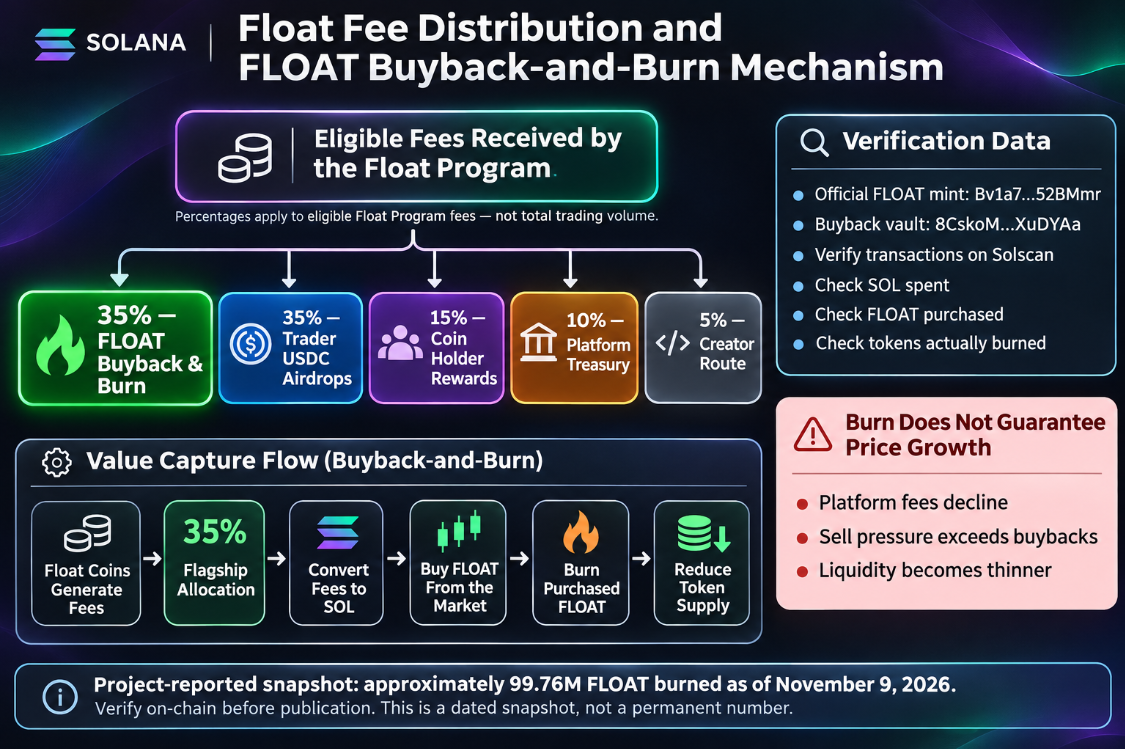
How are eligible fees divided?
Creators select the user-facing trading fee, and Raydium takes its applicable portion. The remaining eligible fees received by the Float Program are divided according to the published model:
- 15% for holders: paid to eligible holders of the relevant launched coin in its paired asset.
- 5% for the creator route: directed according to the chosen fee route, which can include a creator, wallet, charity or holder distribution.
- 35% for the flagship token: used to buy and burn FLOAT.
- 35% for traders: accumulated in USDC and distributed to qualifying traders based on eligible volume.
- 10% for the treasury: used to support the platform.
These percentages must not be multiplied by gross trading volume. If a coin records $10 million of volume, it does not mean $3.5 million automatically buys FLOAT. The 35% applies to eligible program fees after applicable Raydium deductions.
For example, if the Float Program actually receives $100,000 in distributable fees, the theoretical flagship allocation is:
[ $100,000 x 35% = $35,000 ]
That example explains the mechanism; it is not a claim about current revenue.
Holder rewards versus trader airdrops
Holder rewards are based on holding a specific launched coin at the relevant payout time. The documentation says smaller rewards can roll over until they meet the payout floor. Selling before payout may cause unpaid amounts to return to the remaining holder pool.
Trader rewards are different. The 35% trader share accumulates in USDC and is distributed to qualifying wallets according to eligible trading volume. Float's published rules exclude obvious bots and wash trading, including wallets that exceed the stated high-frequency threshold.
Trying to farm a trader reward can still lose money. Trading fees, spread, slippage, adverse price movement and disqualification can exceed the value of any eventual USDC payment.
4. How FLOAT Buybacks and Burns Capture Value
How does the mechanism work?
Eligible fees accumulate in program-controlled vaults and are cycled through the published fee routes. The flagship share is converted to SOL, used to buy FLOAT in the market and then burned.
The official documentation identifies the buyback-and-burn vault as:
8CskoMx4FaXjp7gzxNzaWQXGXGVBWYnNWXGcisXuDYAa
The project states that this is a program account without a private key held by an individual. That claim is useful, but users should still verify the actual instructions, transfers and burn destination on Solscan.
On November 2, 2026, the project announced a change from smaller ten-minute purchases to larger executions. Under that published setting, a buyback occurs after funds reach 5 SOL; if four hours pass before the threshold is reached, the accumulated amount is used anyway. This parameter can change and should not be treated as a permanent protocol guarantee.
How can investors verify the burns?
A basic verification process is:
- Open the official Float analytics or Burns page.
- Select a buyback transaction and open its Solscan record.
- Confirm that funds came from the documented buyback route.
- Identify the FLOAT market purchase and amount of SOL spent.
- Confirm the purchased token mint matches the official FLOAT address.
- Verify that the acquired tokens were burned or permanently removed according to the transaction instructions.
- Compare cumulative burns with the mint's current supply and timestamp the result.
Do not rely only on a dashboard total. A trustworthy dashboard should reconcile with individual transactions and current on-chain supply.
What do the latest project-reported figures show?
On November 9, the project's social account reported more than $1 million in cumulative fees, about $371,380 spent buying FLOAT and approximately 99.76 million FLOAT burned—close to 9.98% of the original one-billion supply. It also reported distributions to traders, holders and creators.
These figures are encouraging for early activity, but they are project-reported, very short-term and influenced by launch excitement. Investors should independently reconcile the total with on-chain records. A week of intense trading cannot establish sustainable annual revenue.
Why buyback and burn does not guarantee a higher price
Burning reduces supply, but price still depends on both supply and demand. FLOAT can fall despite burns when:
- Holders sell more value than buybacks purchase.
- Launch activity declines.
- Fees are driven by temporary incentive farming.
- Liquidity contracts.
- The market has already priced in aggressive future growth.
- A security or issuer event damages confidence.
The most useful ratio is not simply the number of tokens burned. Investors should compare buyback value with eligible fees, market capitalization, daily liquidity and net sell pressure.
The long-term thesis is:
More sustainable launches → recurring eligible fees → verified FLOAT purchases → lower supply and potential demand support.
If the first two steps fail, the rest of the chain weakens.
5. Where to Buy FLOAT Safely
FLOAT can be traded through Solana decentralized markets, including Raydium and Meteora. HIBT also announced the FLOAT/USDT spot pair on November 9, 2026. Because the listing was new at the time of writing, users should confirm whether deposits, trading and withdrawals are fully open before transferring assets.
Buying FLOAT on HIBT
For a beginner who prefers an account-based interface and USDT pricing, a centralized exchange can be simpler than a Solana DEX.
The general process is:
- Register through the official HIBT website and complete any verification required for the user's region.
- Enable two-factor authentication and anti-phishing protections.
- Deposit USDT using a network supported by both the sending wallet and HIBT.
- Confirm that the FLOAT/USDT market is open.
- Review price, spread, order-book depth and minimum order size on the FLOAT trading and market page.
- Choose a market order for immediate execution or a limit order to control the maximum purchase price.
- Verify the filled quantity, average execution price and fee in order history.
A market order does not guarantee the displayed last price. In a thin order book, a larger order can execute across several price levels. Beginners should consider a small test order before committing the full planned amount.
Do not deposit Solana FLOAT to HIBT until the deposit page explicitly shows the Solana network and the matching mint. An exchange listing announcement and an active deposit service are not always available at exactly the same time.
Buying through Raydium or Meteora
A DEX purchase requires a Solana-compatible wallet and sufficient SOL for network costs.
The safer workflow is:
- Open Raydium, Meteora or a trusted Solana aggregator through a verified URL.
- Connect a wallet containing only the amount intended for the trade.
- Paste the complete FLOAT mint address instead of searching only by ticker.
- Confirm the selected pool, paired asset and available liquidity.
- Request a quote and inspect price impact, minimum received and slippage tolerance.
- Start with a small swap.
- Confirm the received token mint in the wallet and inspect the transaction on Solscan.
DEX trading gives the user direct custody but adds contract, wallet, routing and slippage risk. Token approvals and signatures should be read carefully.
CEX or DEX: which is better for a beginner?
A CEX is generally easier for users who already hold USDT and want familiar order types. The trade-off is exchange custody and withdrawal dependence.
A DEX offers direct wallet settlement and access to on-chain liquidity. The trade-off is that the user must verify the contract, protect the seed phrase, manage SOL fees and understand slippage.
Neither option is automatically safer in every circumstance. The better choice is the one whose risks the user can actually control.
6. FLOAT Price, Liquidity and Risk Compared With BTC and ETH
FLOAT's first major pool appeared around October 28, 2026, making the token roughly twelve days old at this article's data date. That is far too short a history for reliable long-term volatility models.
As a November 9 snapshot, CoinGecko displayed FLOAT near $0.0125, while an on-chain tracker estimated a market capitalization around $11 million, 24-hour volume in the multi-million-dollar range and DEX liquidity below or around $1 million depending on pools and aggregation methodology. These numbers can change within minutes and should be refreshed before publication.
The relationship between volume and liquidity matters. Large reported volume shows intense turnover, not necessarily deep exit capacity. If a pool contains limited liquidity, a sell order can move the price sharply even when the token's market capitalization appears large.
Before deciding position size, simulate the intended sell—not only the buy. Check the quoted output for progressively larger amounts and ask whether the portfolio could exit during stress rather than during ideal conditions.
Why FLOAT is riskier than BTC or ETH
Bitcoin and Ethereum have deeper global liquidity, longer operating histories, broader custody support and more diversified holders. They still carry substantial volatility, but their risk is not dependent on one young launchpad's adoption.
FLOAT is a much higher-beta asset because its value depends on:
- Float platform activity.
- Fee generation.
- The accuracy and security of fee routing.
- Continued market demand for the flagship token.
- Solana liquidity.
- Third-party paired-token issuers.
- A very short holder and trading history.
The BTC price prediction and ETH price prediction pages can help monitor broader market scenarios, but BTC or ETH strength does not prove that FLOAT's fundamentals are improving.
For FLOAT-specific scenario research, the FLOAT price prediction page should be treated as an auxiliary sentiment tool, not a valuation guarantee.
Three FLOAT investment scenarios
In a bull case, Float continues attracting launches and real traders after early incentives fade. Eligible fees remain high, buybacks are verified, burns continue, liquidity deepens and platform security improves. FLOAT may then deserve a higher platform-token valuation.
In a base case, launch volume declines from the initial surge but a smaller active community remains. Buybacks continue at a lower rate, liquidity stabilizes and FLOAT trades primarily as a speculative ecosystem token. Returns depend more on entry valuation and market cycles.
In a bear case, new launches lose attention, fees fall, buybacks shrink and early holders sell into limited liquidity. A problem involving the program, payout bot, paired-token issuer or Solana market could accelerate the decline.
These conditions are more useful than a fabricated 2030 price target for a token with less than two weeks of market history.
7. FLOAT Investment Strategy and Position Management
How much should a beginner invest?
There is no universal percentage, but FLOAT should normally sit in the highest-risk part of a portfolio—not beside emergency savings or essential living funds.
A useful approach is to set the maximum acceptable portfolio loss first. For example, if an investor can tolerate only a 1% total-portfolio loss and assumes a speculative position could lose 80%, the position size must remain small enough that such a decline stays near the risk budget.
The principle is:
Position size x assumed loss ≤ maximum portfolio loss
This is more disciplined than choosing a position because the token “looks cheap.”
A three-stage entry process
An experienced trader may divide the intended position into three stages:
- Observation position: a very small amount used to test liquidity, custody and thesis tracking.
- Confirmation position: added only when platform fees, launches and verified buybacks remain healthy after initial excitement.
- Trend position: considered only when liquidity and adoption improve without valuation becoming excessive.
If the data weakens after the first stage, there is no obligation to continue buying.
When could adding exposure be justified?
Possible confirmation signals include:
- Platform fees remain active after trader incentives normalize.
- The number of genuine launches and graduations grows.
- Buybacks reconcile with the documented fee split.
- FLOAT liquidity deepens across reputable markets.
- Holder concentration falls rather than increases.
- An independent security audit is published and major authority risks are reduced.
Price rising by itself is not confirmation.
When should an investor reduce or exit?
Reassess the position when:
- Fees and launches decline persistently.
- Buyback transactions do not match public reporting.
- Liquidity falls while reported volume remains high.
- Large early wallets distribute into the market.
- A tokenized-stock issuer freezes a major paired asset.
- The platform suffers a contract, keeper or payout incident.
- The original trade becomes an emotional “long-term investment” only after a loss.
Long-term holding is appropriate only if the platform thesis matures. At present, FLOAT is better classified as a small, actively monitored speculative allocation than a set-and-forget core asset.
8. Risks, On-Chain Checklist and Final Verdict
Has Float been externally audited?
Float's public risk documentation states that the Float Program has not had an outside audit. This is a material risk, not a minor disclaimer. The platform handles fee routing, buybacks, payouts and integrations with external assets; a bug could affect one or several parts of the system.
The documentation also says a keeper temporarily handles some creator-share operations between sweeping and payout. An outage may delay distributions. Users should distinguish program-controlled funds, keeper-controlled processes and liquidity-pool assets.
The main FLOAT risks
Smart-contract risk: unaudited code may contain vulnerabilities or unexpected behavior.
Liquidity risk: the token can show substantial volume while offering limited depth for large exits.
Adoption risk: the buyback thesis weakens if launches, real users and eligible fees decline.
Third-party issuer risk: tokenized-stock issuers may freeze, move or burn tokens or change transfer rules.
Reward-design risk: trader incentives can create temporary volume that disappears after distributions.
Distribution risk: complete team, investor and market-making allocation disclosures should be independently verified rather than inferred from missing information.
Platform and keeper risk: automation, routing, bots or operational processes can fail.
Impersonation risk: the FLOAT name and ticker can be copied by unrelated tokens.
Regulatory risk: tokenized-stock products and region-specific access can face legal restrictions.
Five checks before buying
- Verify identity: confirm Solana and the full mint
Bv1a7cEj5aRnJQhMw4kRQqAFesMSd5LwcDnUzq52BMmr. - Verify market quality: inspect liquidity, spread, price impact and pool concentration.
- Verify supply: review current supply, burns, mint authority and top-holder classifications on-chain.
- Verify value capture: reconcile eligible fees, SOL spent on buybacks and FLOAT actually burned.
- Verify risk limits: decide the maximum loss and exit conditions before placing the order.
Final verdict: is FLOAT worth buying?
My assessment is that Float has a more coherent product and fee-routing model than a typical attention-only meme launchpad. The connection between eligible platform fees and automatic FLOAT buybacks is observable and, in principle, measurable on-chain.
That does not make FLOAT a proven investment. The token is extremely young, the program has not had an external audit, liquidity remains modest relative to potential volatility, and the platform depends on third-party token issuers and sustained speculative activity.
For beginners, FLOAT is best treated as a small observation position—or avoided until security, distribution and recurring revenue become clearer. It should not be purchased simply because the supply is being burned or because the first days produced high fees.
The investment thesis should be reviewed in this order:
Real users → sustainable launches → eligible fees → verified buybacks → lower supply → sufficient market demand.
If any of the first four steps weakens, the burn narrative alone is not enough.
Frequently asked questions
What is FLOAT crypto?
FLOAT is the flagship Solana token associated with the Float launch platform. Its primary documented value-capture mechanism is that 35% of eligible Float Program fees is allocated to market buybacks and burns.
Is FLOAT a meme coin?
FLOAT trades with meme-token-level volatility, but it is positioned as a platform flagship token. Its thesis depends on fee-generating launchpad activity rather than only its own cultural narrative.
What is the official FLOAT contract address?
The published Solana mint is Bv1a7cEj5aRnJQhMw4kRQqAFesMSd5LwcDnUzq52BMmr. Verify the complete address through official documentation and Solscan before trading.
Where can I buy FLOAT?
FLOAT trades through Solana markets such as Raydium and Meteora. HIBT announced a FLOAT/USDT spot listing on November 9, 2026. Confirm current market, deposit and withdrawal availability before sending funds.
Does holding FLOAT pay stock-token rewards?
Not automatically. Holder rewards belong to holders of specific Float-launched coins according to their fee route. FLOAT receives value through the separate flagship buyback-and-burn allocation.
Are Float's tokenized stocks real shares?
They are third-party crypto tokens whose legal and economic rights depend on the issuer. They should not be assumed to equal shares held in a traditional brokerage account.
Does burning FLOAT guarantee the price will rise?
No. Burns reduce supply, but price also depends on demand, liquidity, valuation and selling pressure. FLOAT can decline even while buybacks continue.
Is Float audited?
The project's published risk documentation states that the Float Program has not undergone an outside audit as of this article's data date.
Is FLOAT suitable for long-term holding?
There is not enough operating history to establish a reliable long-term thesis. Long-term investors should wait for sustained usage, transparent fee data, deeper liquidity and stronger security evidence.
How should I monitor a FLOAT investment?
Track eligible platform fees, real launches, graduations, buyback SOL, tokens burned, active traders, pool liquidity, holder concentration, audit status and changes to third-party paired assets.
Sources and methodology
Core mechanism, risk and contract information comes from the project's public Float Pair documentation. Market snapshots use CoinGecko and Solana market trackers and should be refreshed before publication. HIBT availability is based on its November 9, 2026 listing announcement and live platform status should be checked before trading.
Project-reported fee and burn figures are labeled as such. They should be reconciled with the official buyback vault, Solscan records and current token supply. All scenario analysis is conditional and does not represent a guaranteed forecast.