
Data benchmark: November 6, 2026. Market prices, staking figures, exchange fees and product availability can change after publication.
Direct answer: Ethereum is the stronger default five-year core holding for investors who want exposure to smart contracts, stablecoins, tokenized assets and on-chain finance. XRP offers a more concentrated, higher-dependency thesis built around payments, institutional settlement and growth of the XRP Ledger. XRP could outperform if real bridge-asset use expands, but ETH currently has the broader and more observable value-capture mechanism. Investors who cannot choose between the two may prefer a diversified allocation rather than treating either outcome as certain.
This is general educational information, not personalized financial advice. XRP and ETH can both experience severe and prolonged drawdowns.
Key takeaways
- XRP and ETH are not close substitutes. XRP primarily exposes investors to a payments and financial-settlement thesis; ETH exposes them to a general-purpose smart-contract economy.
- XRP has a fixed original supply of 100 billion units, but Ripple's holdings and escrow releases remain important supply-side variables.
- ETH has no fixed maximum supply. New issuance to validators and fee burning under EIP-1559 jointly determine whether supply expands or contracts.
- Ethereum currently offers the clearer link between network activity and token demand through gas, staking and fee burning. XRP's value capture depends more heavily on whether payment and liquidity use creates lasting demand for the asset itself.
- A five-year investor should monitor adoption, supply, valuation and competitive position—not merely price targets.
- HIBT publicly lists XRP/USDT and ETH/USDT spot markets. Availability, fees and regional access should always be checked before depositing funds.
1. XRP vs Ethereum: Which Is Better for a Five-Year Investment?
The most useful comparison begins with what each asset is designed to do.
What is XRP?
XRP is the native digital asset of the XRP Ledger, or XRPL. The network launched in 2012 and uses a validator-based consensus process rather than proof-of-work mining. Transactions normally settle within a few seconds, and the network charges a small XRP-denominated fee that is destroyed rather than paid to a miner.
XRP can function as a bridge asset between currencies or tokens, pay network costs and support applications built on XRPL. Payments are its best-known use case, but the network also includes a decentralized exchange, issued assets, automated market makers and a growing tokenization ecosystem.
Ripple and XRP are not the same thing. Ripple is a private technology company that builds payment and digital-asset infrastructure. XRP is an independently transferable asset on an open public ledger. Ripple's commercial success may support the XRP thesis only when its products create actual XRP demand. A Ripple customer does not necessarily use XRP in every transaction.
The XRPL overview confirms that no more than the original 100 billion XRP can be created. It also explains that Ripple received 80 billion XRP from the network's founders and later placed 55 billion into on-ledger escrow to make supply releases more predictable.
What is Ethereum?
Ethereum is a general-purpose blockchain launched in 2015. Developers can deploy smart contracts that hold assets, enforce rules and compose with other applications. ETH is the network's native asset. It is used to pay gas, secure proof-of-stake consensus and act as collateral or settlement money across the wider ecosystem.
Ethereum supports decentralized exchanges, lending, derivatives, stablecoins, tokenized real-world assets, games and many other applications. Layer 2 networks such as Base, Arbitrum and OP Mainnet execute transactions more cheaply while ultimately relying on Ethereum for settlement or data availability.
ETH therefore has several overlapping demand channels: users need it for gas, validators lock it to participate in consensus, applications use it as collateral, and part of the base fee is burned. However, none of those mechanisms guarantees a rising price. If demand weakens or Layer 2 activity contributes too little revenue to the base layer, ETH value capture can disappoint.
Why compare XRP and ETH?
Both are large, liquid crypto assets with long operating histories, global exchange access and institutional interest. But they represent different investment theses:
- XRP: blockchain payments, bridge liquidity, XRPL financial applications and institutional settlement.
- ETH: smart contracts, stablecoins, DeFi, tokenization, Layer 2 settlement and programmable on-chain finance.
For a five-year horizon, the central question is not which coin has the lower unit price. Unit price says nothing about valuation without supply. The better question is which network can create durable demand for its token relative to the market value already assigned to it.
My starting judgment is that ETH has the stronger diversified base case because its utility is spread across more forms of economic activity. XRP offers more asymmetric upside if it becomes materially important as a bridge and settlement asset, but that outcome relies on a narrower set of adoption assumptions.
2. XRP Ledger vs Ethereum: Technology and Architecture

Consensus and settlement
XRPL validators compare transaction proposals and agree on the next ledger without mining or native staking. A ledger generally closes in approximately three to five seconds. Validators do not receive newly issued XRP rewards, which removes mining inflation but also means network security is not organized around a market-priced staking bond in the way Ethereum's is.
Ethereum uses proof of stake. Validators deposit ETH, propose blocks and attest to the chain. Slots occur roughly every 12 seconds, while economic finality requires additional time. A single slot time should not be compared directly with XRPL ledger closure as if both measured exactly the same security property.
For users, XRPL emphasizes fast, low-cost value transfer. Ethereum emphasizes programmability and credible settlement for a large application ecosystem.
Fees and scalability
XRPL transaction fees are normally very low. This makes the network suitable for frequent payments and asset transfers, although low fees also mean fee burning alone is unlikely to create large scarcity pressure under ordinary conditions.
Ethereum mainnet fees vary with network demand. Layer 2 networks reduce user costs by processing transactions off the base layer and posting data or proofs back to Ethereum. This improves accessibility but complicates the investment thesis: a successful Layer 2 ecosystem may strengthen Ethereum's settlement role while simultaneously reducing mainnet fee revenue per user action.
According to Ethereum Institutional's November 5, 2026 State of the Ledger, Ethereum mainnet averaged about 2.17 million daily transactions from January through October 2026, up 54% year over year. Ethereum and a tracked group of Layer 2 networks together averaged roughly 25 million daily transactions. The same report cautions that transactions are not equivalent to unique users or institutional payments.
Smart-contract capability
Ethereum has the deeper and more mature programmable application environment. The Ethereum Virtual Machine and its developer tooling have become widely used standards.
XRPL includes native financial functions and continues to add capabilities, including AMMs and smart-contract-related extensions such as Hooks. It should not be described as identical to an EVM network. Its narrower design can be an advantage for payments and issued assets, but Ethereum currently provides a much larger surface area for application development.
Security and decentralization
Decentralization cannot be measured by one number. An informed comparison should consider validator diversity, client software, geographic distribution, governance, concentration and the consequences of failure.
Ethereum's security is backed by staked ETH that can be penalized for dishonest behavior. The official Ethereum staking page showed roughly 44 million ETH staked around the article's data date. This is substantial economic security, but liquid-staking providers and large custodians create concentration concerns.
XRPL uses a different trust model involving validators and Unique Node Lists. The network has a long operating record, but critics and supporters differ over how its validator-selection process should be assessed. Investors should avoid simplistic claims that either network is fully decentralized or centrally controlled.
3. Adoption: Payments vs the Smart-Contract Economy
XRP, Ripple Payments and institutional settlement
XRP's strongest bull case is that global money movement remains fragmented, slow and capital intensive. A neutral bridge asset could reduce the need to pre-fund accounts in multiple currencies and make cross-border settlement more efficient.
The important distinction is between three separate layers:
- Ripple can grow as a company.
- XRPL can grow as a network.
- XRP can experience durable demand as an asset.
These outcomes may reinforce one another, but they are not interchangeable. A payment provider can use Ripple technology without holding XRP for long periods. A stablecoin can settle on XRPL while generating only modest XRP demand beyond fees and liquidity. The investment thesis becomes stronger when transaction flows require recurring XRP liquidity, not merely when Ripple announces a customer.
RLUSD and tokenized real-world assets could broaden XRPL usage. The network's built-in exchange and AMM features may also support liquidity. Over the next five years, investors should monitor XRP-denominated liquidity, active addresses, DEX volume, issued-asset value and the proportion of payment flows that actually use XRP.
Ripple states that XRP has processed more than four billion transactions and transferred more than $1.7 trillion in value since 2012. These are company-published figures and should be labeled accordingly; cumulative transfer value does not by itself measure current user growth or economic revenue.
Ethereum, stablecoins, DeFi and tokenization
Ethereum's adoption case is broader. It is a major settlement environment for stablecoins, decentralized finance and tokenized assets. Developers can reuse standards, wallets and existing liquidity, creating a network effect that is difficult to reproduce quickly.
The 2026 State of the Ledger report estimated $25.8 trillion in stablecoin transfer volume on Ethereum mainnet from January through October 2026, 61% more than the comparable 2025 period. That figure is unadjusted transfer volume, not equivalent to consumer payments or unique economic activity; bots, internal movements and repeated transfers can inflate the total.
The same report estimated 44.2 million ETH staked as of October 31, 2026, equal to approximately 36.1% of circulating supply. Staking can reduce liquid supply and align validators with network security, although staked ETH can eventually be withdrawn and should not be treated as permanently unavailable.
Ethereum's durable advantage is composability: a stablecoin can be used in lending, trading, payments and tokenized-asset markets without leaving the broader ecosystem. The risk is that applications and Layer 2 networks capture more value than ETH itself, or that competitors attract users with faster and cheaper execution.
Which ecosystem has stronger growth potential?
Ethereum currently has the larger and more diversified developer and application ecosystem. That gives ETH the stronger base-case adoption thesis. XRP's potential advantage is focus: if it wins a meaningful share of institutional liquidity and cross-border settlement, the market may reprice it quickly.
For investors, ecosystem size is only the first half of the analysis. The second half is token value capture.
4. XRP vs ETH Tokenomics: Supply, Demand and Value Capture
XRP supply and escrow
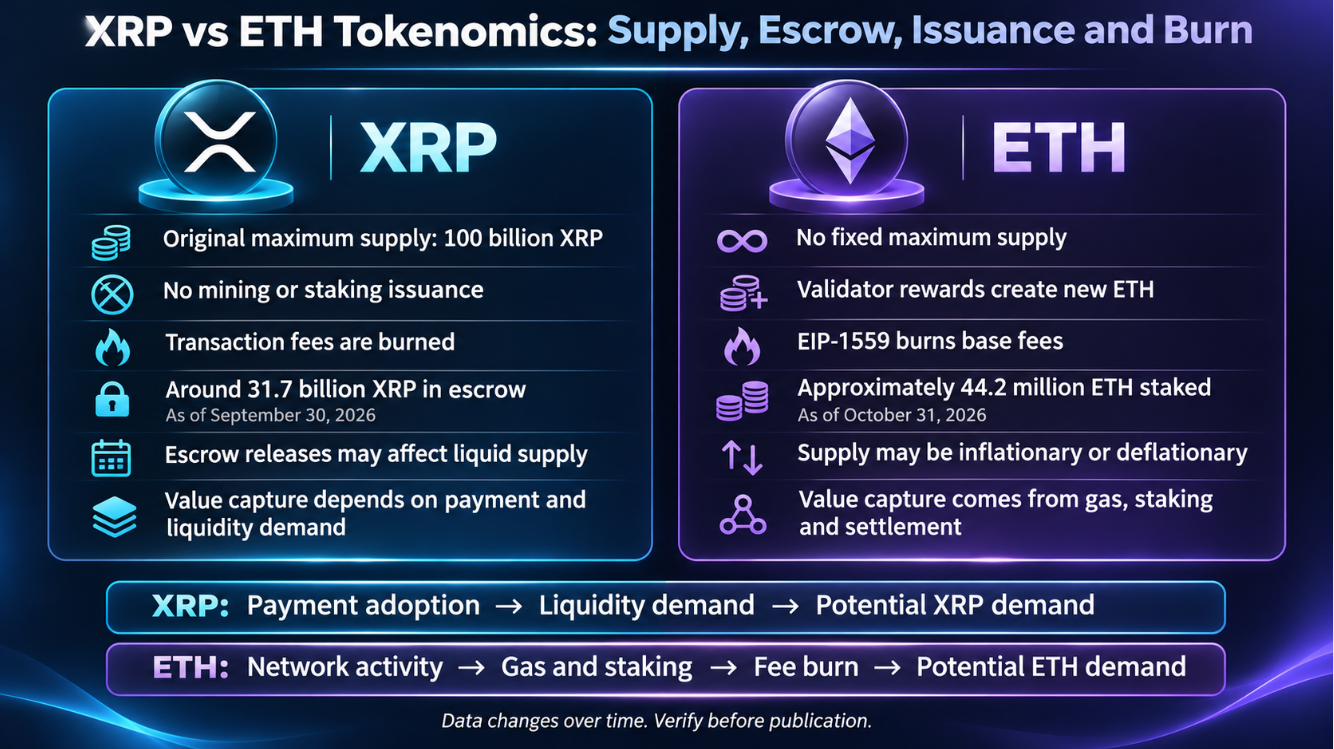
XRP began with a fixed supply of 100 billion. No mining or staking process can create more. Transaction costs destroy a small amount of XRP, so total ledger supply gradually declines.
Fixed maximum supply does not mean fixed liquid supply. Ripple still controls a significant amount of XRP, divided between immediately available holdings and on-ledger escrow. Ripple's XRP information page reported the following as of September 30, 2026:
- Approximately 63.176 billion XRP had been distributed.
- Approximately 31.7 billion XRP remained in escrow.
- Ripple's total available and escrowed holdings were approximately 36.809 billion XRP.
Those categories should not be added together as if they were separate pools; the total Ripple figure includes relevant categories disclosed on the page. Escrow releases improve predictability but do not eliminate supply risk. Investors should track how much released XRP is sold, used, transferred or returned to escrow.
ETH issuance and burning
ETH has no fixed maximum supply. Under proof of stake, the protocol issues ETH to validators. Under EIP-1559, the base portion of transaction fees is burned. Net supply change is therefore:
Net ETH supply change= validator issuance - fee burn
The official Ethereum supply guide correctly emphasizes that both values are dynamic. High-fee periods can make ETH net deflationary; low-fee periods can make it inflationary. ETH should not be marketed as permanently deflationary.
Staking creates demand for ETH and can reduce the immediately liquid float. Yet higher staking participation also increases aggregate validator issuance, and withdrawals can return supply to the market.
Which token captures network value more directly?
ETH presently has the clearer mechanical relationship:
On-chain activity → gas demand → base-fee burn and blockspace revenue → ETH staking and settlement demand.
This pathway is imperfect because Layer 2 networks lower base-layer fees and can retain user revenue. Still, ETH is required to secure and use the protocol.
XRP's pathway is more conditional:
Payments and tokenization → liquidity and transfer demand → potential XRP bridge use → possible inventory and market demand.
XRPL activity always consumes a very small amount of XRP in fees, but fee burning is unlikely to be the main valuation engine. The stronger thesis requires users or institutions to hold or source meaningful XRP liquidity.
For that reason, ETH wins the current value-capture comparison, while XRP may offer more sensitivity to a specific adoption breakthrough.
5. What the Previous Five Years Actually Show
Historical comparison is useful only when dates and data sources match.
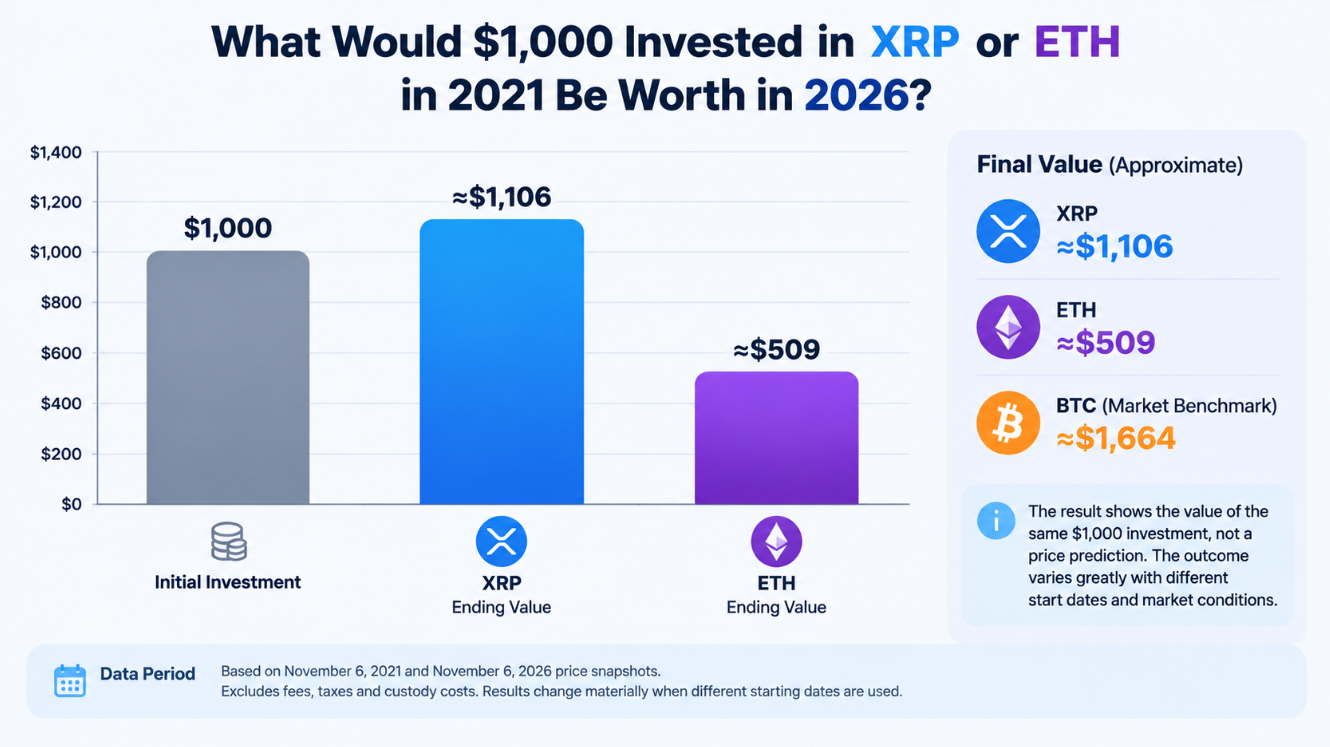
CoinMarketCap's November 6, 2021 historical snapshot listed XRP at approximately $1.1525 and ETH at approximately $4,521.58. HIBT's public market snapshot on November 6, 2026 showed XRP near $1.2748 and ETH near $2,301.87. Using those specific snapshots and excluding trading fees, taxes and custody costs:
- $1,000 invested in XRP would be worth approximately $1,106, a gain of about 10.6%.
- $1,000 invested in ETH would be worth approximately $509, a loss of about 49.1%.
These figures are an illustration, not a verdict on the assets. November 2021 was close to a major crypto-market peak, especially for ETH. A different start date would produce a radically different result. Intraday market prices also move continuously, so a published calculation should preserve its timestamp.
Both assets experienced severe volatility. A five-year holder needed to withstand deep drawdowns, extended recovery periods and changing narratives. Any claim about annualized volatility, Sharpe ratio or maximum drawdown should be calculated from one consistent daily-price dataset rather than copied from platforms using different methodologies.
Past returns also do not determine the next five years. ETH's 2026 ecosystem, staking structure and Layer 2 environment differ materially from 2021. XRP's regulatory position, institutional products and XRPL financial ecosystem have also changed.
6. Growth Catalysts and Risks From 2026 to 2031
XRP catalysts
XRP could outperform if several conditions occur together:
- Ripple Payments expands and a meaningful share of flows uses XRP as bridge liquidity.
- XRPL gains stablecoin, tokenized-asset, AMM and DeFi activity.
- RLUSD deepens liquidity without displacing XRP's role.
- Regulated investment products widen institutional access.
- Ripple's sales and escrow releases remain manageable relative to market demand.
The critical measurement is not the number of partnership announcements. It is the amount of recurring economic activity that creates XRP demand.
XRP risks
Banks and payment companies may prefer stablecoins, tokenized deposits or closed networks. Ripple's enterprise business may expand without requiring large XRP balances. XRPL may struggle to attract developers relative to Ethereum and faster application-focused chains. Ripple's concentrated holdings and escrow releases remain a persistent market concern.
Ethereum catalysts
ETH could outperform if:
- Ethereum remains the preferred settlement environment for stablecoins and tokenized assets.
- Layer 2 adoption grows while returning sufficient fees and strategic value to the base layer.
- DeFi develops into more durable financial infrastructure.
- Institutional staking and regulated investment access continue expanding.
- Protocol upgrades increase capacity without weakening decentralization or value capture.
Ethereum risks
Competitors can win applications, liquidity and developers. Layer 2 networks may fragment users and capture most of the economics. Lower fees can reduce ETH burn, allowing supply to grow. Staking can become concentrated in a small number of liquid-staking protocols or custodians. Smart-contract failures, bridges and application exploits can create ecosystem-wide losses even when Ethereum's base protocol continues operating.
Regulatory outlook
XRP's U.S. legal history requires precise wording. On August 7, 2025, the U.S. Securities and Exchange Commission announced that it and Ripple had dismissed their appeals, resolving the civil enforcement action. The district court's final judgment—including a $125,035,150 civil penalty and injunction—remained in effect. This outcome should not be summarized as “XRP is legally a non-security everywhere and in every transaction.” The SEC litigation release is the appropriate primary source.
ETH also faces regulatory uncertainty involving staking services, intermediaries, DeFi applications and token classification in different jurisdictions. Regulated access can increase demand, while new rules can restrict products or raise compliance costs.
7. XRP vs Ethereum Price Scenarios for 2030–2031
Long-range crypto targets should be treated as conditional valuation scenarios, not promises.
XRP scenarios
Using approximately 63.2 billion distributed XRP as a rough circulating reference and 100 billion as the fully diluted maximum:
- **Bear case: **0.60–1.20. Payment adoption disappoints, market liquidity weakens and XRP-specific demand remains limited. The implied circulating value would be roughly 38–76 billion.
- **Base case: **2–5. XRPL activity and institutional access grow, but XRP remains one of several payment and liquidity options. The implied circulating value would be roughly 126–316 billion; fully diluted value would be 200–500 billion.
- **Bull case: **6–10. XRP becomes materially more important to global bridge liquidity and XRPL financial activity. The implied circulating value would be roughly 379–632 billion; fully diluted value would reach 600 billion–1 trillion.
A $10 XRP price is mathematically possible, but it requires a very large valuation and strong, durable demand. Readers can review the XRP price prediction page as one sentiment reference, not as a guaranteed forecast.
ETH scenarios
Using approximately 122 million ETH as a rounded supply reference for valuation illustration:
- **Bear case: **1,200–2,200. Ethereum loses market share, fee burn stays weak and risk appetite contracts. Implied network value would be roughly 146–268 billion.
- **Base case: **4,000–8,000. Ethereum remains a leading settlement layer, while stablecoins, tokenization and Layer 2 activity grow steadily. Implied network value would be about 488–976 billion.
- **Bull case: **10,000–16,000. Ethereum becomes core global infrastructure for tokenized finance and captures enough value through settlement, staking and burn. Implied network value would be around 1.22–1.95 trillion.
The Ethereum price prediction page can supplement scenario research, but its output should never replace an independent assessment of adoption, supply and valuation.
Can either asset deliver 5x or 10x?
From the November 6, 2026 HIBT price snapshot, a fivefold move would place XRP around $6.37 and ETH around $11,509. A tenfold move would place XRP around $12.75 and ETH around $23,019.
Those targets imply enormous valuations. A 10x move does not require ten times as much cash to enter the market, but it does require marginal buyers to sustain that price across the available supply. As market capitalization rises, achieving another multiple generally becomes harder.
The wider market also matters. The Bitcoin price prediction can help investors monitor crypto risk appetite, but BTC does not determine the fundamental success of XRPL or Ethereum.
8. How to Buy XRP and Ethereum on HIBT
HIBT publicly displays XRP/USDT and ETH/USDT spot markets. Before depositing, confirm that the service and desired trading pair are available in your jurisdiction. Exchange products, fees and limits can change.
Step 1: Create and secure an account
Visit the official HIBT website, register using the supported method and complete any identity verification required for your region or intended service. Use a unique password, enable two-factor authentication and verify the website domain before entering credentials.
Step 2: Deposit or obtain USDT
Open the deposit section, select USDT and choose a network supported by both the sending wallet and HIBT. The network must match on both sides. Sending an ERC-20 deposit to a TRC-20 address, or the reverse, may prevent automatic crediting and can result in loss.
Start with a small test transfer when using a new address or network. Wait for it to arrive before sending the remainder.
Step 3: Buy XRP with USDT
Open Spot, search for XRP/USDT and inspect the order book. The XRP live price page is useful for market monitoring, while the spot interface is where orders are submitted.
Choose an order type:
- A market order prioritizes immediate execution against available liquidity. The final average price can differ from the displayed last price.
- A limit order sets the maximum price you are willing to pay. It may remain unfilled if the market never reaches that price.
Enter the XRP quantity or USDT amount, review the estimated result and fee, and confirm. After execution, check the order history and asset balance.
Step 4: Buy ETH with USDT
Repeat the process for ETH/USDT. Review the Ethereum live price, open the corresponding spot pair, select market or limit execution and verify the filled quantity and fee.
HIBT's published spot-fee guide listed a standard 0.2% maker and taker fee when checked for this article, with a minimum order value around 5 USDT. Treat the live trading page and your account tier as authoritative because fee schedules can change.
Step 5: Decide where to hold the assets
Leaving assets on an exchange is convenient for trading but creates custodial and platform risk. Self-custody gives the holder direct control but also makes them responsible for private-key security.
For XRP withdrawals, correctly enter a destination tag or memo whenever the receiving platform requires one. For ETH, select a network that the receiving wallet supports; “ETH” can exist on several networks, and the cheapest option is not automatically the correct option. Always verify the full address and consider a small test withdrawal.
9. Five-Year Portfolio Strategies
Which asset should be the core holding?
For a neutral investor choosing only between these two, I would make ETH the larger core allocation because it has broader usage, a more mature developer ecosystem and clearer token utility. XRP can serve as a satellite allocation for investors who specifically believe in blockchain-based payments and bridge liquidity.
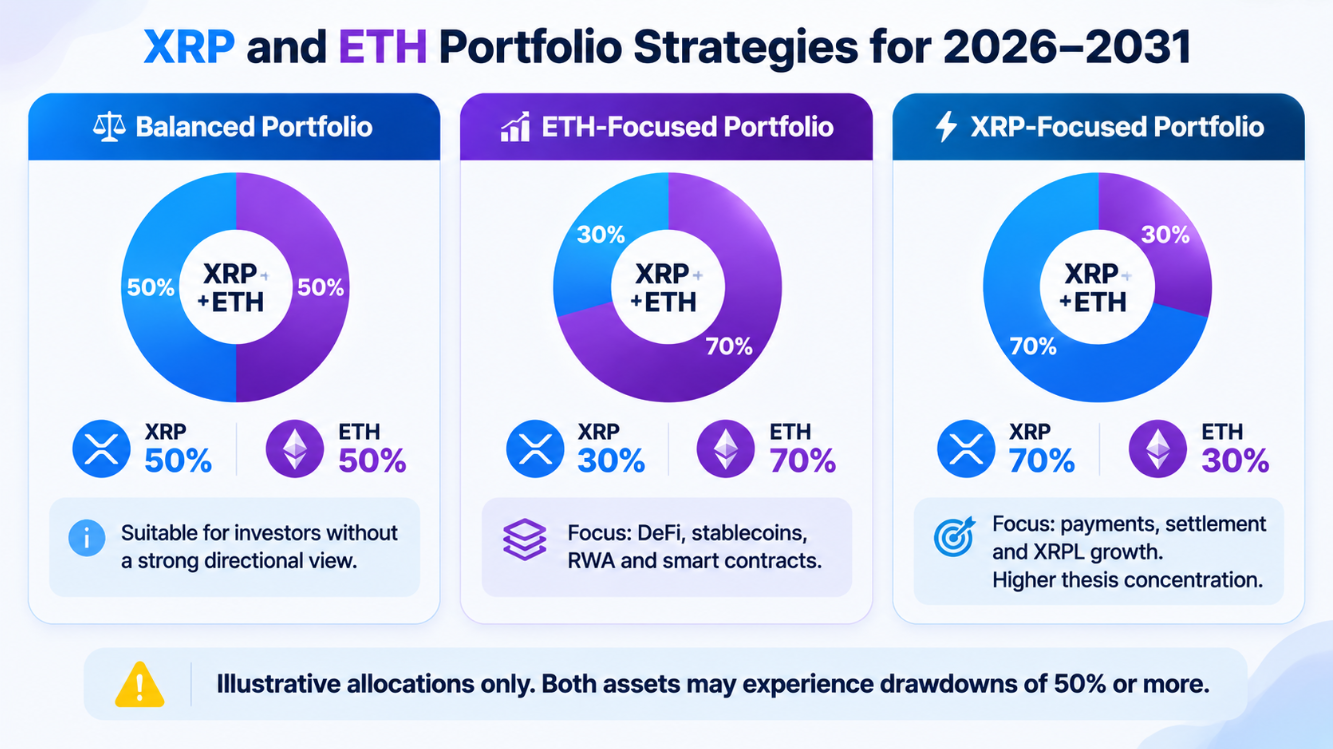
Three illustrative allocations show how conviction changes the portfolio:
- Balanced: 50% XRP and 50% ETH. Suitable when the investor has no strong view about which thesis will win.
- ETH-focused: 30% XRP and 70% ETH. Suitable for investors prioritizing smart contracts, stablecoins, DeFi and tokenization.
- XRP-focused: 70% XRP and 30% ETH. Suitable only for investors with strong conviction in XRP-based payment adoption and tolerance for thesis concentration.
These examples are not personalized recommendations. A lower-risk investor may decide that neither asset should dominate a broader portfolio.
Dollar-cost averaging
Dollar-cost averaging divides purchases over time. Investing $200 each month for 60 months produces total contributions of:
200 x 60 = $12,000
An investor could split each contribution equally or use a fixed target allocation. DCA reduces timing dependence but does not guarantee profit. If the asset suffers permanent impairment, regular purchases can compound losses.
Lump sum versus DCA
A lump-sum purchase tends to perform better when prices rise soon after investment because more capital is exposed earlier. DCA tends to be easier psychologically when markets fall because later contributions buy more units.
A practical compromise is to invest part of the intended allocation immediately, phase the remainder over six to twelve months and keep an emergency reserve outside crypto.
Rebalancing
Suppose a portfolio begins at 50% XRP and 50% ETH. If XRP appreciation raises its weight to 65%, the investor can either sell some XRP, direct new contributions to ETH or accept the new concentration.
Reviewing the portfolio every six months is usually more disciplined than reacting daily. Rebalance when allocation or investment thesis changes materially, while considering fees and taxes.
When to sell
Long-term investing does not mean permanent ownership. Reassess when:
- XRP payment adoption fails to create XRP demand.
- XRPL loses developers, liquidity or institutional traction.
- Ethereum loses settlement relevance or ETH value capture weakens structurally.
- Supply, regulation or governance changes invalidate the original thesis.
- A position becomes too large relative to the investor's risk budget.
Price alone should not be the only exit signal. A rising price can coexist with deteriorating fundamentals.
10. Risks of Holding XRP or ETH for Five Years
Market risk
Both assets can decline by more than 50%. A five-year horizon does not guarantee recovery. Crypto liquidity can contract quickly when leverage unwinds or macroeconomic conditions deteriorate.
Regulatory risk
Rules governing exchanges, staking, stablecoins and token classification differ by jurisdiction and can change. Regulatory clarity may improve access, but compliance actions can also restrict products.
XRP-specific risks
The main risks are Ripple's concentrated holdings, escrow-related supply, uncertain conversion of payment partnerships into XRP demand, competition from stablecoins and other settlement networks, and a smaller application ecosystem than Ethereum.
Ethereum-specific risks
The main risks are competition from other smart-contract chains, Layer 2 fragmentation, reduced fee burn, staking concentration, smart-contract exploits and the possibility that applications capture more value than ETH.
Exchange and custody risk
Centralized exchanges can suffer insolvency, cyberattacks, operational failures or withdrawal restrictions. Self-custody can fail through lost seed phrases, malicious approvals, phishing or sending assets to an incompatible network.
Never invest essential living funds, borrow to buy a volatile asset or use high leverage for a five-year strategy. Review account security quarterly and test recovery procedures before they are needed.
11. Final Verdict: XRP or Ethereum for the Next Five Years?
My conclusion is not a tie: ETH is the stronger default five-year investment for most investors comparing only these two assets. Its utility spans gas, staking, collateral and settlement across a larger smart-contract economy. This gives investors more observable ways to evaluate adoption and value capture.
XRP remains a legitimate but more concentrated thesis. It could outperform ETH if institutions adopt XRP as meaningful bridge liquidity and XRPL expands in payments, stablecoins and tokenized finance. If Ripple's business grows without requiring XRP, however, the token may capture much less value than the headline growth suggests.
The decision framework is straightforward:
- Choose a larger XRP weight if your strongest conviction is that a neutral bridge asset will gain meaningful share in global settlement.
- Choose a larger ETH weight if your conviction is that stablecoins, DeFi, tokenized assets and Layer 2 networks will expand around Ethereum.
- Hold both if you want exposure to both theses and can accept crypto volatility.
- Hold neither or only a small amount if a 50% drawdown would force you to sell or impair your financial security.
Over 2026–2031, the winner will not be determined by which coin looks cheaper per unit. It will be determined by adoption, token demand, supply discipline, competitive position and the valuation paid at entry.
12. Frequently Asked Questions
Is XRP better than Ethereum?
Not in every category. XRP is optimized around fast value transfer and payment-related financial infrastructure. Ethereum supports a much broader smart-contract economy. ETH is the stronger general-purpose investment thesis; XRP is the more focused payment and settlement thesis.
Should I buy XRP or ETH for five years?
ETH is the stronger default core holding based on ecosystem breadth and current value capture. XRP may suit investors with higher conviction in bridge-asset and institutional-payment adoption. Holding both can reduce dependence on one narrative but does not remove market risk.
Which has more growth potential, XRP or ETH?
XRP may offer higher sensitivity to a major payment-adoption breakthrough, while ETH has more diversified growth drivers. Potential return must be assessed relative to current market capitalization, supply and the probability that each adoption thesis succeeds.
Can XRP outperform Ethereum by 2030?
Yes, but only under favorable conditions. XRP would likely need stronger real use as bridge liquidity, sustained institutional access and growth in XRPL financial activity. Ripple partnership announcements alone are not sufficient evidence.
Can Ethereum reach $10,000 by 2030?
It is mathematically possible. With roughly 122 million ETH, a $10,000 price implies a market value near $1.22 trillion. That scenario would require continued leadership in stablecoins, tokenization, DeFi and settlement, plus adequate ETH value capture.
Can XRP reach $10 by 2030?
It is possible but demanding. At roughly 63.2 billion distributed XRP, $10 implies about $632 billion in circulating market value and a $1 trillion fully diluted value. Strong adoption and deep liquidity would be necessary.
Is XRP riskier than Ethereum?
They have different risks. XRP depends more on payment adoption and concentrated supply management. Ethereum faces smart-contract competition, Layer 2 value-capture uncertainty and staking concentration. Both can experience extreme price volatility.
Does XRP have a fixed supply?
Yes. The original maximum was 100 billion XRP, and no more can be created. However, a substantial amount remains in Ripple-related escrow, so circulating supply and potential distribution still matter.
Is Ethereum deflationary?
Not permanently. Validator rewards create ETH while EIP-1559 burns base fees. ETH is deflationary only when burn exceeds issuance; it becomes inflationary when issuance is greater.
Can I stake XRP and ETH?
ETH has native proof-of-stake participation. XRP does not have native staking on XRPL. Third-party XRP yield products introduce counterparty, smart-contract or lending risk and should not be described as native XRP staking.
Where can I buy XRP and ETH?
Both assets are widely available on centralized and decentralized markets, subject to regional restrictions. HIBT publicly lists XRP/USDT and ETH/USDT spot markets. Verify current availability and fees before depositing.
How do I buy XRP and ETH on HIBT?
Create and secure an account, deposit USDT over a matching network, open Spot, search XRP/USDT or ETH/USDT, choose a market or limit order, review the fee and confirm. Check the filled order and balance afterward.
Methodology and sources
This article prioritizes primary sources for protocol, supply and regulatory claims. Core references include XRPL's XRP overview, Ripple's quarterly XRP holdings, Ethereum's supply documentation, Ethereum staking data, Ethereum Institutional's State of the Ledger, the SEC's Ripple litigation release, HIBT's spot-trading guide and HIBT's fee guide.
Historical illustrations use the CoinMarketCap November 6, 2021 snapshot and HIBT public prices observed on November 6, 2026. Scenario ranges are the author's conditional valuation framework, not forecasts or guaranteed outcomes.