
FLOAT is the flagship token of Float, a Solana launchpad that lets creators launch coins paired with tokenized stocks and other crypto assets. Platform fees are divided among holder rewards, creator incentives, trader airdrops, treasury funding and FLOAT buybacks and burns. FLOAT can be traded through Hibt, Raydium and Meteora, but it remains a very new, highly volatile token with unaudited smart-contract and liquidity risks.
The idea combines meme-coin distribution with tokenized assets. That gives Float a clearer product thesis than a token driven only by attention, but it does not make FLOAT a stock or platform share.
My assessment is straightforward: Float has a differentiated working model, but FLOAT remains a high-risk early-stage platform token. Its long-term case depends on sustainable activity, real fees, verifiable buybacks, transparent ownership and stronger security.
Key Takeaways
- Float is a Solana launchpad for creating and trading coins paired with tokenized stocks, crypto assets and other supported tokens.
- FLOAT is Float’s flagship token. It is different from the independent coins created through the launchpad.
- Float’s published fee model sends 35% of eligible Float Program fees to FLOAT buybacks and burns. That is not 35% of total trading volume.
- Holder rewards belong to holders of each launched coin and may be paid in that coin’s paired asset. They are not automatically a dividend for all FLOAT holders.
- FLOAT’s verified Solana mint address is
Bv1a7cEj5aRnJQhMw4kRQqAFesMSd5LwcDnUzq52BMmr. - FLOAT is available through the FLOAT/USDT spot market on Hibt and on Solana DEXs including Raydium and Meteora.
- The project reported more than 35 million FLOAT burned by November 2, 2026, but transactions and remaining supply require onchain verification.
- Distribution disclosure and external-audit evidence remain incomplete, while important authorities reportedly await multisignature migration.
- FLOAT remains speculative until usage, revenue, security and distribution are proven over a longer period.
1. What Is FLOAT Crypto?
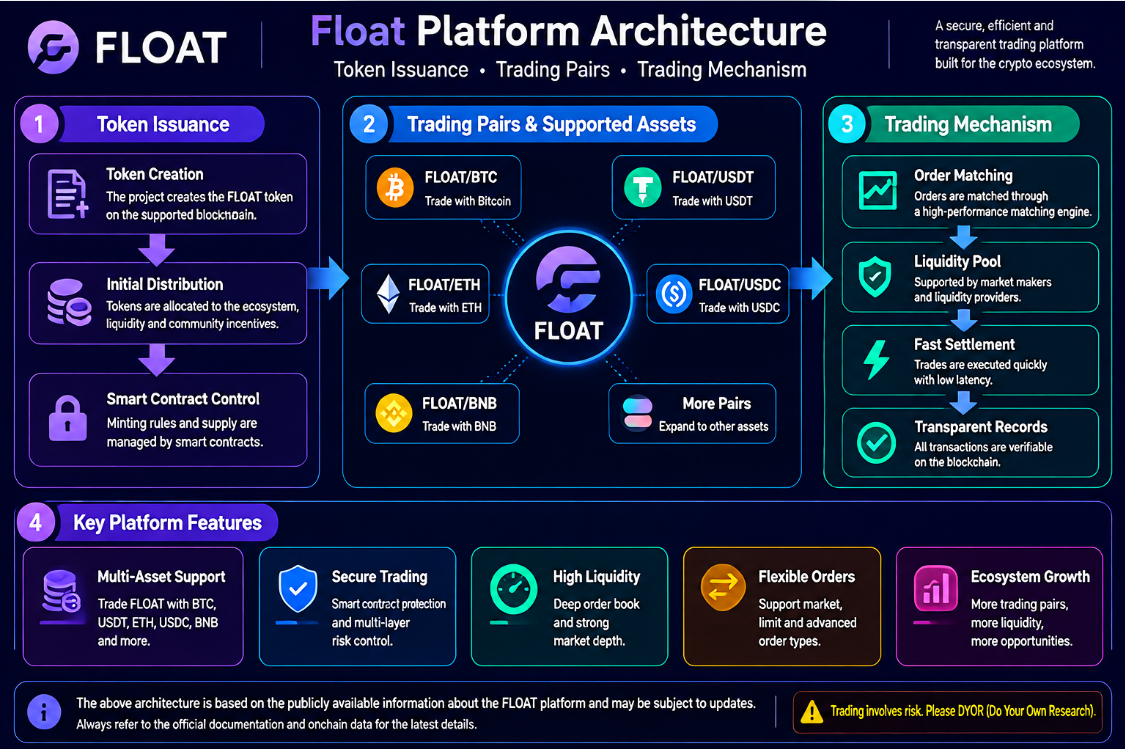
Float is a Solana-based token launch and trading platform. Its differentiating feature is the quote asset used behind newly created coins. Instead of limiting every launch to a standard SOL or USDC pair, Float allows creators to select supported tokenized stocks and other assets.
A creator could, for example, launch a community coin associated with a stock-linked NVIDIA token. Traders may enter with SOL through the Float interface, while the platform handles the conversion and launch mechanics. Holders of the newly created coin may then receive part of eligible trading fees in the paired asset.
The result combines meme-coin issuance, tokenized-asset pairing and platform-token economics. Float is not a traditional securities exchange, and its launched coins are not shares in the companies referenced by their paired assets.
What is the FLOAT token?
FLOAT is the flagship token of the Float ecosystem. It launched separately through Raydium LaunchLab and has its own market, holders and supply.
Its principal documented value-capture mechanism is buyback and burn. Under Float’s published fee model, part of the fees received by the Float Program is converted into market purchases of FLOAT. The purchased tokens are then burned, reducing supply when the transactions execute successfully.
FLOAT, Float-launched coins and third-party paired assets are three different instruments. Holding FLOAT does not automatically entitle a user to holder rewards generated by other coins. Those rewards belong to holders of the relevant launched coin; FLOAT benefits through its separate buyback lane. The token is also not platform equity unless formal legal terms explicitly grant such rights.
What makes Float different from a traditional meme launchpad?
A typical launchpad allows a creator to issue a token on a bonding curve, attract early buyers and graduate into an automated-market-maker pool after reaching a threshold. Float adds asset pairing and a more complex fee-distribution system.
Its three most distinctive elements are:
Tokenized-asset pairing. A launch can be paired with a supported stock-linked token or another crypto asset rather than relying only on SOL.
Paired-asset holder rewards. Eligible holders of a launched coin can receive a portion of fees in the paired token, subject to the platform’s rules.
FLOAT buyback and burn. Part of eligible platform fees creates market demand for the flagship token and removes purchased FLOAT from supply.
These features create a stronger economic story but add dependencies on Raydium, Solana, third-party issuers, routing, smart contracts and liquidity.
2. How Does the Float Launchpad Work?
Float uses Raydium LaunchLab for initial issuance and a bonding-curve process for early price discovery. The project’s published parameters describe a standard launch sequence, although creators and platform settings may change over time.
Step 1: a creator launches a coin
The creator chooses a token name, ticker, media and supported pair asset. Float states that each new coin begins with a supply of 1 billion units and an initial market capitalization of approximately $20,000.
Creators can reportedly choose a 1%, 2% or 2.5% trading fee. Check the fee on each coin because it directly affects entry and exit costs.
Step 2: the coin trades on a bonding curve
A bonding curve automatically changes the token price as users buy and sell. Early purchases push the quoted price upward; sales move it downward. This creates immediate liquidity without requiring a conventional order book.
Bonding curves simplify launches, but market capitalization can be misleading: it does not show how much capital can exit near the displayed price.
Step 3: the coin reaches its graduation threshold
Float’s published launch model describes graduation at approximately $150,000 market capitalization, or roughly 7.5 times the stated starting valuation. Reaching that number means the launch has completed a platform-defined stage; it does not prove that the coin has sustainable demand or good fundamentals.
Step 4: liquidity migrates to Raydium
After graduation, liquidity moves into a Raydium pool. Float describes the liquidity as handled through Raydium’s Burn & Earn mechanism, designed to lock the liquidity position while allowing fee rights to remain usable.
Verify the actual pool, liquidity position and lock status for every coin.
3. How Do Tokenized Stocks Work on Float?
The words “tokenized stock” can create a dangerous misunderstanding. A token that references NVIDIA, Tesla or an ETF is not automatically the same as a share held in a regulated brokerage account.
Rights depend on the issuer and legal structure. A token may provide economic exposure or synthetic pricing but no voting rights, direct dividends or ordinary-share redemption. Float has described stock-linked, pre-IPO-related, bridged privacy, native and stable crypto pair assets. Their custody and regulatory risks differ substantially.
Do traders need to hold the paired stock token first?
Float’s interface is designed to let users enter through an asset such as SOL and handle the routing into the relevant pair. That may make the experience simpler, but it does not remove the underlying conversion, price-impact or issuer risk.
Before trading, identify the issuer, backing or synthetic structure, redemption rules, supported regions, liquidity and the consequences of an issuer pause.
Does a Float coin track the paired stock price?
Not necessarily. A new meme coin paired with a stock token remains an independent asset. Its price is driven by its own bonding curve, buyers, sellers, liquidity and attention. The paired stock asset may influence the value of rewards or the composition of a liquidity pool, but the new coin does not become a one-for-one tracker of the stock.
The connection is a pairing and narrative, not a guarantee of identical performance.
4. How Does Float Distribute Trading Fees?
Float’s fee model is central to the FLOAT investment thesis. It is also easy to describe incorrectly.
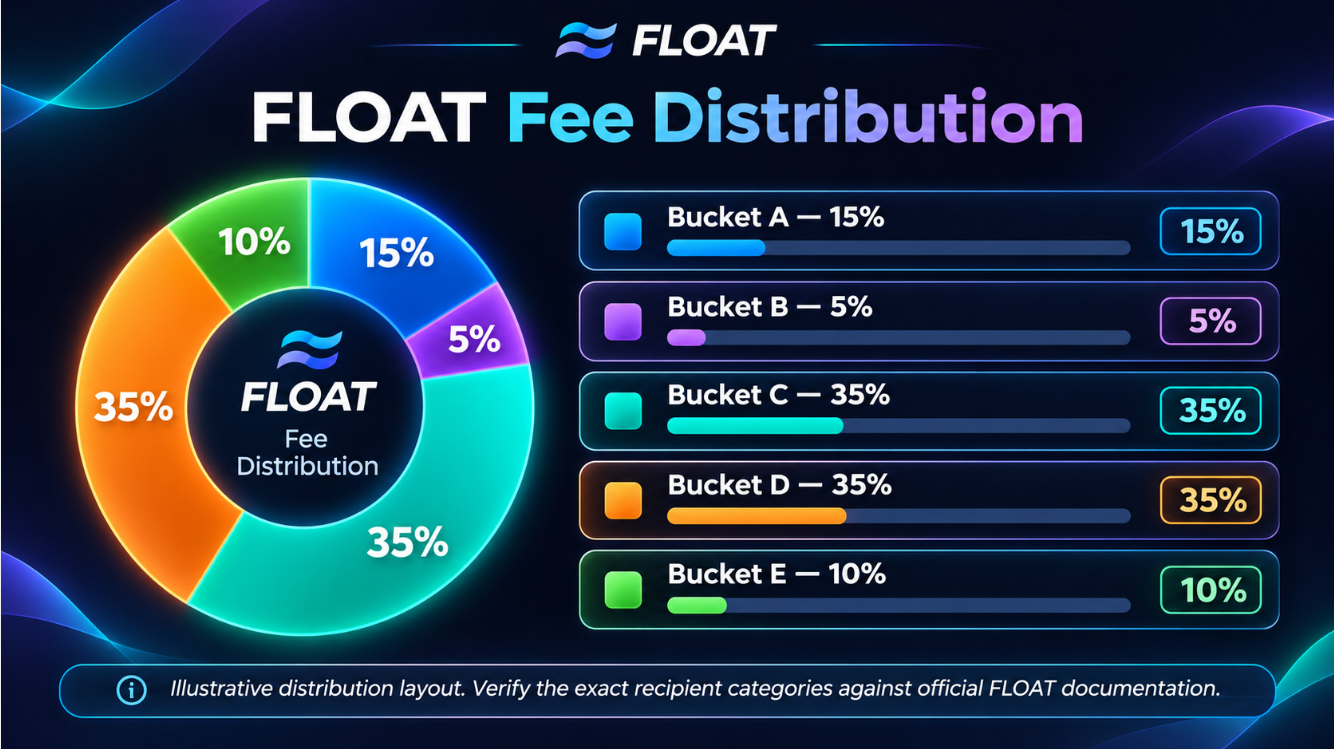
Creators reportedly choose a buy-and-sell fee of 1%, 2% or 2.5%. During the bonding-curve phase, Raydium takes its applicable portion. The remaining fees collected by the Float Program are allocated according to the platform’s published split:
- 15% for holders, paid in the relevant paired asset;
- 5% for creators, directed to the creator’s designated wallet;
- 35% for FLOAT buyback and burn;
- 35% for trader airdrops, generally accumulated in USDC;
- 10% for the platform treasury.
These percentages apply to eligible fees received by the Float Program after applicable Raydium deductions. They are not percentages of total trading volume, and they should not be applied directly to gross user turnover.
If the Float Program receives $100,000 in distributable fees, the theoretical buyback amount is:
FLOAT Buyback Value=100,000\times35%=35,000
This is a mechanism example, not current revenue.
How do holder rewards work?
The holder-reward portion is intended for holders of each eligible launched coin, usually in the associated paired asset. A coin paired with a stock-linked token may therefore distribute that token rather than USDC.
This is not a company dividend. The reward comes from crypto trading fees, not the underlying company’s earnings.
Verify snapshot timing, minimum holdings, excluded wallets and distribution intervals. Rewards can be worth less than the fees and volatility incurred to qualify.
What is the trader airdrop?
Float allocates another 35% of eligible program fees to trader rewards. The initial published structure used a volume-based leaderboard, with USDC intended for qualifying wallets.
Volume farming is not free money: fees, spread and price impact can exceed the eventual reward, while bot filters can disqualify activity.
How does FLOAT buyback and burn work?
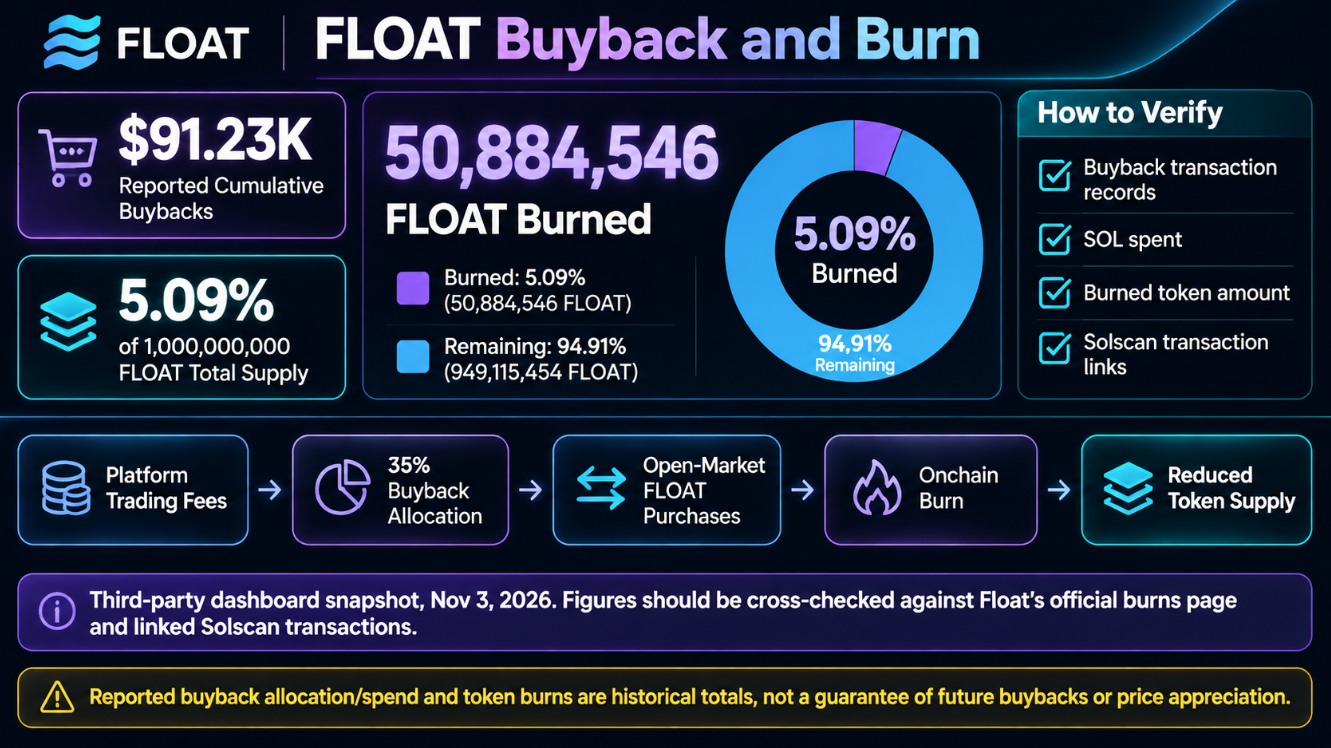
The buyback allocation accumulates value from eligible fees. The platform then executes market purchases of FLOAT and sends the acquired tokens to a burn mechanism, permanently reducing accessible supply if the transaction is correctly executed.
On November 2, 2026, the project reported that more than 35 million FLOAT—about 3.5% of the original 1 billion supply—had been burned. It also changed the execution pattern to larger 5 SOL buybacks, or the accumulated amount after four hours if the threshold was not reached.
This is a project-reported milestone. Verify each Solscan transaction, source vault, burn instruction, SOL spent and whether cumulative burns reconcile with current supply.
Buybacks can create incremental demand and burns can reduce supply, but neither guarantees appreciation. If holders sell faster than the platform buys, price can fall despite continued burns.
5. FLOAT Tokenomics and Supply Risk
FLOAT’s official Solana mint address is:
Bv1a7cEj5aRnJQhMw4kRQqAFesMSd5LwcDnUzq52BMmr
The original maximum supply is reported as 1,000,000,000 FLOAT with six decimals. Onchain trackers indicate that mint and freeze authorities are disabled, reducing the risk of simple additional minting or account freezing through those authorities.
By November 3, 2026, CoinGecko displayed approximately 950 million FLOAT as circulating and a market capitalization near its FDV. Other onchain services showed slightly different totals because burns, indexing times and supply definitions vary.
Supply data should be timestamped and reconciled with verified burns.
What is not publicly verified?
Float has documented the flagship mint and fee mechanism, but a complete allocation and vesting schedule covering team, investors, treasury, liquidity and community distribution has not been clearly published in the materials reviewed for this article.
Unanswered questions include team and investor ownership, market-making allocations, lockups and operational reserves. Do not infer “fair launch” or “no team allocation” from missing information.
What utility does FLOAT have today?
The clearest documented utility is economic value capture through buyback and burn. FLOAT is not required for every user action in the launchpad, and the reviewed materials do not establish broad governance, staking or direct fee-distribution rights for ordinary FLOAT holders.
Float has also explained that fees generated by trading the FLOAT flagship token itself go to the development wallet rather than through the standard fee split used by other Float-launched coins. This detail matters: not every FLOAT trade automatically contributes 35% of its fee to buying and burning more FLOAT.
The long-term thesis is indirect: more successful launches → more eligible fees → more FLOAT buybacks → lower supply. If sell pressure remains larger than buybacks, the chain does not create durable value.
6. FLOAT Market Performance and Liquidity
FLOAT began trading around October 28, 2026 after launching through Raydium LaunchLab. This makes every historical-performance conclusion extremely fragile: a few days of trading do not establish a mature cycle, reliable support level or stable valuation range.
Market snapshot on November 3, 2026
At the research snapshot, CoinGecko reported approximately:
- price: $0.00377;
- market capitalization: $3.58 million;
- 24-hour trading volume: $5.31 million;
- circulating supply: about 950 million FLOAT;
- all-time range: roughly $0.000405 to $0.004386.
The token was up about 100% over 24 hours. Refresh all figures at publication: a triple-digit move proves volatility, not sustainable adoption.
Where is FLOAT trading?
The most clearly verified markets are:
- Hibt: FLOAT/USDT spot market;
- Raydium: FLOAT/WSOL liquidity;
- Meteora: FLOAT/WSOL and FLOAT/USDC pools;
- Hadron: a smaller tracked Solana market, subject to activity and liquidity checks.
Hibt states that FLOAT/USDT trading opened on October 30, 2026 at 08:50 UTC and withdrawals opened the following day.
Why volume is not the same as liquidity
At the same CoinGecko snapshot, Hibt showed more than $1 million in daily volume but only about $125–$137 of quoted 2% depth. Raydium showed much deeper 2% depth, around $7,600 on each side, despite the token’s multimillion-dollar headline volume.
Trading volume measures historical turnover; market depth estimates executable size near the current price. Check spread, 2% depth, pool liquidity, price impact, unique traders and large-wallet activity.
7. Where to Buy $FLOAT
FLOAT can be purchased with USDT through Hibt or exchanged on Solana DEXs such as Raydium and Meteora. The safest starting point is not the platform name; it is verifying the Solana network and complete mint address.
How to buy FLOAT on Hibt
Hibt offers the most direct route for users who already hold USDT.
Step 1: Create and secure the account. Use the official Hibt domain, complete required verification and enable two-factor authentication.
Step 2: Deposit USDT. Select a network supported by both platforms. Network names must match.
Step 3: Open FLOAT/USDT. Search the spot market, not a futures or unrelated token page. Confirm the token name, pair and official listing announcement.
Step 4: inspect the order book. Review spread, depth and recent trades.
Step 5: choose an order type. Limit orders control price but may not fill; market orders prioritize execution but can slip.
Step 6: verify the fill. Check average price, fee, quantity and remaining open orders. Do not calculate cost basis from the chart price alone.
Step 7: verify withdrawal support. Select Solana and test with a small amount before moving the full balance.
How to buy FLOAT on Raydium
Raydium is suitable for users comfortable with Solana wallets and DEX execution.
Step 1: Set up a Solana wallet. Secure the recovery phrase offline and never enter it into a swap site.
Step 2: Prepare SOL. SOL is needed both as the asset to exchange and to pay Solana network fees. Keep a small reserve outside the planned swap amount.
Step 3: Open the official Raydium interface. Avoid links from unsolicited messages, comments or fake support accounts.
Step 4: Import FLOAT by mint address. Paste Bv1a7cEj5aRnJQhMw4kRQqAFesMSd5LwcDnUzq52BMmr. Do not identify the asset by the word FLOAT alone; unrelated tokens can share the ticker.
Step 5: review the quote. Check output, price impact, slippage, liquidity and network fee.
Step 6: approve the transaction in the wallet. Review the assets and amounts before signing. After confirmation, open the transaction through Solscan and confirm that the expected tokens reached the correct wallet.
Can you buy FLOAT on Meteora?
CoinGecko tracks FLOAT/WSOL and FLOAT/USDC liquidity on Meteora. The process is similar to Raydium: connect a Solana wallet, verify the mint, select the correct pool and inspect liquidity and slippage.
Prices differ across pools; always review the final route and output.
Is a CEX or DEX better for buying FLOAT?
Hibt offers a simpler USDT-based workflow and does not require users to manage a Solana wallet for the initial purchase. The trade-off is platform custody, account access, withdrawal and order-book risk.
Raydium and Meteora provide self-custodial execution and direct access to onchain liquidity. The trade-off is wallet security, smart-contract exposure, slippage and the possibility of selecting the wrong token or pool.
Choose the venue with verified identity, adequate depth and a custody model you understand.
8. FLOAT Price Prediction: Bull, Base and Bear Scenarios
FLOAT is too new for a reliable long-term forecast based on historical price patterns. Scenario analysis is more honest than assigning a precise 2030 target.
Bull case
The bull case requires Float to become a persistent Solana launch destination. Repeat creators and active traders must generate real fees, while buybacks remain meaningful relative to market cap and sell pressure.
FLOAT could then gain value as a deflationary token tied to measurable activity.
Base case
In the base case, launches and volume vary while buybacks remain too small to dominate supply, leaving FLOAT volatile and narrative-driven.
The market remains active without earning a premium valuation.
Bear case
In the bear case, issuer restrictions, contract problems or declining meme demand reduce fees and buybacks as holders sell into thinner liquidity.
Under this scenario, supply reduction cannot compensate for weakening demand and price can fall substantially.
Valuation scenarios
Using the original 1 billion maximum supply:
- $0.001 per FLOAT implies a $1 million FDV.
- $0.005 implies a $5 million FDV.
- $0.01 implies a $10 million FDV.
- $0.025 implies a $25 million FDV.
- $0.05 implies a $50 million FDV.
These are mathematical conversions, not predictions. As supply is burned, market capitalization calculations may use the lower current supply while some platforms continue displaying the original maximum.
Broader market conditions also matter. Bitcoin Price Prediction can help frame crypto-wide risk appetite, while Ethereum Price Prediction offers another view of capital flows into smart-contract assets. FLOAT is a Solana token, so SOL performance and Solana onchain activity remain more direct ecosystem indicators.
9. FLOAT Investment Strategies
Is FLOAT a good investment?
FLOAT has a clearer design than a productless meme token: the launchpad operates, fee flows are defined, markets exist and burn data is published.
But the project is days old, distribution is incomplete, depth is limited, no external audit is confirmed and pair assets depend on third parties.
My conclusion is that FLOAT is suitable for high-risk observation or a small speculative allocation, but the evidence is not yet strong enough for a large long-term position. A few days of fees and burns cannot prove a sustainable business model.
Short-term trading strategy
Short-term traders should focus on liquidity and flows rather than the long-term tokenized-stock narrative.
Monitor:
- 15-minute, one-hour and four-hour volume;
- Hibt spread and order-book depth;
- Raydium liquidity and price impact;
- large transfers into exchange or pool wallets;
- project buyback transactions;
- platform launch volume and social attention;
- BTC, SOL and the wider meme-coin market.
Predictable buybacks can become exit liquidity rather than permanent catalysts.
Medium-term strategy
Over one to three months, the best evidence will come from platform retention rather than token price.
Track:
- launches per week;
- repeat creators;
- active and returning traders;
- eligible Float Program fees;
- cumulative SOL spent on FLOAT buybacks;
- FLOAT burned as a percentage of current supply;
- holder concentration;
- DEX liquidity and CEX depth;
- reliability of tokenized-asset issuers.
A useful measure is:
Buyback Ratio = Value Spent Buying FLOAT / Eligible Float Program Fees
The numerator and denominator must cover the same period and fee scope. Comparing buybacks with total trading volume would exaggerate or distort the relationship.
Long-term strategy
Long-term investors should ask whether Float can become durable financial infrastructure rather than a temporary meme-coin product.
Required evidence includes sustained launches, returning users, liquid paired assets, transparent fee reporting, onchain buyback accounting, audits, multisignature control and a clear distribution policy.
If the only recurring activity is speculative turnover created by rewards, then fees may come from users paying each other rather than from a durable product advantage.
Position sizing and risk control
Suppose a portfolio is worth $1,000, the maximum acceptable loss on FLOAT is $20, and the exit is planned 10% below entry. The theoretical position is:
Position Size = 200
For FLOAT, the actual size may need to be lower because slippage can cause an exit below the planned price. A stop order is not a guarantee in a shallow market.
Avoid leverage and borrowed funds, split entries, test liquidity, define invalidation before buying and cap total early-stage-token exposure.
10. FLOAT Compared With Other Crypto Projects
FLOAT vs ANTFUN
FLOAT is a tokenized-asset meme launchpad; ANTFUN is better analyzed as a social wallet or DEX product. FLOAT’s key metric is launchpad activity feeding buybacks, while ANTFUN requires wallet and social-feature adoption.
Both attempt to connect a product with a token, but they are not direct substitutes. See the separate ANTFUN Token research for its own value-capture framework.
FLOAT vs Forever Crypto
FLOAT focuses on token creation, stock-linked pairs, trading fees and buyback burns. Forever focuses on AI agents proposing investment mandates, token holders authorizing them and agents executing capital allocations.
Both try to convert protocol activity into token value, but the Forever Crypto thesis depends on governance, treasury safety and agent performance rather than launch volume.
FLOAT vs NovaAI
FLOAT belongs mainly to the launchpad and tokenized-asset narrative. NovaAI belongs to the broader AI crypto narrative and must prove its product, users and token utility.
Comparing them only by price or market capitalization would ignore the businesses underneath. The NovaAI Token research provides a separate framework for evaluating AI-themed token value.
11. Major Risks of Investing in FLOAT
Tokenized-asset issuer risk
Float does not control every paired token issuer. An issuer may change redemption terms, restrict regions, pause transfers or discontinue a product. A stock-linked token may also lack the shareholder rights users assume it has.
Smart-contract and control risk
Published descriptions state that the Float Program has not undergone an external audit and that important authorities remain team-controlled pending multisignature migration. Investors should look for a named audit, verified program IDs and proof of the migration.
Liquidity risk
FLOAT can display millions of dollars in daily turnover while maintaining comparatively small executable depth. During a rapid sell-off, liquidity providers can withdraw or move their ranges, and slippage can expand.
Market-manipulation risk
New tokens are vulnerable to coordinated wallets, bots, wash trading and concentrated early holders. Bonding curves can create dramatic percentage moves from relatively small capital flows. Buyback timing may also become predictable enough for traders to front-run.
Tokenomics risk
The incomplete public allocation picture makes it difficult to model future selling. Burns reduce supply, but undisclosed or concentrated holdings can create much larger sell pressure. Fee growth may also decline after incentives or early attention fade.
Regulatory risk
Tokenized equities and pre-IPO-related products may be regulated differently across countries. A token being transferable on Solana does not mean it is legally available to every user. Regional restrictions can reduce asset availability, liquidity and the number of launches Float can support.
Platform competition risk
Solana already has strong launchpads. Float must retain users after competitors copy its fee model or add stock-linked assets.
12. Pre-Purchase Checklist
Before buying, confirm the Solana network and full mint address; inspect mint and freeze authorities, supply, burns, holder concentration and market depth; verify which fees fund buybacks; check audit and multisignature status; understand paired-asset legal risks; and define the maximum acceptable loss. If important information is unclear, reduce the position or do not trade.
13. Frequently Asked Questions About FLOAT
What is FLOAT crypto?
FLOAT is the flagship token of Float, a Solana launchpad that lets users create coins paired with tokenized stocks and other assets. Its main documented value mechanism is fee-funded buyback and burn.
Is FLOAT built on Solana?
Yes. FLOAT is a Solana token, and Float uses Solana infrastructure including Raydium LaunchLab and Raydium liquidity pools.
What is the FLOAT contract address?
The FLOAT mint address is Bv1a7cEj5aRnJQhMw4kRQqAFesMSd5LwcDnUzq52BMmr. Verify the complete address before trading.
Where can I buy FLOAT?
FLOAT is available through the FLOAT/USDT spot market on Hibt and through Solana DEX liquidity on Raydium and Meteora.
How do I buy FLOAT with USDT?
Hibt provides a FLOAT/USDT spot pair. Deposit USDT through a supported network, open the spot market, inspect depth and place a market or limit order.
What is the total supply of FLOAT?
The original maximum supply is 1 billion FLOAT. The current supply is lower after token burns, so investors should verify the latest figure on Solscan.
How does FLOAT buyback and burn work?
Float allocates 35% of eligible Float Program fees to market purchases of FLOAT and burns the tokens acquired. This percentage does not apply directly to total platform trading volume.
Does holding FLOAT pay stock-token rewards?
Not automatically. The stock-token holder-reward lane is associated with holders of each eligible coin launched on Float. FLOAT benefits through its separate buyback-and-burn mechanism.
Is FLOAT a good investment?
FLOAT has a working product and identifiable value-capture design, but it remains a very new, unaudited and volatile token. It is more appropriate for small speculative exposure than a large long-term allocation at this stage.
Can FLOAT reach $0.01?
At the original 1 billion maximum supply, $0.01 implies a $10 million FDV. Reaching or sustaining that valuation depends on platform fees, burns, demand, token distribution and liquidity. It is not a price prediction.
Final Verdict
Float is a differentiated Solana launchpad combining meme-coin creation, tokenized-asset pairs, rewards and FLOAT buybacks.
That design gives FLOAT a measurable thesis:
More useful launches → more sustainable trading → more eligible fees → more FLOAT buybacks → lower token supply
This is not proof of long-term value. Float is days old, auditing and allocation remain incomplete, third-party issuers add risk and market depth is modest.
My position is clear: FLOAT is worth researching and may offer a high-risk trading opportunity, but it has not earned the status of a proven long-term platform investment. I would raise its rating only if activity persists, fees and burns remain verifiable, liquidity deepens, security improves and the team publishes a clearer distribution structure.
Investors should verify the asset first, measure liquidity second, examine platform economics third and consider price only after those checks. Reversing that order is how a differentiated product becomes an undisciplined trade.
Research date: November 3, 2026. Prices, supply, trading venues, fees and platform rules can change. This article is educational and does not constitute financial advice.
Primary and supporting sources: Float official website, Float official project updates, Hibt FLOAT listing announcement, CoinGecko FLOAT market page, SolanaTerminal FLOAT data, and the Solscan token explorer.