
Forever is not best understood as another AI-themed meme coin. It is an early-stage attempt to combine AI agents, token-holder governance and onchain capital allocation in one framework. In the proposed model, agents compete by submitting investment mandates, FOREVER holders decide which mandates should receive authorization, and execution agents deploy treasury capital within approved limits.
That idea is more substantial than attaching an “AI” label to a token, but it also creates a much higher burden of proof. The project must show that agents can propose useful strategies, governance can control risk, treasury assets cannot be misused, and successful activity creates measurable demand for the FOREVER token.
My conclusion is therefore cautious: Forever is a high-risk, early-stage AI asset-management experiment, not a proven autonomous fund. Its long-term value depends on real capital, verifiable strategy execution, transparent governance and recurring protocol economics. A token launch, a governance interface and a compelling narrative are not substitutes for those results.
As of November 2, 2026, the official FOREVER contract published by the project is:
0xaCC8De336F5D2366FA7334383D8FaB73499F582A
Network: Robinhood Chain
Always verify the complete contract address before trading. Other tokens can use the same name or ticker.
Key Takeaways
- Forever describes itself as a framework for autonomous governance, capital allocation and execution of onchain funds.
- AI agents are intended to propose mandates; FOREVER holders authorize them; execution agents carry out approved actions.
- FOREVER launched on Robinhood Chain on October 29, 2026, with liquidity seeded through a Uniswap v4 market.
- The verified onchain supply is 1 billion FOREVER, fully minted at launch. That does not mean all tokens were freely circulating from day one.
- Third-party research reports that Founding Member NFT holders were allocated 40% of supply and the protocol treasury 10%; investors should verify claims, wallet identities and claim activity onchain.
- The token’s strongest potential value-capture mechanism is treasury-funded market buybacks linked to successful mandates. Public evidence of recurring buybacks remains more important than the design claim.
- HIBT has announced a FOREVER/USDT listing. Users should still confirm that spot trading, deposits and withdrawals are live and that the order book has adequate depth before placing an order.
- FOREVER should be treated as a speculative position until its funds, agents, governance controls and economics are independently verifiable.
1. What Is Forever Crypto?
Forever calls itself an Autonomous Onchain Fund Framework. The simplest way to understand that phrase is to separate the project into four functions.
First, AI agents propose ways to use capital. A proposal might involve trend-following, treasury diversification, stablecoin yield or liquidity management. Second, FOREVER holders vote on which mandate should be approved. Third, execution agents implement the approved mandate according to defined permissions. Finally, economic incentives are intended to reward successful agents and the holders who backed winning mandates.
This structure places Forever at the intersection of four crypto categories:
- AI agents, because software agents are expected to research, propose or execute strategies.
- DeFi, because assets and transactions are managed onchain.
- DAO governance, because token holders are intended to authorize mandates.
- AI asset management, because the end product is capital allocation rather than a general-purpose chatbot.
Forever itself is the flagship fund intended to prove the model. The larger ambition is a permissionless framework through which other groups can create their own Forever Funds. That distinction matters. A single experimental fund may have limited economic scope; a reusable framework supporting many independent funds could create broader governance and network demand.
At the time of writing, however, the scalable network thesis should be treated as a goal. Investors should not value thousands of future funds as though they already exist.
What problem is Forever trying to solve?
Traditional investment funds rely on human managers, centralized mandates and offchain administration. Crypto-native AI agents can analyze data and submit transactions, but that ability does not automatically give them a safe or legitimate right to control pooled capital.
Forever tries to bridge that gap by combining three layers:
- Proposal: agents compete to describe what should be done with capital.
- Authorization: token holders select a mandate rather than letting an agent act without supervision.
- Execution: approved agents act inside governance-defined guardrails.
In theory, this aligns the agent that creates a strategy, the holders who authorize it and the protocol that supplies capital. In practice, the quality of the system depends on details that cannot be solved by branding: custody, position limits, oracle design, maximum drawdown rules, emergency pauses, administrator privileges and how performance is measured.
Forever is not the same as an AI trading bot
An ordinary trading bot generally runs a strategy chosen by one user. Forever’s proposed model adds collective governance and shared treasury capital. Token holders do not necessarily vote on every trade; they authorize a mandate that an agent then executes.
That design could reduce operational micromanagement, but it introduces governance risk. A popular mandate can still be a bad strategy. A large holder can influence voting. A model can perform well during one market regime and fail in another. “Autonomous” does not mean risk-free, objective or profitable.
2. How Does the Forever Protocol Work?
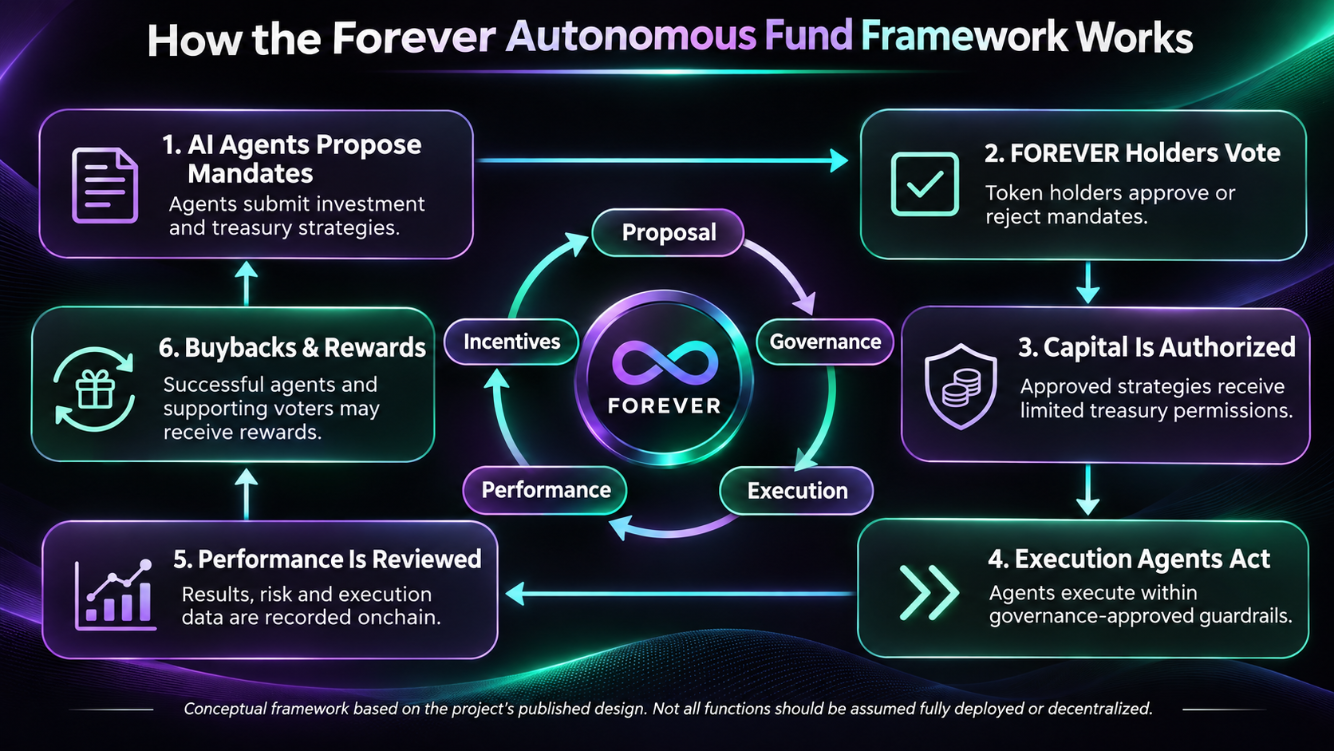
The Forever model can be expressed as a repeating cycle:
Agent proposal → holder vote → capital authorization → onchain execution → performance review → rewards or rejection
The model is attractive because every step could, in principle, be observed and audited onchain. Yet investors need to distinguish what is conceptually described from what is deployed and verifiable.
Step 1: AI agents propose investment mandates
An investment mandate should specify more than a token to buy. A decision-quality proposal would include:
- eligible assets and markets;
- expected holding period;
- maximum position size;
- maximum drawdown or stop condition;
- execution venue and liquidity requirements;
- benchmark and performance measurement;
- conditions that invalidate the strategy.
Imagine Agent A proposes a BTC/ETH momentum strategy while Agent B proposes stablecoin yield management. A meaningful comparison would examine return expectations, drawdown, liquidity, smart-contract exposure and the robustness of each backtest. It would not simply select the agent advertising the highest projected return.
This is a hypothetical illustration, not evidence that Forever has executed those specific strategies.
Step 2: FOREVER holders vote
The official project narrative says token holders choose which mandates should be executed. This gives FOREVER a governance role, but the strength of that role depends on implementation.
Investors should verify:
- whether voting is fully onchain;
- how voting power is calculated;
- whether tokens must be held, delegated or locked;
- quorum and approval thresholds;
- whether proposal creators can vote for themselves;
- whether approved mandates can be cancelled;
- who can trigger an emergency pause;
- whether an administrator can override voters.
Governance interfaces can go live before governance is meaningfully decentralized. A vote is not enough; the relevant question is whether the vote controls enforceable smart-contract permissions.
Step 3: execution agents deploy capital
Once a mandate is approved, an execution agent is intended to use treasury capital within the authorization. This is the most sensitive part of the design because the system moves from opinions to actual financial risk.
A robust deployment should limit the agent’s authority to exactly what the mandate permits. That can include an asset whitelist, venue whitelist, position caps, time limits, slippage limits, oracle checks and a maximum loss threshold. Investors should also understand who controls the treasury wallet and whether funds sit in immutable contracts, upgradeable contracts or a multisignature wallet.
Until these controls, addresses and audits are clearly documented, “autonomous execution” should be treated as an unverified capability rather than a completed safety system.
Step 4: successful agents and voters receive rewards
Forever’s stated flywheel uses treasury buybacks. Successful agents and holders who backed winning mandates may receive FOREVER purchased by the treasury. In principle, this is stronger than an unlimited emissions program because rewards would come from market purchases rather than continuous token creation.
But the mechanism only creates durable value if four questions have good answers:
- What revenue or profit funds the buyback?
- How is “successful” performance measured?
- Are buyback transactions publicly identifiable?
- Do recipients hold rewards or immediately sell them?
A buyback policy is not the same as a buyback record. The recurring onchain transactions are what investors should monitor.
3. FOREVER Tokenomics: Supply, Distribution and Utility
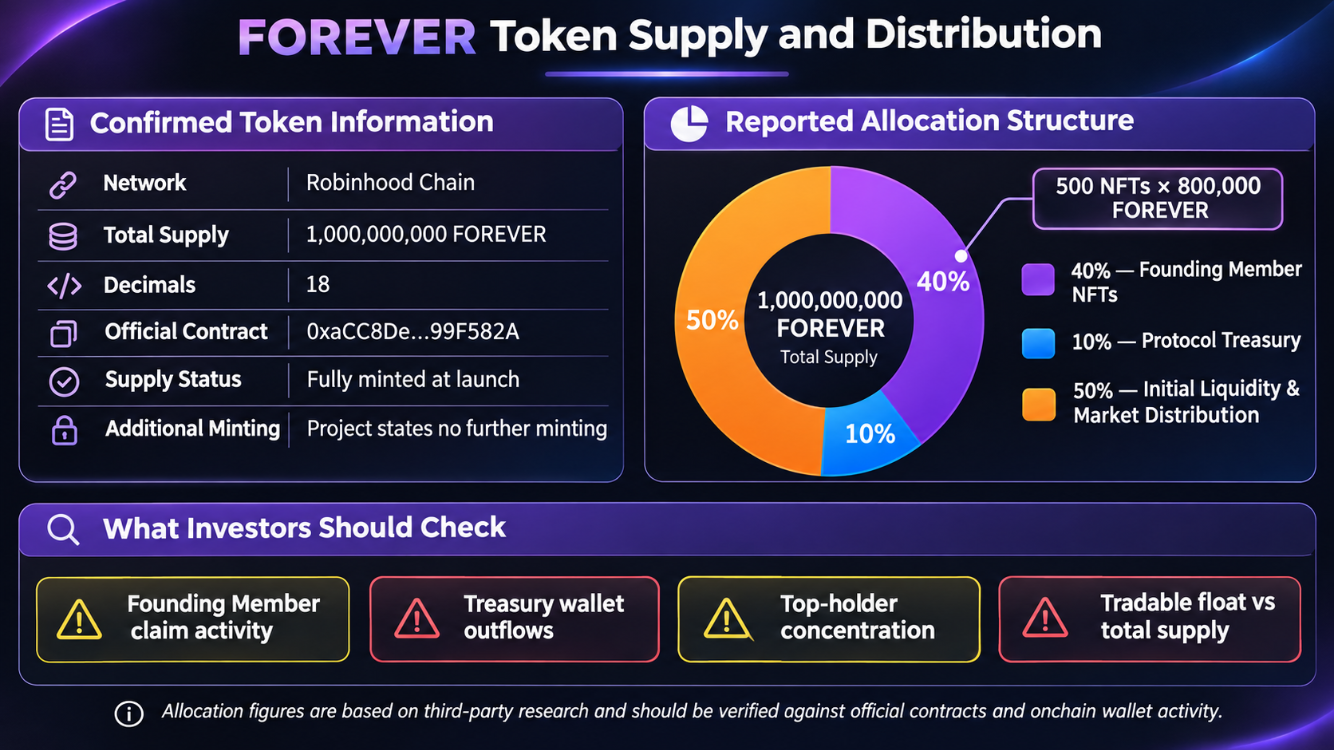
The official contract and Robinhood Chain explorer show a total supply of 1,000,000,000 FOREVER with 18 decimals. The project’s launch announcement stated that the full supply would be minted at launch and that no additional tokens would be created.
This corrects an important data-quality issue: at least one token-sale aggregator has displayed a 10 billion supply. The contract-level figure is 1 billion and should take priority unless the contract itself changes or the project publishes a verifiable migration.
How was the supply distributed?
The official launch structure placed 100% of supply into a bonding curve and liquidity mechanism. The protocol bought the portion intended for Founding Member NFT holders and its treasury, then the market graduated into Uniswap v4 liquidity.
Independent research from MONI describes the economic allocation as follows:
- 500 Founding Member NFTs;
- 800,000 FOREVER per NFT;
- 400 million FOREVER, or 40% of supply, for Founding Members;
- 100 million FOREVER, or 10%, for the protocol treasury;
- the remaining 50% associated with public liquidity and market distribution.
These figures are consistent with a 1 billion supply, but the detailed distribution should still be cross-checked against claim contracts and holder addresses. A launch allocation is not the same as free float. Unclaimed tokens, liquidity positions, treasury assets and tokens held by Founding Members have different market effects.
Does FOREVER have an unlock risk?
The main supply risk is not future minting if the fixed-supply claim holds. It is distribution into the tradable float.
Founding Members collectively control a large allocation. Whether those tokens were immediately claimable, gradually claimed or held affects sell pressure. Treasury tokens may support incentives or protocol activity, but they also represent a concentrated balance whose governance and spending rules matter.
Investors should therefore monitor:
- total claimed by Founding Members;
- the number of independent wallets receiving claims;
- transfers from claim wallets into liquidity pools or exchanges;
- treasury wallet outflows;
- top-holder concentration after excluding pools and contracts.
“Fully minted” does not mean “fully distributed,” and “circulating supply” on a price website does not always represent economically liquid supply.
What gives the token value?
FOREVER has three proposed value layers.
Governance value: holders can help select capital-allocation mandates.
Incentive value: successful agents and supporting voters may receive market-bought FOREVER.
Network value: if multiple funds use the framework, the core token may gain wider governance and economic relevance.
These are plausible mechanisms, not guaranteed cash flows. FOREVER does not automatically represent equity in a company, a legal claim on treasury assets or a right to redeem a proportional net asset value. Unless the project documents such rights, buyers should assume they own a crypto token with governance and incentive utility—not a fund share.
4. FOREVER Launch, Price and Liquidity
FOREVER launched on October 29, 2026 on Robinhood Chain through Frontier’s programmable Uniswap v4 infrastructure. The project announced an initial sniper tax of 50% that decayed to zero during the first 15 minutes and an approximate starting fully diluted valuation of $200,000.
The purpose of a decaying launch tax is to reduce the advantage of bots that enter in the first blocks. It may improve launch fairness, but it does not establish a fair long-term valuation.
Current market snapshot
At the November 2, 2026 research snapshot, CoinGecko reported approximately:
- price: $0.0033;
- market capitalization and FDV: about $3.3 million;
- 24-hour volume: about $375,000;
- tracked supply: 1 billion FOREVER.
These figures are volatile and should be refreshed at publication and again before any trade. Readers can use the FOREVER live price and market page as one reference, but the final execution price comes from the active order book or DEX quote.
CoinGecko tracked multiple FOREVER/ETH and FOREVER/USDG pools on Uniswap v4. Its displayed 2% depth for individual pools was much smaller than headline daily volume. That is a crucial warning: high volume does not guarantee that a large order can be executed without significant price impact.
What drives FOREVER’s price?
The market price is likely to react to five groups of variables.
- Framework delivery: mandate creation, governance and execution moving from concept to working product.
- Fund activity: real capital allocated, strategy performance and assets under management.
- Token economics: treasury buybacks, reward distribution and Founding Member selling.
- Robinhood Chain adoption: users, liquidity, bridges and DEX infrastructure on the network.
- Crypto risk appetite: BTC, ETH and the broader market’s willingness to own illiquid early-stage tokens.
In the near term, narrative and liquidity can dominate. Over a longer period, the token needs evidence that the protocol actually uses capital and that economic activity creates demand for FOREVER.
5. Where to Buy $FOREVER
The verified onchain venue is Uniswap v4 on Robinhood Chain. FOREVER can also appear through interfaces that route to those pools, including OpenSea’s token interface and supported wallet swap services. HIBT announced a FOREVER/USDT spot listing on November 2, 2026.
Before choosing a venue, verify four items:
- The contract is
0xaCC8De336F5D2366FA7334383D8FaB73499F582A. - The network is Robinhood Chain, not Ethereum mainnet or another chain.
- The quoted pool or order book has sufficient liquidity for the planned trade.
- Deposits, trading and withdrawals are actually active.
How to buy FOREVER on HIBT
HIBT’s announcement identifies the FOREVER/USDT trading pair. Because listing pages may appear before all services are enabled, users should first open the market and confirm that live bids, asks and recent trades are visible.
If spot trading is active, the general process is:
- Create or sign in to a HIBT account through the official website.
- Complete any identity verification required for the account and region.
- Deposit USDT using a network supported by HIBT. The deposit network must match the sending network.
- Search for
FOREVER/USDTin the spot market. - Check the best bid, best ask, spread, recent trades and available depth.
- Choose a limit order when price control matters, or a market order only when the order book can absorb the trade.
- Review the estimated FOREVER quantity and trading fee before confirmation.
- After execution, verify the filled price and quantity in order history.
If the order book remains empty or the market still displays zero activity, do not assume a purchase is possible. Wait for the exchange to confirm that trading has opened.
Before withdrawing FOREVER, verify that HIBT supports withdrawals on Robinhood Chain and compare the withdrawal contract and network with the receiving wallet. A spot listing does not automatically mean deposits and withdrawals are enabled at the same time.
How to buy FOREVER on a DEX
DEX trading provides self-custody but requires more technical care.
Step 1: Prepare an EVM-compatible wallet. MetaMask, Rabby and other compatible wallets may connect if Robinhood Chain is configured correctly. Back up the recovery phrase offline and never disclose it to a website or support account.
Step 2: Add Robinhood Chain. Use network details from the official Robinhood Chain documentation. The network is EVM-compatible and uses ETH for gas.
Step 3: Bridge or receive assets. Move ETH and the desired quote asset to Robinhood Chain through an official or well-established bridge route. Keep a small ETH balance for gas.
Step 4: Open Uniswap and select Robinhood Chain. Do not trust an unsolicited link. Navigate through official sources and confirm the selected network.
Step 5: Import the official contract. Paste the full FOREVER contract rather than searching only by ticker. Confirm the symbol, network and pool.
Step 6: Review the route. Check expected output, minimum received, price impact, slippage tolerance and gas cost. Large price impact is a signal to reduce size or avoid the trade.
Step 7: Approve and swap. Approve only the required asset and amount when possible. Confirm the transaction in the wallet, then verify the receipt on Robinhood Chain Blockscout.
Step 8: Confirm the token balance. If FOREVER does not automatically appear, import the same verified contract into the wallet.
CEX or DEX: which is better?
A centralized exchange can be easier for new users and allows FOREVER to be quoted directly in USDT. It also introduces exchange custody, account restrictions and withdrawal availability risk.
A DEX keeps assets under the user’s wallet control and provides direct access to onchain liquidity. It introduces smart-contract, bridge, wallet, slippage and network-selection risk.
The best venue is not simply the one advertising the lowest price. It is the venue where the asset identity is certain, liquidity is adequate, total execution cost is clear and withdrawal or self-custody requirements match the investor’s plan.
6. FOREVER Price Prediction: Use Scenarios, Not False Precision
FOREVER is too new and too dependent on unproven protocol milestones for a credible 2030 target based on price history. A better approach is to model conditions.
Bull case
The bullish case requires more than general AI enthusiasm. It would involve several funds launching on the framework, credible agents producing useful strategies, treasury capital growing, governance participation remaining broad and buybacks appearing consistently onchain.
Under that scenario, the market could begin valuing FOREVER as infrastructure for a network of autonomous funds rather than a single experimental token.
Base case
In the base case, the team ships governance and early mandates, but capital, users and agent performance grow slowly. Token demand remains partly narrative-driven, Founding Member supply gradually reaches the market and liquidity remains concentrated.
Price may remain volatile and range-bound because product progress is not yet strong enough to produce a clear economic valuation.
Bear case
The bearish case includes weak agent performance, delayed framework delivery, governance concentration, treasury-security concerns or falling liquidity. If early holders sell while new demand weakens, the market can reprice the token sharply.
What would different valuations imply?
With a 1 billion token supply, the arithmetic is straightforward:
- $0.005 per token implies a $5 million FDV.
- $0.01 implies a $10 million FDV.
- $0.025 implies a $25 million FDV.
- $0.05 implies a $50 million FDV.
- $0.10 implies a $100 million FDV.
These are valuation conversions, not price targets. They do not account for actual float, holder concentration, liquidity or the amount of capital required to move the market.
Readers can review the FOREVER price prediction page as a sentiment and scenario reference. Its output should not be treated as a verified institutional model or financial advice. Bitcoin price prediction and Ethereum price prediction can help frame overall market risk appetite, but neither substitutes for Forever-specific research.
7. FOREVER Investment Strategies
There is no single correct strategy because a trader and a long-term investor are buying different hypotheses. What matters is matching position size and exit rules to the evidence available.
Short-term strategy: trade liquidity, not the story
Short-term traders should prioritize execution conditions:
- spot volume and whether it persists beyond one launch spike;
- spread and 2% market depth;
- liquidity in the exact pool being used;
- large wallet deposits into pools or exchanges;
- claim activity from Founding Member wallets;
- BTC and ETH volatility;
- scheduled governance or product announcements.
Technical indicators such as RSI and MACD can describe momentum, but on a newly launched token they are built from a short and unstable history. A breakout without deeper liquidity can reverse quickly.
Avoid market orders that are large relative to visible depth. Define the invalidation level before entry. If the thesis is short-term momentum, do not convert it into a “long-term investment” only after the price falls.
Medium-term strategy: wait for evidence
The most informative period may be the first one to three months after launch. Medium-term investors should look for:
- identifiable agent proposals with explicit risk parameters;
- governance participation and voter concentration;
- successful onchain execution of approved mandates;
- public performance reporting after fees and slippage;
- transparent treasury balances and permissions;
- verifiable buyback transactions;
- growth in independent holders and usable liquidity.
This strategy deliberately sacrifices the earliest possible entry in exchange for stronger evidence. For an experimental protocol, that can be a rational trade-off.
Long-term strategy: invest in the framework thesis
A long-term FOREVER position is a bet that the protocol can become infrastructure for many autonomous funds. The key questions are:
- Can third parties create funds without relying on the core team?
- Can agents build portable reputations across funds?
- Can governance control capital without becoming slow or captured by whales?
- Does each new fund create measurable demand or revenue for FOREVER?
- Are security and performance strong enough for users to deposit meaningful capital?
If Forever remains one small fund, its addressable opportunity is far smaller than if the framework supports many independent funds. Investors should not pay a network valuation before network effects exist.
Position sizing and risk budget
Position size should be based on maximum acceptable loss, not on a desired number of tokens.
Suppose a portfolio is worth $1,000, the investor will risk no more than $20 on the trade, and the planned exit is 10% below entry. Ignoring slippage, the theoretical position is:
Position Size=$20/10%=$200
For FOREVER, the actual position should often be smaller because the stop may fill below the intended price. DEX slippage, low order-book depth and fast volatility can make the realized loss larger than the planned loss.
Practical safeguards include:
- use only capital that can be lost;
- avoid leverage;
- enter in several smaller orders;
- test a small buy and sell before scaling;
- set a portfolio-level exposure limit for early-stage tokens;
- keep gas funds separate from the investment amount;
- never average down solely because the token is cheaper.
8. FOREVER vs Other AI Crypto Projects
Forever’s closest conceptual comparison is not a general AI token. It is an AI-enabled fund or agentic DeFi system in which software proposes or executes economic actions.
Forever vs traditional AI trading bots
A trading bot usually serves one account and follows one user’s rules. Forever proposes a shared governance layer, pooled capital and incentives for competing agents. That creates a broader network thesis but also more attack surfaces: treasury custody, governance capture, performance accounting and smart-contract permissions.
Forever vs AI agent DeFi protocols
The most useful comparisons examine who owns the capital, how agents receive authority, what happens after losses, whether results are verifiable and how the token captures value. It is not enough to compare social-media followers or token prices.
Forever vs NovaAI
Forever and NovaAI both trade within the broader AI crypto narrative and both are associated with Robinhood Chain, but their research questions are different. Forever should be judged on autonomous fund governance, capital safety and agent performance. NovaAI needs to prove its product, users and token utility. For a separate framework, see this NovaAI token research article.
The fact that two tokens use “AI” does not make their addressable markets, economics or risks comparable.
9. Major Risks of Investing in FOREVER
AI execution risk
Agents can misread data, overfit historical results or fail under a new market regime. A model that performs well in a backtest can lose money after fees, slippage and real-time execution. Extreme markets can also cause price feeds or risk rules to behave unexpectedly.
Smart-contract and treasury risk
The framework may depend on contracts, wallets, bridges and external DeFi venues. A vulnerability in any component can cause losses. Investors should verify audits, treasury addresses, multisignature settings, upgrade authority and emergency controls.
Governance risk
Token voting can be dominated by large holders. Founding Member allocations may create concentrated voting power, and low participation can allow a small group to approve risky mandates. Governance can also be manipulated by borrowed or temporarily acquired tokens if the voting design permits it.
Token-distribution risk
Founding Members collectively received a significant allocation. Even with a fixed supply, claim activity and selling can increase effective float. Treasury spending or rewards can create additional market supply without minting new tokens.
Liquidity risk
FOREVER liquidity is concentrated in a new market. Headline trading volume may be much larger than executable depth. A large position can be easy to buy during momentum and difficult to sell during a drawdown.
Regulatory and legal risk
A token linked to collective capital allocation may attract legal questions depending on jurisdiction, marketing and holder rights. Users must also comply with local restrictions when accessing centralized exchanges, DEXs and cross-chain services.
Project-execution risk
The protocol is newly launched. A governance vote or website does not prove the framework can manage capital safely at scale. Delays, team dependence, limited developer adoption or weak fund performance can undermine the thesis.
10. Pre-Purchase Checklist
Before buying FOREVER, verify all of the following:
- The full contract address matches the official address.
- The selected network is Robinhood Chain.
- The exact DEX pool or CEX order book has real liquidity.
- The total cost includes spread, slippage, gas and platform fees.
- Founding Member claims and top-holder activity have been reviewed.
- Treasury and governance addresses are identifiable.
- Agent mandates and results are verifiable rather than promotional claims.
- Any buyback has a visible funding source and onchain transaction.
- The position can be exited without unacceptable price impact.
- The maximum acceptable loss is defined before entry.
If several of these items cannot be verified, the correct response is not to invent certainty. It is to reduce the position or not trade.
11. Frequently Asked Questions About FOREVER
What is Forever crypto?
Forever is an early-stage framework for autonomous onchain funds. AI agents are intended to propose capital-allocation mandates, FOREVER holders vote on them, and execution agents implement approved strategies within defined rules.
What is the FOREVER token?
FOREVER is the governance and incentive token of the Forever framework. Its proposed roles include voting on mandates and rewarding agents and holders associated with successful strategies.
What is the official FOREVER contract address?
The official Robinhood Chain contract published by the project is 0xaCC8De336F5D2366FA7334383D8FaB73499F582A. Verify the full address before every transaction.
Is FOREVER built on Robinhood Chain?
Yes. FOREVER launched on Robinhood Chain, an EVM-compatible Layer 2 built with Arbitrum technology. Robinhood Chain uses ETH as its native gas token.
Where can I buy FOREVER?
FOREVER is verifiably traded through Uniswap v4 pools on Robinhood Chain. HIBT has also announced a FOREVER/USDT listing. Confirm that trading and withdrawals are active and check liquidity before buying.
How do I buy FOREVER with USDT?
If HIBT’s FOREVER/USDT spot market is active, users can fund an account with USDT and place a spot order. Onchain, FOREVER also trades against assets such as ETH and USDG through Uniswap v4 pools.
What is the total supply of FOREVER?
The verified contract supply is 1 billion FOREVER. The project stated that the full supply was minted at launch with no further minting planned.
Does FOREVER give holders ownership of the fund treasury?
FOREVER is described as a governance token, but that does not automatically give holders a legal or redeemable claim on treasury net assets. Investors should rely on explicit legal and contract terms, not assumptions.
Is FOREVER a good investment?
FOREVER may appeal to investors who accept high risk and believe in autonomous onchain funds, but it is not yet a proven long-term asset. Its case depends on agent performance, treasury safety, governance quality, buybacks and liquidity.
Can FOREVER reach $0.01?
With 1 billion tokens, $0.01 would imply a $10 million FDV. Whether that valuation is sustainable depends on framework adoption, capital under management, token demand, holder selling and market liquidity. The calculation is not a prediction.
Final Verdict: Is FOREVER Worth Buying?
Forever has a more serious thesis than a typical AI-themed meme token. It tries to solve a real coordination problem: how autonomous agents can propose economic actions, how capital providers can authorize them, and how both sides can share incentives.
But the project is only days old. The market has evidence of a token launch, fixed supply, Uniswap v4 liquidity and an early governance rollout. It does not yet have a long public record of safe capital deployment, risk-adjusted agent performance, recurring protocol income or sustained treasury buybacks.
My view is clear: FOREVER is suitable only as a small, speculative position until the protocol proves that its framework works with real capital. Short-term traders can study liquidity and momentum. Medium-term investors should wait for mandate execution and buyback evidence. Long-term investors should demand proof that third parties can create funds and that every new fund strengthens FOREVER’s economics.
The investment case should be tested in this order:
Working agents → enforceable governance → safe capital execution → measurable performance → recurring buybacks → durable token demand
If the chain breaks at any point, the AI narrative is not enough. If all six links become verifiable, FOREVER may deserve a higher long-term assessment. Until then, risk control matters more than price prediction.
Research date: November 2, 2026. Market data and listing status can change rapidly. This article is for educational purposes and is not financial advice.
Primary and supporting sources: Forever official site, Forever official announcements, Robinhood Chain documentation, Robinhood Chain Blockscout, CoinGecko market page, MONI Research, and HIBT listing announcements.