
PYPLON is not a "platform coin" issued by PayPal, nor is it an ordinary crypto token valued on burn mechanisms, staking, or community narratives. It is a tokenized stock product tied to PayPal within the Ondo ecosystem, designed to give eligible investors on-chain economic exposure to PayPal Holdings (NASDAQ: PYPL), a company listed on the Nasdaq. HIBT uses PYPLON/USDT as its trading pair, allowing users accustomed to USDT to trade this equity-linked asset.
To understand PYPLON, what really needs to be studied is not "the tokenomics of this coin" but whether PayPal can improve the growth quality of its branded checkout business, accelerate Venmo monetization, restructure Braintree's profitability, and convert free cash flow and share buybacks into sustained per-share value growth.
In Q2 2026, PayPal's total payment volume (TPV) grew 10% year over year, net revenue grew 5%, but transaction margin dollars grew only 1%, and non-GAAP operating margin declined 248 basis points year over year. These figures show that PayPal is still growing, but they also expose the central tension of its current transformation: payment volumes are expanding faster than high-quality profits. At the same time, the company generated $1.775 billion in quarterly free cash flow and repurchased roughly $6 billion of stock over the trailing twelve months, demonstrating that its capital return capacity remains a standout strength. PayPal Q2 2026 Earnings Release
So whether PYPLON is worth investing in cannot be judged merely by how "cheap" the PayPal stock looks, nor by crypto market hype alone. A more sensible framework is:
PayPal's business quality × per-share cash flow × stock valuation × PYPLON's issuance structure and premium/discount.
Risk disclaimer: This article reflects data as of September 17, 2026, and is intended for market research and investor education only. It does not constitute a recommendation to buy or sell any security, crypto asset, or other financial product. In addition to the risks of the underlying stock, tokenized equities involve issuance, custody, smart contract, liquidity, platform, and regional regulatory risks. Before trading, verify local eligibility restrictions, product documentation, and the latest contract address.
Key Takeaways: 7 Things to Know Before Investing in PYPLON
- PYPLON is one of the trading tickers for PayPal Tokenized Stock (Ondo). Its core price reference comes from PYPL, not from the tokenomics of a standalone crypto project.
- PYPLON provides economic exposure linked to the underlying security. It is not equivalent to directly holding PayPal stock in a brokerage account, nor does it automatically confer traditional shareholder voting rights or a right to claim the underlying shares.
- In PayPal's Q2 2026, TPV grew 10%, but revenue, transaction margin dollars, and margins all lagged payment volumes noticeably — growth quality still needs repair.
- Venmo, Braintree, and financial services offer growth opportunities, but their margins, capital requirements, and risks differ entirely — not all transaction volume should be treated as equally valuable.
- Free cash flow and buybacks are among the clearest value supports for PayPal right now; whether buybacks create value depends on whether the repurchase price is below the company's intrinsic value.
- PYUSD may enhance PayPal's strategic optionality in stablecoin payments, but PYUSD is not PYPLON, and it should not yet be treated as a core pillar of PayPal's earnings.
- Before trading PYPLON, you must simultaneously check the PYPL price, the conversion ratio, PYPLON/USDT order book depth, and the premium or discount relative to the underlying reference value.
1. What Is PYPLON? Understanding the Relationship Between PYPLON, PYPLon, and PYPL
The asset structure behind PYPLON can be broken down into four layers:
- PayPal Holdings is a listed company operating payments, digital wallets, merchant acquiring, credit, and related financial services.
- PYPL is the ticker for PayPal's common stock trading on Nasdaq.
- PYPLon is the name or ticker format used by Ondo for its tokenized product tied to PayPal stock.
- PYPLON/USDT is the USDT-quoted trading pair displayed by HIBT for its users.
According to HIBT's announcement, PYPLON/USDT opened for trading on September 17, 2026, on the Ethereum network. The contract address listed in the announcement is:
0x4EFD92F372898B57F292De69fCe377dd7D912bDd
This address can also be verified on Ethereum block explorers. Because popular assets often attract copycat tokens with identical names, investors must never deposit or transfer funds on-chain based on the "PYPLON" name alone — always verify the network, contract, issuance documentation, and the exchange's deposit page. HIBT Listing Announcement
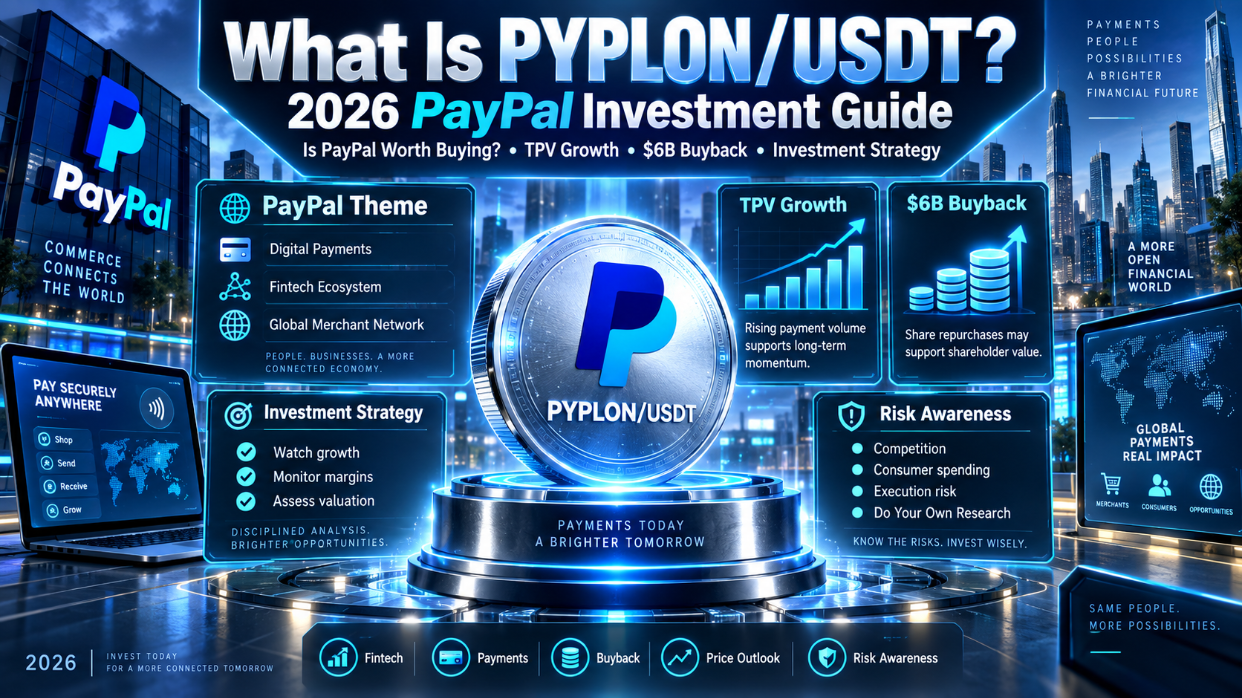
You can check the latest price, trading volume, and order book on the PYPLON live price and PYPLON/USDT market page, but a market page only answers "how is the market pricing it right now" — it cannot replace research into the underlying stock and the product's legal structure.
Is PYPLON officially issued by PayPal?
No. PYPLON is not a public-chain token, loyalty point, or payment platform coin launched by PayPal, nor does it mean PayPal guarantees its trading price.
It is a financial product brought on-chain by a third party that provides economic exposure to PayPal stock. PayPal is the source of the underlying company's value, Ondo's issuance and infrastructure arrangements determine the token structure, and HIBT provides the specific trading venue. The three roles must not be conflated.
Why can a PayPal-linked asset be traded with USDT?
PYPLON/USDT is simply a quoting convention: the market expresses the price of one unit of PYPLON in USDT. Settling in USDT does not change the underlying source of value, nor does it turn PayPal stock into an ordinary altcoin.
2. Does Buying PYPLON Equal Buying PayPal Stock Directly?
Not exactly.
Ondo states explicitly in its legal disclaimer that Ondo Stocks are designed to give holders economic exposure to publicly traded underlying assets and dividend value (net of applicable withholding), but the tokens themselves are not stocks or ETFs, and holders have no right to directly hold or obtain the underlying securities. Ondo Legal Disclaimer
This means PYPL and PYPLON, while potentially highly correlated, sit at different levels of rights and risks.
Directly holding PYPL stock generally means holding common shares through a brokerage account and enjoying the corresponding shareholder rights under the broker, custodian, and local law. Holding PYPLON means holding an on-chain tokenized product; what the investor obtains is primarily exposure to the price and related economic value — not that one share of PYPL in a traditional securities account.
PYPLON also carries additional risks:
- Issuer and product legal structure risk;
- Underlying asset custody and rights enforcement risk;
- Smart contract and Ethereum network risk;
- Exchange and wallet risk;
- On-chain and CEX liquidity risk;
- Risk of the price deviating (premium/discount) from the underlying security;
- Regional restrictions, investor eligibility, and regulatory change risk.
Therefore, "backed by real stock-related value" does not mean "risk-free," and certainly does not mean "exactly the same as holding shares directly."
3. PYPLON and PYUSD Are Not the Same Asset
Both names are associated with PayPal, but PYPLON and PYUSD represent two entirely different logics.
PYPLON is a tokenized asset linked to PayPal stock, whose price is driven primarily by the market value of PYPL. PYUSD is a stablecoin product pegged to the U.S. dollar, designed primarily for holding, transferring, and payments. PayPal PYUSD Product Page
The two are not interchangeable:
- PYPLON carries PayPal's share price volatility and can rise or fall significantly;
- PYUSD targets a value near $1 and does not share in PayPal's share price gains;
- Buying PYUSD is not investing in PayPal stock;
- Buying PYPLON does not mean holding PYUSD reserves or any stablecoin yield rights.
For PayPal investors, PYUSD's significance is better understood as strategic optionality: if stablecoin payments, settlement, and merchant adoption develop rapidly, PayPal could gain new transaction scenarios, fund retention, and ecosystem stickiness. But until those scenarios generate meaningful revenue and profit, PYUSD's scale should not be equated with shareholder value.
4. PayPal's Q2 2026 Report Card: Payment Volume Recovered, Profit Quality Still Under Pressure
PayPal's key figures for Q2 2026:
- Net revenue of $8.682 billion, up 5% year over year, or 3% on a currency-neutral basis;
- TPV of $486.448 billion, up 10% year over year, or 9% currency-neutral;
- Payment transactions of 6.75 billion, up 8% year over year;
- Active accounts of 439 million, up roughly 0.3% year over year and down about 2 million sequentially;
- Transactions per active account (TPA) of 60, up 3% year over year, or up 7% excluding payment service provider (PSP) transactions;
- Transaction margin dollars of $3.900 billion, up 1% year over year, or up 3% excluding the impact of interest earned on customer balances;
- GAAP operating income of $1.427 billion, down 5% year over year;
- Non-GAAP operating income of $1.507 billion, down 8% year over year;
- Non-GAAP operating margin of 17.4%, down 248 basis points year over year;
- GAAP EPS of $1.25, down 3% year over year;
- Non-GAAP EPS of $1.38, down 1% year over year;
- Free cash flow of $1.775 billion, up 157% year over year; adjusted free cash flow of $1.832 billion, up 179%.
All figures come from the materials PayPal filed with the SEC for Q2 2026. Transaction margin dollars, non-GAAP profit, and adjusted free cash flow are non-GAAP measures used by the company and should not be interpreted in isolation from their definitions and adjustment items.
Why did revenue grow only 5% when TPV grew 10%?
Total payment volume is not revenue. When a user or merchant processes a $100 payment, PayPal keeps only a portion of the fee and must also cover transaction processing, funding-source costs, credit losses, partner incentives, customer support, and technology infrastructure.
The Q2 2026 numbers show that the volume of funds PayPal processed grew quickly, but the revenue and transaction profit generated per unit of payment volume did not keep pace. Possible reasons include:
- A higher mix of low-rate large-merchant processing business;
- Braintree and similar businesses expanding TPV with a different economic structure than branded checkout;
- Providing more co-marketing support to large merchants, with portions offset against revenue;
- Declining cross-border and foreign-exchange-related fee revenue;
- Shifts in product, geographic, merchant, and funding-source mix.
PayPal's 10-Q further discloses that Braintree products and services contributed roughly $400 million of incremental revenue during the quarter, while Venmo contributed about $60 million. Meanwhile, revenue from PayPal-branded products and services fell by roughly $130 million, primarily due to increased co-marketing with large merchants and lower foreign-exchange fee revenue. PayPal Q2 2026 Form 10-Q
A more useful way to observe "growth quality"
You can build an unofficial, directional indicator:
Growth Quality Coefficient = transaction margin dollar growth rate ÷ TPV growth rate
Using Q2 2026 reported figures:
1% ÷ 10% = 0.10
Using the transaction margin dollar growth rate excluding the impact of customer-balance interest:
3% ÷ 10% = 0.30
This indicator is not a PayPal accounting metric and cannot be mechanically compared across companies, but it helps investors quickly identify whether payment volume growth is effectively converting into transaction profit. A persistently rising coefficient usually means improving monetization efficiency or business mix; a persistently low coefficient means the gap between "volume" and "value" remains wide.
Another simple estimate:
$3.9 billion transaction margin dollars ÷ $486.448 billion TPV ≈ 0.802%
In other words, every $100 of TPV in the quarter corresponded to roughly $0.80 of transaction margin dollars. This is only an estimate based on disclosed data, not an official take rate, and transaction margin dollars must not be equated with net profit.
5. Why Branded Checkout Remains the Core of PayPal's Turnaround
PayPal's branded checkout business — the scenario where consumers actively choose PayPal on a merchant's checkout page — typically carries stronger brand recognition, wallet relationships, and data value, and often has better economics than pure back-end processing.
Management said in the Q2 results that branded checkout performance further stabilized. But "stabilized" is not the same as "re-accelerated." What PYPLON investors really need to watch is:
- Whether branded checkout transaction volume can move from low growth to sustained acceleration;
- Whether Fastlane and the new checkout experience can lift conversion rates;
- Whether mobile and passwordless experiences can narrow the gap with Apple Pay, Google Pay, and Shop Pay;
- Whether large-merchant partnerships require ever-increasing subsidies or co-marketing spend;
- Whether branded checkout growth can drive a recovery in transaction margin dollars.
If PayPal sustains TPV growth only through low-rate processing volume while branded checkout stagnates, the market may continue to assign it a low valuation. Conversely, if branded checkout re-accelerates without relying on continuously expanding marketing concessions, the low valuation could translate into strong per-share earnings leverage.
6. Why Co-Marketing Spend Deserves Special Attention
The co-marketing support PayPal provides to large merchants can help the platform maintain presence, boost checkout visibility, or drive transaction volume — but this growth is not free.
Under the accounting treatment in the company's 10-Q, portions of co-marketing amounts are recorded as reductions of revenue. When TPV growth looks solid but branded product revenue is under pressure, investors should ask:
- Does new transaction volume require higher subsidies to win?
- After subsidies end, will users and merchants still stay with PayPal?
- Does co-marketing-driven volume generate enough long-term transaction margin dollars?
- Is merchant bargaining power compressing PayPal's take rate?
Short-term concessions may be a reasonable customer-acquisition investment. But if concession intensity keeps rising while profit conversion fails to improve, it may signal declining pricing power against large merchants.
7. Venmo's Growth: The Key Is Not User Count but the Monetization Path
Venmo has long looked like a highly active P2P transfer tool. Its long-term value depends on whether it can convert social-payment relationships into broader, higher-frequency financial activity.
Venmo's potential monetization chain can be summarized as:
P2P user acquisition → balance retention → Venmo debit card and merchant payments → Pay with Venmo → credit, BNPL, and other financial services → higher revenue per user
In Q2 2026, Venmo revenue increased by roughly $60 million year over year, indicating monetization is still progressing. But investors should not look only at Venmo's total payment volume; they should also track:
- Pay with Venmo merchant coverage and usage frequency;
- Venmo debit card activity;
- Whether users upgrade Venmo from a transfer tool into an everyday spending account;
- Whether revenue per active user keeps rising;
- Whether new financial services lift revenue without materially worsening credit losses;
- Whether Venmo growth requires excessive rewards or marketing spend.
If Venmo can raise per-user revenue without significantly increasing risk costs, it could become an important source of PayPal's re-rating. Conversely, a highly active but poorly monetized platform can hardly support a high valuation.
8. Why Braintree Is Both a Growth Engine and a Margin Pressure Source
Braintree primarily provides unbranded or weakly branded payment processing for large enterprises and platforms. It can rapidly scale PayPal's transaction volumes and give the company access to more large merchants and complex payment scenarios.
But scale does not equal high profit. PayPal notes in its 10-Q that a higher proportion of Braintree TPV typically carries a higher cost rate than other products. This means:
- Braintree can drive TPV and revenue growth;
- Large clients have stronger bargaining power;
- Profit per dollar of transaction volume may be lower than branded checkout;
- Processing costs, partner costs, and infrastructure investment weigh on margins;
- Chasing market share alone can dilute overall economics.
Judging whether Braintree creates shareholder value requires looking not just at new large clients or TPV, but at its gross profit contribution, transaction margin dollars, pricing discipline, and scale effects.
The ideal scenario: Braintree maintains high growth while improving unit economics through product upgrades, risk management, value-added services, and cost efficiency. The worst scenario: PayPal wins more transaction volume while leaving pricing power and profit with large merchants.
9. Will Financial Services and BNPL Raise the Valuation — or Add Risk?
PayPal is expanding from a payment tool into a fuller suite of financial services. Merchant financing, consumer credit, BNPL, debit cards, credit products, and balance management can improve user retention and per-user revenue, and may also give PayPal deeper account relationships.
As of June 30, 2026, PayPal's merchant loans, advances, and receivables were approximately $1.9 billion, up roughly 14% from before — showing growing financial services exposure. PayPal Q2 2026 Form 10-Q
But credit growth cannot be understood purely as a revenue opportunity. It also introduces:
- Borrower default and credit loss risk;
- Rising loss rates during recessions;
- Funding cost and liquidity risk;
- Fraud and identity verification risk;
- Consumer finance regulation and compliance costs;
- Balance-sheet or partner risk.
Investors should pay particular attention to whether loan growth outpaces risk provisioning, whether delinquency and loss rates are deteriorating, and how much credit risk PayPal actually retains. Financial services can lift the valuation only if risk-adjusted returns are high enough — not simply because the loan book is bigger.
10. Active Accounts Are Barely Growing — Does PayPal Still Have Growth Room?
Q2 2026 active accounts were about 439 million, up only ~0.3% year over year and slightly down sequentially. Viewed in isolation, this suggests PayPal's user growth has stalled.
But the value of a mature payments platform depends not only on account count, but also on each account's activity level, payment frequency, merchant coverage, and monetization ability. Over the same period, TPA reached 60, up 3% year over year; excluding PSP transactions, TPA grew 7%.
This shows existing users can still become more active. Future valuation requires watching both lines:
- User scale: whether active accounts return to net growth;
- User quality: whether TPA, branded checkout usage, Venmo monetization, and per-user profit can rise.
If account count stays flat but per-user transactions and profit keep rising, PayPal can still be a cash-flow compounding company. If accounts stall while transaction quality and margins decline, the platform's network effects may be weakening.
11. Free Cash Flow, Buybacks, and Dividends: PayPal's Clearest Value Support Right Now
PayPal generated $1.775 billion in free cash flow in Q2 and $1.832 billion in adjusted free cash flow. Free cash flow can fund product investment, acquisitions, debt repayment, buybacks, or dividends — it is a key metric for evaluating mature tech companies.
In Q2, the company spent roughly $1.5 billion to repurchase about 33 million shares; over the twelve months ended Q2, it repurchased roughly $6 billion worth, about 111 million shares. In the first half of 2026, PayPal spent about $3 billion to repurchase roughly 67 million shares, at an average repurchase price of about $44.99. At the end of June, approximately $10.9 billion remained under the repurchase authorization.
PayPal's outstanding common shares fell from roughly 920 million at the end of 2025 to about 862 million at the end of June 2026 — a reduction of roughly 6.3% in six months. Holding net income constant, a declining share count lifts EPS and free cash flow per share.
Are buybacks always a positive?
No. Buybacks create value only if at least two conditions hold:
- The company has sufficient and sustainable free cash flow;
- The repurchase price is below or near the company's reasonable intrinsic value.
If management buys back stock when it is undervalued, remaining shareholders' claim on future cash flow increases. If it repurchases at inflated prices, it is essentially transferring cash to exiting shareholders.
In the market snapshot as of September 17, 2026, PYPL traded around $52.71. Compared with the average H1 repurchase price of $44.99, completed buybacks carry some price cushion — but that alone does not prove the stock is undervalued. What really matters is whether future earnings and cash flow deliver.
PayPal also declared a quarterly cash dividend of $0.14 per share. A dividend can broaden the investor base and establish capital-return discipline, but it also means the company has entered a more mature capital-allocation stage. Investors should not interpret a first or increased dividend as simply "growth is over," nor automatically as a strong growth signal.
12. How Important Is PYUSD to PayPal, Really?
PYUSD gives PayPal a foundation to participate in stablecoin payments, cross-border settlement, on-chain transfers, and digital-dollar applications. Its potential value to PayPal includes:
- Reducing certain settlement frictions;
- Increasing in-wallet fund retention and usage scenarios;
- Connecting the traditional merchant network with on-chain liquidity;
- Participating in global digital-dollar demand;
- Providing developers and merchants with new payment rails.
But PYUSD should still be viewed as optionality, not the center of the current investment thesis. Investors should track:
- PYUSD real payment volumes, not just issuance;
- Merchant acceptance and cross-border usage;
- How reserve yield is split among issuers, partners, and PayPal;
- Whether users keep using it after incentives end;
- Regulatory, reserve, redemption, and on-chain contract risks;
- Whether PYUSD actually increases PayPal's revenue or lowers its costs.
If these indicators fail to translate into financial results, PYUSD is more like strategic defense and a future option than a cash-flow asset supporting the current valuation.
13. PayPal's Competition: Not One Rival but Four Battlegrounds
Summarizing PayPal's competition as "Apple Pay is the competitor" understates the problem.
Consumer checkout entry point
PayPal competes with Apple Pay, Google Pay, Shop Pay, Stripe Link, and merchants' own account systems. The key metrics are checkout conversion, mobile experience, authentication speed, and default user choice.
Merchant payment processing
Braintree faces Stripe, Adyen, Fiserv, and other acquiring and payments-infrastructure companies. Competition here centers on global coverage, reliability, pricing, risk management, developer experience, and value-added services.
P2P and digital wallets
Venmo faces Cash App, Zelle, Apple Cash, and banking apps. User scale matters, but monetization and everyday financial relationships matter more.
BNPL and financial services
PayPal also competes with Affirm, Klarna, bank credit cards, and other consumer finance products. This space can raise revenue but also adds credit and regulatory risk.
PayPal's advantage is its simultaneous ownership of consumers, merchants, wallets, payment processing, and risk-control data; its weakness is inconsistent growth quality across products, with parts of the business vulnerable to margin compression by operating systems, merchants, or specialized payments companies.
14. Is PayPal a Growth Stock, a Value Stock, or a Value Trap?
The most accurate description: a mature fintech company in transition, and a potential free-cash-flow compounding asset.
As of September 17, 2026, PYPL traded around $52.71, with a market cap of roughly $46.49 billion and trailing-twelve-month EPS of about $5.29, implying a trailing P/E of roughly 9.96x. The company's guidance for 2026 non-GAAP EPS is approximately $5.38; dividing the current price by that guidance yields a reference non-GAAP multiple of about 9.8x.
These two multiples use different accounting bases and must not be mixed without explanation. The former is based on trailing GAAP EPS near the market snapshot; the latter uses the company's full-year non-GAAP guidance and is suitable only as a directional reference.
A low valuation may signal opportunity — or it may reflect market expectations of long-term growth and competitive decline. To distinguish value investing from a value trap, consider:
- Whether branded checkout returns to sustained growth;
- Whether transaction margin dollars can gradually catch up with TPV growth;
- Whether Venmo revenue outpaces marketing and risk costs;
- Whether Braintree can improve its profit contribution;
- Whether free cash flow is sustainable rather than dependent on working-capital timing;
- Whether buybacks keep shrinking the share count and raising per-share value;
- Whether EPS growth comes from operating improvement or mainly from a lower share count and adjustment items;
- Whether management keeps cutting medium- to long-term guidance.
If the core business stabilizes, margins stop falling, and per-share cash flow grows, the low multiple may offer valuation-repair room. If competitiveness keeps deteriorating, even a very low P/E may not be cheap.
15. Why Is PYPLON Rising? Don't Just Look at Crypto Volume
PYPLON's price drivers can be separated into five layers.
Layer 1: The PYPL stock price
This is the core variable. PayPal earnings, guidance, analyst expectations, buybacks, and valuation changes are first reflected in PYPL, then transmitted to PYPLON's reference value.
Layer 2: Expectations for PayPal's fundamentals
Changes in branded checkout, Venmo, Braintree, financial services, free cash flow, and buybacks will affect the market's judgment of future EPS and the fair valuation multiple.
Layer 3: The U.S. equity market and interest-rate environment
Falling rates generally support valuations for growth and fintech assets, but a recession could weaken consumption, payment volumes, and credit quality. Don't explain the entire move with "rate cuts are good for tech stocks."
Layer 4: RWA and tokenized-equity adoption
More users entering on-chain equity markets may increase PYPLON's volume, accessibility, and liquidity — but RWA hype does not directly add to PayPal's profits.
Layer 5: PYPLON's own market structure
USDT flows, order book depth, bid-ask spreads, market-making efficiency, Ethereum transfers, and stock-market closing hours can all cause PYPLON to deviate from its underlying reference value in the short term.
16. PYPLON Price Forecast: Three Scenarios Instead of One Target Price
You can view PYPLON price forecasts and market scenarios, but no model replaces verification of the underlying PYPL, the conversion ratio, and the token's premium/discount. For tokenized stocks, forecasting company earnings and valuation first, then discussing the token price, is far more reasonable than extrapolating directly from crypto candlestick charts.
Bull Case: Growth quality and capital returns improve together
The optimistic scenario requires:
- Branded checkout moving from stabilization to acceleration;
- Venmo monetization continuing to improve;
- Braintree maintaining growth while improving unit economics;
- Transaction margin dollar growth gradually approaching revenue and TPV growth;
- Operating margin bottoming and recovering;
- Free cash flow remaining strong;
- Management continuing buybacks at reasonable valuations;
- Financial services and PYUSD adding incrementally with risk costs under control.
In this case, the market could simultaneously raise PayPal's earnings expectations and valuation multiple, and PYPLON would likely benefit in tandem.
Base Case: Business stabilizes; buybacks slowly lift per-share value
The neutral scenario might look like:
- TPV growing at a mid-to-high single-digit pace;
- Branded checkout improving slowly;
- Venmo and Braintree growth offsetting part of the legacy pressure;
- No clear margin expansion;
- Free cash flow supporting buybacks and dividends;
- EPS growth driven mainly by modest operating improvement and a shrinking share count.
Here PYPL behaves more like a low-valuation cash-flow asset, with price performance depending on earnings delivery and the valuation range rather than a rapid-growth narrative.
Bear Case: The low valuation becomes a value trap
The pessimistic scenario includes:
- Branded checkout stuck at zero or negative growth for consecutive quarters;
- TPV growth decelerating markedly, and not for short-term FX or macro reasons;
- Transaction margin dollars persistently lagging revenue;
- Braintree's low-margin business continuing to take share;
- Venmo monetization stalling;
- Operating margin and free cash flow declining;
- Credit losses rising;
- Management cutting EPS guidance;
- PYPLON trading at a significant premium followed by liquidity contraction.
In this case, the low P/E could compress further, and PYPLON would compound that with token-market discounts and liquidity risk.
17. Which Signals Mean the PYPLON Investment Thesis Has Broken Down?
When building a buy case, also write down your exit or re-evaluation conditions in advance. Warning signs worth noting:
- Branded checkout at zero or negative growth for multiple consecutive quarters;
- TPV growth slowing sharply, and not due to short-term FX or macro factors;
- Transaction margin dollars persistently and significantly weaker than revenue and TPV;
- Non-GAAP adjustments widening while GAAP profit keeps deteriorating;
- Operating margin and free cash flow declining for consecutive periods;
- Venmo revenue and user engagement losing growth;
- Braintree transaction volume expanding without improved profit contribution;
- Credit losses, fraud losses, or regulatory costs rising markedly;
- EPS guidance being cut repeatedly;
- Buybacks failing to produce visible per-share value gains;
- PYPLON sustaining a significant premium with no effective redemption or arbitrage mechanism to close the gap;
- Major changes to the issuance, custody, compliance, or smart-contract structure.
Sell decisions are best driven by changes in the investment thesis, not single-day price swings; likewise, a falling price does not automatically mean better value.
18. What Investment Strategies Suit PYPLON?
Long-term fundamental strategy
Suited to investors willing to track PayPal's earnings, competitive landscape, and valuation continuously. The focus is not predicting next week's price, but judging whether per-share free cash flow can grow over the next three to five years.
The research order should be:
Branded checkout and Venmo → transaction margin dollars and margins → free cash flow → per-share value after buybacks → stock valuation → PYPLON premium/discount.
Earnings-confirmation strategy
Investors unwilling to bear earnings-gap risk can wait for results and observe:
- Whether revenue and TPV beat expectations;
- Whether transaction margin dollars improved;
- Whether EPS and free cash flow guidance were raised;
- Whether the stock rally is supported by volume and analyst revisions;
- Whether PYPLON shows abnormal premiums.
Deciding after the market digests the information may mean missing the initial move, but it reduces the risk of "betting on a single number."
Staged allocation strategy
For companies in transition, going all-in at once amplifies the cost of being wrong. Investors can split planned capital into an observation position, a fundamentals-confirmation position, and a re-evaluation position after pullbacks. The proportions should reflect personal risk tolerance — don't mechanically copy a fixed template.
Valuation-range strategy
Because PYPLON is backed by an equity asset, forward P/E, free-cash-flow yield, growth expectations, and peer valuations matter far more than crypto-style RSI. Note that when using non-GAAP EPS, keep the basis consistent and check whether adjustment items keep widening.
Premium/discount strategy
Never assume one PYPLON necessarily equals one share of PYPL. First confirm the conversion ratio in the product documentation, then calculate:
Premium/discount rate = (PYPLON price − PYPL reference price × conversion ratio) ÷ (PYPL reference price × conversion ratio)
If the conversion ratio is unconfirmed, directly using "PYPLON price ÷ PYPL price − 1" may yield a wrong conclusion. Also account for exchange rates, dividend treatment, fees, trading hours, and quote delays.
19. How Is PYPLON Different from Other Popular Tokenized Assets?
Tokenization does not give all assets the same fundamentals. Investors should first identify the underlying asset, then choose the valuation framework.
PYPLON vs TQQQX: single company vs leveraged tech index
The core risk of what TQQQX is comes from the Nasdaq-100's daily leverage structure, volatility decay, and index direction. PYPLON concentrates exposure on a single company — PayPal — its operations, competition, and capital allocation.
Being bullish on tech stocks is not the same as being bullish on PayPal; being bullish on PayPal does not mean a daily-leveraged index product is suitable.
PYPLON vs XAMAT: fintech vs semiconductor equipment
What XAMAT is tracks a logic closer to semiconductor equipment, wafer-fab capex, and the chip cycle; PYPLON is driven primarily by payment volumes, take rate, wallet competition, credit risk, and free cash flow.
Both may be grouped under "tech assets," but their earnings cycles are completely different.
PYPLON vs XSNXX: payments platform vs enterprise software
What XSNXX is follows more of an enterprise software, cloud services, and subscription-growth logic; PYPLON is a consumer-and-merchant payments network. Software companies are typically analyzed on ARR, subscription retention, and margins; PayPal should be analyzed first on TPV, transaction margin dollars, branded checkout, and per-share cash flow.
20. Why BTC and ETH Market Moves Can Still Affect PYPLON
PYPLON's long-term value comes primarily from PayPal, not from the price of Bitcoin or Ethereum. But because it trades in a crypto environment, overall risk appetite still affects its short-term liquidity.
Investors can combine the BTC price forecast and market cycle view to gauge whether crypto capital is expanding or contracting. A BTC rally does not raise PayPal's payment profits, but it may increase USDT market activity; a sharp BTC drop could cause investors to dump a broad range of on-chain risk assets simultaneously.
PYPLON is deployed on Ethereum, and on-chain transfers, wallets, and smart contract usage are tied to Ethereum infrastructure. The ETH price forecast and Ethereum trends can help explain the on-chain environment, but a rising ETH does not mean PYPL's fundamentals have improved.
Therefore, BTC and ETH are trading-environment variables, not PayPal earnings variables.
21. HIBT's Nine-Factor Framework for Observing PYPLON
To judge whether PYPLON is worth investing in, track these nine indicators over the long term.
1. Branded checkout growth
Determines whether PayPal's most brand-valuable business is re-accelerating.
2. TPV growth
Tracks overall platform payment scale, but should never be a standalone buy signal.
3. Transaction margin dollar growth
Tests whether payment volume converts into higher-quality transaction profit.
4. Venmo monetization
Focus on Pay with Venmo, the debit card, financial services, and per-user revenue.
5. Braintree unit economics
Look at revenue and TPV, but also transaction profit, costs, and pricing discipline.
6. Operating margin and free cash flow
Tests whether the turnaround produces real cash, not just adjusted metrics.
7. Share count and buyback price
Observe whether buybacks truly reduce shares and whether management allocates capital at reasonable valuations.
8. PYPL valuation
Examine both GAAP and non-GAAP bases; don't assume cheapness just because the multiple is low.
9. PYPLON premium/discount and liquidity
Check the conversion ratio, order book, spreads, volume, and deviation from the underlying reference value.
The core relationship among the nine factors:
Volume growth must convert into profit; profit must convert into cash flow; cash flow must convert into per-share value; and the PYPLON price must avoid detaching from the underlying reference value.
22. The 14 Biggest Risks of Investing in PYPLON
1. Branded checkout growth falls short of expectations
If the core branded entry point keeps losing share, PayPal may be valued permanently as a low-growth payment processor.
2. TPV growth quality risk
A rising mix of low-rate business can produce volume growth while profit growth lags.
3. Margin pressure
Rising marketing, technology, cloud, risk-control, and processing costs all compress operating margin.
4. Venmo monetization failure
High activity may never convert into sufficient revenue and profit.
5. Braintree pricing and customer concentration risk
Large clients have strong bargaining power; losing one or accepting price cuts can materially hit revenue.
6. Competitive risk
Apple, Google, Stripe, Adyen, Block, Zelle, banks, and merchants' own wallets can all erode PayPal's entry points and pricing power.
7. Credit and BNPL risk
In a weak economy, loan losses can rise and offset financial-services revenue.
8. Fraud, cybersecurity, and operational risk
Payment platforms face account takeover, fraud, outages, and data breaches.
9. Regulatory risk
Payments, stablecoins, AML, consumer protection, data privacy, and cross-border rules can all raise compliance costs.
10. Value-trap risk
A low P/E may reflect structural competitive pressure rather than a market pricing error.
11. Issuance and custody risk
PYPLON is not direct stock; the issuance structure and underlying-asset arrangements can affect holder rights.
12. Smart contract and Ethereum risk
Code vulnerabilities, misconfigured approvals, network congestion, or wallet mistakes can all cause losses.
13. Liquidity and premium/discount risk
PYPLON's order book can be far thinner than PYPL's Nasdaq market, especially when U.S. stocks are closed.
14. Platform and regional restriction risk
Trading, deposits, withdrawals, redemption, or holding eligibility can change with platform rules and local regulation.
23. How to Buy PYPLON? Complete These 8 Checks Before Trading
PYPLON/USDT means PYPLON is quoted and settled in USDT. The typical trading path: log in to a platform that supports the asset, prepare USDT, search for the trading pair, check the market and depth, choose a limit or market order, and confirm the fill.
But tokenized stocks cannot be handled like an ordinary crypto purchase. Before placing an order, complete these checks:
- Confirm the asset's full name is the PayPal Tokenized Stock (Ondo) product;
- Confirm the trading pair is PYPLON/USDT;
- If depositing or withdrawing, confirm the network is Ethereum;
- Verify the contract address; never transfer based on a name search;
- Read Ondo's product documentation, regional eligibility, and rights disclosures;
- Check the latest PYPL price and today's company news;
- Confirm the PYPLON-to-PYPL conversion ratio and premium/discount;
- Check bid-ask spreads, order book depth, and estimated slippage.
In thinly traded markets, limit orders generally help control execution prices. Market orders fill immediately but can produce significant slippage. Users should also confirm whether the platform supports on-chain withdrawals and whether the withdrawal address matches the correct network.
24. For Future PYPLON Article Updates: 15 Metrics to Keep Tracking
- PayPal quarterly net revenue;
- TPV and currency-neutral growth rate;
- Branded checkout growth rate;
- Transaction margin dollars and their growth rate;
- Operating margin;
- The gap between GAAP and non-GAAP EPS;
- Free cash flow and cash conversion quality;
- Active accounts and TPA;
- Venmo revenue and payment usage;
- Braintree TPV, revenue, and unit economics;
- Credit scale, delinquency, and loss rates;
- Buyback amounts, average price, and share count;
- PYUSD payment adoption and contribution to financial results;
- PYPL valuation and earnings-expectation changes;
- PYPLON supply, holders, volume, liquidity, and premium/discount.
The research order should be: verify the underlying business and per-share value first, then judge the stock valuation, and only then examine token pricing. Never reverse-engineer a justification for PayPal's continued rise simply because PYPLON has already gone up.
25. FAQ: The Most Common Questions About PYPLON
What is PYPLON?
PYPLON is the trading ticker for a tokenized stock product related to PayPal Tokenized Stock (Ondo), designed to provide economic exposure linked to PayPal (PYPL), a company listed on Nasdaq.
What kind of coin is PYPLON?
More precisely, it is a tokenized stock or RWA product — not an ordinary crypto project coin that runs on its own public chain, mining, staking, or tokenomics.
What is the relationship between PYPLON and PYPL?
PYPL is PayPal's common stock on Nasdaq; PYPLON is an on-chain product providing economic exposure to the stock. The two prices should be strongly correlated, but their legal rights, trading channels, and risk structures differ.
Does buying PYPLON equal buying PayPal stock?
No — it does not equal directly holding PYPL common shares in a brokerage account. Ondo explicitly states that its tokens provide economic exposure but are not stocks, and holders have no right to obtain the underlying securities directly.
Is PYPLON officially issued by PayPal?
No. It is not a corporate token issued by PayPal, but a product within a third-party tokenized-stock system.
What is the difference between PYPLON and PYUSD?
PYPLON tracks value linked to PayPal stock and fluctuates with the company's valuation; PYUSD is a stablecoin targeting a value near $1. Their uses, return sources, and risks are entirely different.
Why is PYPLON rising?
Possible drivers include PYPL's rise, better-than-expected earnings or guidance, buyback and free-cash-flow expectations, a re-rating of the fintech sector, RWA enthusiasm, and changes in PYPLON's own liquidity.
How did PayPal perform in Q2 2026?
TPV grew 10% and revenue grew 5% year over year, but transaction margin dollars grew only 1% and margins declined. Free cash flow improved markedly — three characteristics coexisted: recovering payment volumes, under-pressure profit quality, and strong cash flow.
Is PayPal a good long-term investment?
It depends on whether branded checkout can recover, whether Venmo and Braintree can raise their profit contributions, whether free cash flow is sustainable, and whether the current valuation adequately compensates for competition, credit, and transition risk. A low P/E alone is not enough.
Is PYPLON suitable for long-term holding?
If an investor is bullish on PayPal's long-term per-share cash flow and fully understands the token structure, liquidity, and compliance risks, PYPLON can be a research candidate. But it must not be mistaken for direct stock or a low-risk stable asset.
Can PYPLON be traded 24 hours a day?
Trading hours depend on platform rules. Even if the token market offers a longer window, the underlying Nasdaq market still has closing hours, so deviations and wider spreads can occur when U.S. stocks are closed.
Does PYPLON pay dividends?
Do not equate PayPal's dividends to common shareholders with cash dividends automatically received by token holders. Ondo says its products provide economic exposure including dividend value, but the actual handling, fees, and withholding should follow the product documentation.
Why can the PYPLON price differ from PYPL?
Possible causes include the conversion ratio, trading hours, market depth, fees, market making, news, dividend handling, and redemption efficiency. Always confirm the reference value represented by one token before calculating a premium or discount.
What is the biggest risk of PYPLON?
Deterioration in PayPal's underlying business is the first layer of risk; issuance, custody, smart contracts, platform, liquidity, premium/discount, and regulation are the second layer added by the tokenized structure.
What should you look at first before investing in PYPLON?
Start with branded checkout, transaction margin dollars, margins, free cash flow, and per-share value after buybacks; then look at PYPL's valuation; finally check the PYPLON conversion ratio, liquidity, and premium/discount.
26. Conclusion: Investing in PYPLON Is Ultimately a Judgment on Whether PayPal Can Turn Payment Volume into Per-Share Value
PYPLON is not an ordinary crypto project. There is no need to analyze it through airdrops, unlock schedules, FDV, burns, or community meme frameworks. Its long-term value comes from PayPal's operating results, layered with Ondo's tokenization structure and the pricing efficiency of the specific trading venue.
PayPal's Q2 2026 sends a mixed signal: TPV growth of 10% shows the payments network still has scale and activity; revenue growing only 5%, transaction margin dollars only 1%, and declining margins show monetization and business mix still need repair; sharply higher free cash flow and roughly $6 billion of buybacks over the trailing twelve months provide tangible support for per-share value.
The chain that will truly determine PYPLON's medium- to long-term direction is:
Branded checkout and Venmo growth → transaction margin dollars → operating margin → free cash flow → per-share value after buybacks → PYPL valuation → PYPLON reference value.
The key to a valid investment thesis is not how big PayPal once was, but whether it can prove it still has pricing power, can still improve transaction quality, and can return cash flow to shareholders at reasonable prices.
So whether PYPLON is worth investing in ultimately requires answering four questions at once:
- Has PayPal's core branded payments business regained competitiveness?
- Can TPV growth convert into faster growth in transaction profit and per-share cash flow?
- Does the current PYPL valuation adequately compensate for competition, credit, and transition risks?
- Does PYPLON's legal structure, liquidity, and premium/discount fit your trading needs?
Only when the first three fundamental questions and the fourth token-pricing question all receive reasonable answers can the low valuation become an opportunity rather than a value trap.