
The core investment logic behind XSMH/USDT is not a bet on a new crypto project. It is about gaining semiconductor industry price exposure related to the VanEck Semiconductor ETF (NASDAQ: SMH) through a crypto trading environment.
SMH is a plain-vanilla 1x ETF. It does not have daily 2x or 3x leverage, nor does it have the daily reset and path decay of leveraged ETFs. It holds semiconductor supply chain companies such as NVIDIA, TSMC, AMD, Broadcom, Micron, ASML, Applied Materials, Lam Research, and KLA, covering chip design, advanced manufacturing, HBM memory, wafer equipment, and EDA software.
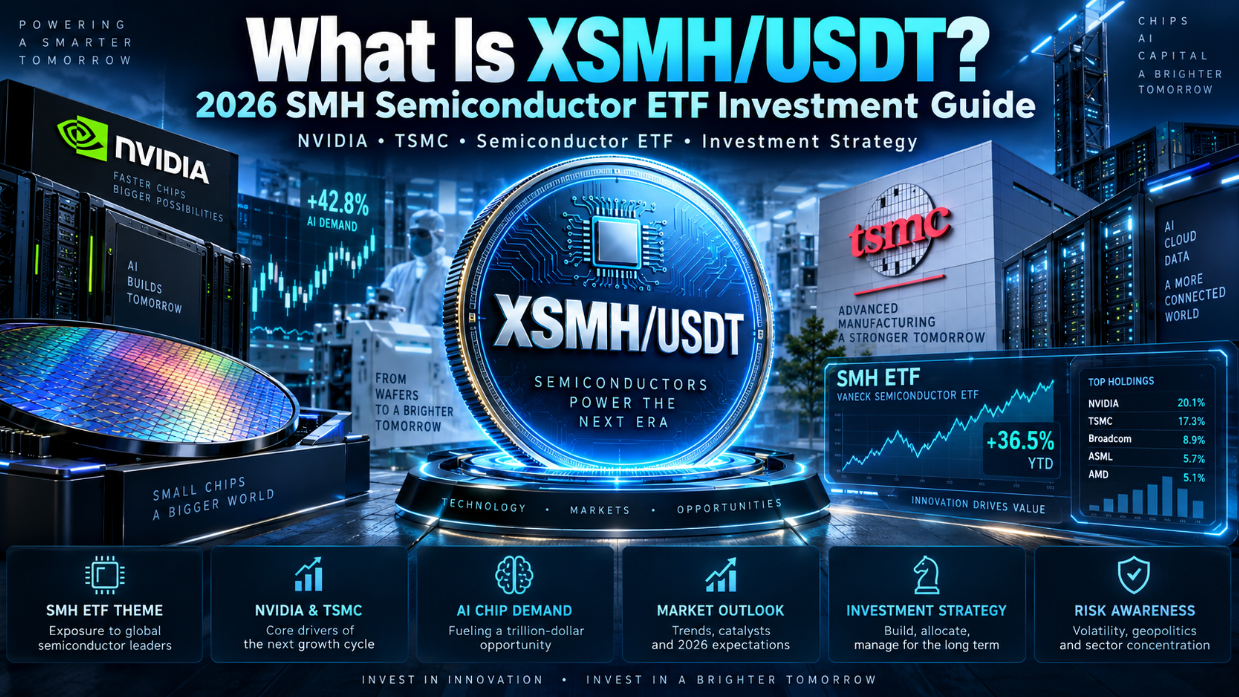
But SMH is not an equally weighted “25-company portfolio.” According to VanEck’s official data, as of September 15, 2026, NVIDIA’s weight was 22.52% and TSMC’s was 9.74%. As of September 16, the fund’s NAV was $545.48, its year-to-date return was 51.48%, and total net assets were about $66.84 billion. It does reduce the risk of betting on a single company, but it remains highly concentrated in AI semiconductor leaders.
Therefore, XSMH’s biggest opportunity is covering multiple profit pools in AI semiconductors with one asset. Its biggest risk is that, after a large rally in 2026, the market’s expectations for AI capex, NVIDIA growth, HBM tightness, and leading-edge process may already be very high.
Users can view XSMH’s real-time price and market data to observe traded prices, the order book, and volume. However, until HIBT officially discloses the issuer, network, contract address, and conversion ratio, you should not assume XSMH is exactly the same as the public SMHx product based only on the ticker.
Risk disclosure: The data in this article was verified as of September 17, 2026. It is for product mechanics, industry research, and risk education only and does not constitute investment advice, a return promise, or a trading recommendation. Dynamic holdings, valuations, prices, and product status should be re-verified before publication and trading.
Key Takeaways: 8 Things to Know Before Investing in XSMH
- XSMH’s underlying investment logic comes from the VanEck Semiconductor ETF (SMH), not an ordinary crypto project token.
- SMH is a plain-vanilla 1x ETF with no daily leverage or daily reset, so long-term results are not affected by the same path decay as leveraged ETFs.
- NVIDIA currently has a single-stock weight above 22%, so SMH has clear large-cap concentration risk.
- SMH does not only hold GPU companies; it also covers TSMC advanced manufacturing, Micron memory, ASML, and U.S. equipment makers, among other parts of the supply chain.
- AI capex, industry earnings revisions, and the semiconductor cycle are more important than BTC’s price moves in determining SMH’s medium- to long-term direction.
- SMH has already risen more than 50% in 2026, and the investment focus is shifting from “Is there AI demand?” to “Can earnings continue to beat high expectations?”
- SMHx is a tracker certificate issued by Backed and is not the same as directly owning SMH ETF shares in a traditional brokerage account.
- Trading XSMH also requires additional checks on issuance mapping, conversion ratio, liquidity, premium/discount, custody, and regional restrictions.
1. What Is XSMH/USDT? First, Separate the Four Layers of the Asset Structure
The most effective way to understand XSMH is not to start with the price chart, but to break it down from the bottom up into four layers.
1.1 Layer One: MVIS US Listed Semiconductor 25 Index
SMH’s reference benchmark is the MVIS US Listed Semiconductor 25 Index (MVSMHTR). The index mainly covers larger, more liquid semiconductor production and equipment companies listed in the United States.
The index determines which companies are selected, how weights are set, and when rebalancing occurs. It is not an equal-weight portfolio, so large leaders can have a more pronounced impact on the index.
1.2 Layer Two: VanEck Semiconductor ETF (SMH)
SMH is managed by VanEck and aims to track the price and yield performance of the index as closely as possible before fees. The fund was launched on December 20, 2011, and currently has a total expense ratio of 0.35%.
Traditional investors buy SMH shares through a brokerage account, gaining indirect exposure to a basket of semiconductor stocks.
1.3 Layer Three: VanEck Semiconductor ETF xStock (SMHx)
Backed’s official product page defines SMHx as a tracker certificate that can be transferred on certain blockchains and tracks the price of SMH. Its issuer is Backed Assets (JE) Limited, its product ISIN is CH1500008789, and the underlying SMH ISIN is US92189F6768.
The official page shows that SMHx supports Ethereum and EVM-compatible networks, as well as Solana. The product connects the ETF and crypto markets through traditional financial custody, brokerage, and an on-chain token structure.
1.4 Layer Four: HIBT’s XSMH/USDT Trading Pair
XSMH/USDT means XSMH is quoted in USDT. Its traded price can be affected by changes in SMH, as well as by platform order books, market making, trading hours, and USDT liquidity.
It is important to note that although XSMH and SMHx have highly related names, a formal article cannot directly state that they are the same product without support from HIBT announcements, asset details, or contract pages. Before publication, the platform should confirm:
- XSMH’s full product name;
- Whether the issuer is Backed Assets (JE) Limited;
- Whether the underlying is SMHx or a direct mapping to SMH;
- Supported networks and official contract addresses;
- How much SMH or SMHx one XSMH corresponds to;
- How minting, redemption, dividends, and corporate actions are handled.
Until this information is confirmed, this article describes XSMH as “an on-chain or platform-traded asset related to SMH,” rather than writing an unverified mapping as established fact.
2. Is XSMH a “Semiconductor Coin”? Why You Cannot Analyze It With an Altcoin Framework
XSMH may exist as a token and trade against USDT, but that does not make it a traditional crypto-native project.
It has no independent blockchain, mining, governance, token unlocks, protocol revenue, or tokenomics dependent on community expansion. Its main source of value should be the SMH ETF, and SMH is in turn determined by its semiconductor constituents.
Therefore, analyzing XSMH should not prioritize:
- Circulating market cap and FDV;
- Token unlocks;
- TVL;
- Staking APY;
- Community meme hype.
It should focus more on:
- Earnings of constituents such as NVIDIA and TSMC;
- AI capex;
- HBM and DRAM cycles;
- Leading-edge process and packaging demand;
- Semiconductor equipment orders;
- Industry valuation;
- XSMH’s premium or discount to SMH.
Quoting in USDT only changes the trading entry point; it does not change the underlying source of value.
3. Does Buying XSMH Mean Directly Owning the SMH ETF?
If HIBT ultimately confirms that XSMH corresponds to Backed’s SMHx, then users receive indirect price exposure to SMH, not SMH shares in a traditional brokerage account.
Kraken’s explanation of SMHx notes that xStocks are backed by traditional assets held by third-party custodians, but holders do not obtain ownership of the underlying ETF shares and do not automatically have the voting, information, and other rights of traditional shareholders or fund unit holders.
The main differences can be understood through five questions.
3.1 Who Is the Direct Holder?
When buying SMH, investors hold ETF shares through the securities system. When buying SMHx, investors hold a tracker certificate token issued by a third party, with the underlying securities held and custodied by the relevant structure.
3.2 What Rights Do Users Get?
SMHx’s core feature is price exposure. It should not be described as users directly becoming registered holders of SMH. Legal rights should be based on the Base Prospectus, Final Terms, and applicable regional documents.
3.3 Can It Be Transferred On-Chain?
Traditional SMH settles within the securities account system. SMHx can be transferred across supported chains and platforms, but this adds wallet, network, smart contract, and cross-platform operational risks.
3.4 Can It Be Redeemed?
Eligible investors may be able to redeem through the issuance structure, but they need to meet compliance, size, fee, and regional requirements. Ordinary trading users on a platform should not assume they can redeem one XSMH for one U.S. SMH ETF share at any time.
3.5 Do They Have the Same Investor Protection?
Not necessarily. The regulatory structure, compensation schemes, bankruptcy remoteness, and investor remedies for tokenized securities may differ from those of traditional brokerage accounts and may vary by jurisdiction.
So “1:1 backing” mainly describes the collateral and price-tracking mechanism. It does not mean legal rights, liquidity, and risk are completely identical.
4. What ETF Is SMH and Why Has It Become an Important AI Chip Trading Tool?
SMH has a very clear positioning: concentrated investment in semiconductor production and equipment companies. Compared with broad technology ETFs that cover software, e-commerce, advertising, consumer electronics, and cloud platforms, SMH concentrates most of its risk and return in the semiconductor supply chain.
VanEck discloses that, as of August 31, 2026, about 99.94% of SMH’s assets were in the information technology sector. In terms of country and regional exposure, the United States was about 82.32%, Taiwan about 9.54%, and the Netherlands about 6.15%, with smaller exposures to Switzerland and the United Kingdom.
Therefore, a more accurate description of SMH is:
A highly concentrated semiconductor sector ETF listed in the United States that holds key global companies.
It can benefit simultaneously from demand for GPUs, custom ASICs, HBM, leading-edge process, and wafer equipment, but it also bears industry cycle, valuation compression, supply chain, and geopolitical risks.
5. SMH Does Not Buy 25 Stocks Equally: Why Does NVIDIA Account for More Than 22%?
As of September 15, 2026, SMH had 26 holdings, including cash. The main stock weights were:
- NVIDIA: 22.52%;
- TSMC: 9.74%;
- AMD: 5.93%;
- Broadcom: 5.73%;
- Micron: 5.53%;
- ASML: 4.88%;
- Qualcomm: 4.61%;
- Texas Instruments: 4.47%;
- Analog Devices: 4.40%;
- Intel: 4.34%;
- Marvell: 4.20%;
- Applied Materials: 4.06%;
- Lam Research: 4.03%;
- KLA: 3.76%.
Cadence, Synopsys, Arm, Astera Labs, and other companies are also in the portfolio, but with relatively smaller weights.
SMH’s index methodology tends to favor larger, more liquid companies in the industry, so after NVIDIA’s market cap grew rapidly during the AI wave, its weight also rose significantly.
This leads to an important conclusion:
SMH achieves company-level diversification, but not equal diversification, and certainly not sector-level diversification.
If NVIDIA alone fell 20%, under the idealized assumption that all other holdings were unchanged, its 22.52% weight could drag the ETF down by about 4.5 percentage points. Actual results would also depend on correlated moves in other constituents and index rebalancing.
6. How Does SMH Cover the Full AI Semiconductor Value Chain?
SMH’s real advantage is not just holding many stocks, but covering multiple bottlenecks in AI chips from design to manufacturing.
Its value chain transmission can be summarized as:
Cloud providers and AI companies increase capex
→ Demand for GPUs and custom ASICs grows
→ Demand for HBM, advanced packaging, and high-speed networking rises
→ Wafer foundries expand leading-edge capacity
→ Demand for equipment, EDA, and materials increases
→ Different SMH constituents gain revenue and profit opportunities
6.1 Chip Design
NVIDIA, AMD, Broadcom, Qualcomm, and Marvell represent areas such as GPUs, CPUs, networking, custom ASICs, and edge computing.
6.2 Wafer Manufacturing
TSMC and Intel represent leading-edge process and manufacturing capability. Even if market share shifts among different chip design companies, advanced chips still require foundry and packaging capacity.
6.3 Memory
Micron gives SMH exposure to HBM, DRAM, and NAND cycles. AI servers increase demand for high-bandwidth memory, but memory remains a highly cyclical industry.
6.4 Semiconductor Equipment
ASML, Applied Materials, Lam Research, and KLA cover key areas such as lithography, deposition, etching, metrology, and inspection.
6.5 EDA and Design Tools
Cadence and Synopsys provide chip design, verification, and IP tools. As chip complexity increases, design software and verification generally become more important.
SMH therefore does not require investors to correctly pick the single winner. As long as value remains within the broader semiconductor supply chain, weakness in some constituents may be offset by other parts of the chain.
7. Why Is TSMC SMH’s Second-Most Important Asset?
TSMC has a weight of about 9.74% and is SMH’s second-largest holding. What it represents is not a single end brand, but the manufacturing bottleneck for AI chips.
Even if NVIDIA, AMD, and large cloud providers’ custom ASICs compete on architecture and customers, many leading-edge chips still depend on TSMC’s process and packaging capabilities. This means that changes in winners within the AI compute market do not necessarily directly break the SMH thesis; some value may shift from chip design to manufacturing.
But the manufacturing bottleneck is also a point of concentrated risk. Investors need to watch:
- Leading-edge utilization;
- HPC revenue growth;
- Advanced packaging capacity such as CoWoS;
- Customer concentration;
- Capex and depreciation;
- Taiwan supply chain and geopolitical risks.
If leading-edge demand weakens or customers delay products, TSMC not only affects its own weight but may also become a signal of slowing AI chip demand across the board.
8. Why Does Micron Give SMH Exposure to Both the HBM Opportunity and the Memory Cycle?
Micron accounts for about 5.53% of SMH. HBM is used for high-speed connection between GPUs and data. As AI training and inference scale, this benefits higher-end memory capacity, bandwidth, and value per server.
But “HBM growth” should not be inferred as “the memory cycle has disappeared.” The memory industry is still affected by capacity, inventory, yield, average selling prices, and capex.
A typical upcycle is:
Demand grows, inventory falls, prices recover, gross margins expand, and companies increase capex.
It may then evolve into:
Supply increases, inventories rebuild, prices fall, margins compress, and capex is cut.
When Micron is at an earnings peak, its P/E ratio may look very low, but this may be the “Peak Earnings Illusion”: the denominator is at a cyclical peak, which does not mean the stock is truly cheap.
Therefore, researching SMH cannot rely only on a static forward P/E. It also requires judging whether memory earnings can persist.
9. Why Do Equipment Companies Give SMH a “Picks and Shovels” Quality?
ASML, Applied Materials, Lam Research, and KLA together account for a significant weight in SMH. Whether capacity expansion is ultimately driven by GPUs, custom ASICs, HBM, or automotive chips, wafer fabs need to buy lithography, deposition, etching, and inspection equipment.
Equipment companies can help SMH capture value from industry capacity expansion, but equipment is not cycle-proof either. Wafer fab capex is often lumpy:
- When orders are strong, revenue and backlog grow rapidly;
- When customers worry about oversupply, equipment deliveries may be delayed;
- Export controls may limit some markets;
- Delays in new capacity construction can affect revenue recognition.
So “picks and shovels” is a relatively diversified demand logic, not a guarantee of immunity to downturns.
10. Why Do AMD, Broadcom, and Marvell Represent a Second AI Growth Curve?
AI compute is not limited to the NVIDIA GPU route.
AMD represents competition in general-purpose AI accelerators; Broadcom and Marvell are linked to custom ASICs, high-speed networking, and hyperscaler in-house chips. As cloud providers try to lower computing costs, custom chip share may rise.
This has a two-sided impact on SMH:
- If custom ASICs erode NVIDIA’s share, NVIDIA may come under pressure;
- But value may shift to Broadcom, Marvell, TSMC, and equipment companies.
For investors making a single-stock bet on NVIDIA, an intra-supply-chain shift is a risk. For SMH, as long as profits remain within the portfolio’s coverage, value migration may be partially absorbed by other constituents.
11. Why Has SMH Risen More Than 50% in 2026?
As of September 16, 2026, VanEck disclosed that SMH’s year-to-date return was 51.48%. It is not enough to simply attribute this rally to “AI being hot.”
There are at least seven interrelated drivers:
- Growth in AI accelerator shipments;
- Tight HBM supply and product mix upgrades;
- Cloud providers increasing custom ASIC investment;
- Growing demand for TSMC leading-edge process and packaging;
- Wafer equipment orders benefiting from capacity expansion;
- Analysts continuing to raise industry earnings estimates;
- The market willing to pay a higher valuation for AI growth.
The first six are more about earnings fundamentals; the seventh is valuation expansion. The two have completely different implications for future returns.
If the rally mainly came from real EPS growth, subsequent valuation pressure is relatively manageable. If prices rose much faster than earnings, future returns will require stronger earnings beats to be sustained.
12. Can You Still Buy After a 50% Rally? First Break Down Earnings and Valuation
Long-term price changes in a stock or ETF can be understood through a simplified framework:
Price return ≈ earnings growth + change in valuation multiple + distributions
Suppose industry earnings grow 25% in the future, but the market valuation multiple falls from 40x to 30x. A 25% valuation contraction could offset most of the earnings growth. A good industry does not mean any price is worth paying.
As of September 17, 2026, Kraken’s SMHx reference page showed a related P/E of about 41.17x. Different platforms may use trailing 12-month, forward earnings, or different calculation methodologies, so this number is only a valuation snapshot and cannot be used directly for a buy/sell conclusion.
Investors should compare:
- SMH’s current valuation versus its historical range;
- The index’s forward 12-month EPS growth;
- The stage of the earnings cycle for NVIDIA, TSMC, and Micron;
- The impact of interest rate changes on high-valuation tech stocks;
- How much AI capex is already priced in;
- Whether actual results can continue to exceed consensus estimates.
After 2026, SMH’s biggest risk may no longer be that “AI has no demand,” but that “AI grows, but not faster than the market expects.”
13. Why Is AI Capex One of SMH’s Most Important Demand Indicators?
Capex from Microsoft, Amazon, Meta, Google, Oracle, and AI cloud service providers determines the pace of GPU, server, networking, storage, and data center buildouts.
The transmission chain is usually:
Hyperscaler CapEx
→ GPU and custom ASIC orders
→ HBM and high-speed networking demand
→ TSMC leading-edge process and packaging
→ Equipment and EDA demand
→ SMH constituent revenue and profit
But judging capex requires comparing actual data with expectations. If the market expects CapEx to grow 50%, actual growth of 35% may still be viewed as negative. If the market expects zero growth, actual growth of 15% may instead drive the stock higher.
The backlog, GPU deployments, financing, and data center investment of AI cloud companies such as CoreWeave can serve as a demand-side observation window. Investors can combine What Is XCRWV/USDT and the AI Cloud Compute Logic to judge whether AI infrastructure expansion is converting into sustainable revenue or is overly reliant on financing and future demand.
14. Why Can Optical Interconnect Validate Whether AI Demand Is Broad Enough?
Large-scale AI clusters need not only GPUs but also 800G and 1.6T optical modules and high-speed network connections. If compute, memory, and optical interconnect orders grow together, the AI infrastructure boom is more likely to have cross-component validation.
Upstream optical communications such as InP, where AXT operates, can provide another lens. Through What Is AXTION/USDT and the AI Optical Interconnect Demand Analysis, investors can further check whether optical communications orders, revenue, and guidance are consistent with the strength in GPUs and HBM.
Conversely, if GPU demand remains strong but networking, optical modules, or memory weaken noticeably, investors need to judge whether this is a supply chain timing difference or the beginning of a broader cooldown in AI capex.
15. Is SMH Safer Than Buying NVIDIA Alone?
The answer is that it diversifies some company-specific risk, but it does not become a low-risk asset.
SMH’s advantages include:
- Reducing management and product execution risk from any single company;
- Covering value migration within the supply chain;
- Participating in design, manufacturing, memory, and equipment at the same time;
- Automatically rebalancing according to index rules.
But it still has:
- Almost complete concentration in the semiconductor industry;
- A single-stock weight in NVIDIA above 22%;
- Heavy dependence on AI capex;
- Shared exposure to valuation and interest rate changes;
- Shared exposure to global supply chain and geopolitical risks.
In one sentence:
Company diversification does not equal sector diversification.
If the entire semiconductor industry enters an earnings downgrade cycle, many companies in SMH may fall at the same time.
16. How Does SMH Differ From a Plain Nasdaq 100 ETF?
Nasdaq 100-type ETFs include multiple business models such as software, internet advertising, e-commerce, consumer technology, cloud platforms, and semiconductors. SMH is almost entirely exposed to the semiconductor industry.
This means SMH usually has higher sector beta:
- When AI chips are booming, returns may be more concentrated;
- When semiconductor inventory or valuations reverse, drawdowns may also be more concentrated;
- It lacks buffers from software, consumer, and healthcare sectors;
- It is more sensitive to wafer capacity, equipment, and supply chain events.
Therefore, SMH is suitable as a targeted sector allocation tool, not as a natural replacement for a core broad-market allocation.
17. Does SMH’s 0.35% Fee Matter?
SMH currently has a total expense ratio of 0.35%. All else equal, holding $10,000 for one year corresponds to about $35 in fund-level fees. The actual fee is reflected in the fund’s NAV and is not charged as a separate bill.
Compared with daily 2x or 3x ETFs, SMH does not have the same financing and daily reset structures required to maintain leverage. For long-term investors, 0.35% is a cost to consider, but it is usually not the biggest risk.
The more important variables are:
- Whether semiconductor earnings can persist;
- Whether industry valuation is too high;
- NVIDIA concentration;
- Whether AI capex is slowing;
- Whether the memory and equipment cycles are reversing.
A sector whose valuation compresses by 20% does not become safe just because its expense ratio is only 0.35%.
18. What Additional Costs Does XSMH Have Versus SMH?
If XSMH ultimately confirms that it corresponds to SMHx, Backed’s current page shows that the underlying fund’s 0.35% annual cost is already reflected in the product; the tracker currently does not charge an additional management fee, but may introduce an annual fee of up to 0.25% in the future; issuance and redemption fees may be up to 0.50% of investment value.
The actual costs for ordinary HIBT users may also include:
- Trading fees;
- Bid-ask spread;
- Market order slippage;
- USDT funding cost;
- On-chain deposit and withdrawal fees;
- XSMH premium to reference value;
- Redemption or cross-platform transfer fees.
Therefore, the all-in cost can be written as:
[ \text{Total cost} \approx \text{underlying ETF fees} + \text{token fees} + \text{trading fees} + \text{spread} + \text{slippage} + \text{premium/discount changes} ]
For short-term traders, spreads and slippage can be far higher than the 0.35% annual fee.
19. Why Can XSMH’s Price Temporarily Differ From SMH?
19.1 Different Trading Hours
U.S. SMH mainly completes price discovery during securities trading hours. A tokenized market may provide 24/5 or longer transfer and trading windows. When the U.S. equities market is closed, XSMH may form an expectation-based price based on news and the order book.
19.2 Different Liquidity
SMH has a large traditional market size, but that does not mean the XSMH/USDT pair on HIBT has the same depth. Relatively small orders in a token market can cause significant volatility.
19.3 Minting and Redemption Constraints
Price deviations are easily corrected only when arbitrageurs can efficiently subscribe, redeem, or trade across markets. Market closures, regional restrictions, compliance reviews, or network issues can all hinder arbitrage.
19.4 Conversion Ratio and Dividend Treatment
Whether one XSMH strictly corresponds to one SMH share, how dividends are reflected, and when fees are deducted all need to be based on the issuance terms.
A simplified formula can be used to monitor the premium/discount:
Premium = (XSMH price - XSMH theoretical reference value) / XSMH theoretical reference value × 100%
The theoretical reference value must be calculated based on the actual conversion ratio. You cannot directly assume that the XSMH price should equal SMH.
20. Is XSMH Suitable for Long-Term Holding? Why It Differs From Leveraged Products Such as XSOXS
SMH is a plain-vanilla 1x ETF. It does not have daily 2x or 3x reset, and it does not produce the same kind of long-term multiple deviation from daily compounding as leveraged products.
If semiconductor companies grow earnings over the long term, SMH’s long-term value logic can be compatible with industry growth. This is clearly different from daily inverse or leveraged ETFs.
But “no daily reset” does not mean it is suitable for everyone to hold long term. Long-term risks still include:
- Industry valuation being too high;
- AI capex declining;
- Technology roadmap changes;
- Inventory and capacity cycles;
- Export controls;
- Taiwan Strait and global supply chain risks;
- XSMH issuance and custody structure risks.
What long-term investors really need to believe is not that “AI will rise forever,” but that semiconductor earnings growth over many years can support current valuations.
21. When Is It Appropriate to Scale In Rather Than Buy All at Once?
After a large rally, price discovery becomes more sensitive to earnings reports and changes in expectations. The value of scaling in is that it separates the directional call from entry timing.
21.1 Earnings Estimates Rising, Valuation Reasonable
If index EPS continues to be revised upward while valuation is not significantly detached from historical and growth levels, fundamentals and price are relatively aligned.
21.2 Earnings Estimates Rising, Valuation Expanding Rapidly
The company’s operations may still be excellent, but future returns depend more on continued beats. At this point, it is more important to control initial position size and avoid equating good fundamentals with a good price.
21.3 Price Pulls Back, Earnings Expectations Stable
If price falls because of interest rates, technical selling, or a short-term sentiment pullback, while revenue and EPS expectations have not clearly declined, the pullback may mainly be a valuation correction.
21.4 Price and Earnings Expectations Fall Together
This situation cannot be considered cheap just because “it has fallen 20%.” The price decline may be reflecting deteriorating fundamentals.
The scaling-in allocation should be based on personal risk budget, not a mechanical copy of 25% × 4. Each time you add to the position, you should re-check earnings, valuation, and the XSMH premium/discount.
22. What Kind of Pullback May Be an Opportunity, and What Kind Is a Warning?
22.1 Valuation Pullback
This shows up as falling prices while AI capex, orders, revenue, margins, and EPS estimates remain stable or are revised upward. Such a pullback may improve the risk/reward, but investors still need to judge whether valuation is truly reasonable.
22.2 Fundamental Pullback
This shows up as falling prices together with:
- Hyperscalers cutting capex;
- NVIDIA, AMD, or Broadcom orders weakening;
- HBM prices falling;
- TSMC leading-edge utilization weakening;
- Equipment orders and backlog declining;
- Industry EPS being repeatedly revised down.
In this case, a lower price may simply be part of an earnings downgrade process.
23. When Should You Admit the SMH Bull Thesis Is Broken?
Being long-term bullish on AI cannot be a universal explanation for every decline. The following signals may indicate that the original thesis needs to be reassessed:
- Large cloud providers repeatedly cut AI capex;
- NVIDIA, AMD, and Broadcom earnings estimates turn into a sustained downgrade cycle;
- HBM and DRAM prices enter a clear downtrend;
- TSMC HPC growth and leading-edge utilization slow markedly;
- Applied Materials, Lam Research, or KLA orders weaken;
- Wafer fabs delay expansion plans;
- Semiconductor inventory rises for several consecutive quarters;
- Industry revenue grows but gross margins keep falling;
- Valuation remains high while EPS stops growing;
- XSMH shows a persistent discount that arbitrage cannot fix or declining liquidity.
Invalidation conditions should be defined before buying, not temporarily revised after prices fall.
24. XSMH Price Forecast: Use Bull, Base, and Bear Scenarios Instead of a Single Target Price
Forecasting XSMH requires at least five steps: forecast earnings of major constituents, estimate industry EPS, determine a reasonable valuation range, derive SMH scenarios, and then add XSMH’s conversion ratio, fees, and premium/discount.
View the XSMH price forecast can be used as market data and model reference, but it cannot replace underlying earnings research.
24.1 Bull Case
The optimistic scenario requires:
- AI capex continues to grow rapidly;
- GPU and custom ASIC demand exceeds expectations;
- HBM remains tight;
- TSMC leading-edge and packaging utilization remains high;
- Equipment orders continue to grow;
- Industry EPS continues to be revised upward;
- Valuation does not become further detached from earnings;
- XSMH maintains ample liquidity and a small premium/discount.
In this case, SMH may continue to benefit from supply chain growth, but the pace of gains may not repeat the first nine months of 2026.
24.2 Base Case
The neutral scenario may be that AI demand continues to grow, but growth begins to normalize; industry revenue and EPS keep growing at a double-digit rate, and valuation no longer expands.
In this case, SMH returns depend more on real earnings rather than the market continuing to raise valuation multiples.
24.3 Bear Case
The pessimistic scenario includes:
- AI capex slows markedly;
- GPU and custom ASIC orders fall short of expectations;
- The memory cycle turns;
- Wafer utilization declines;
- Equipment capex is revised down;
- High valuations experience multiple compression;
- Geopolitics or export restrictions hit the supply chain;
- XSMH liquidity declines and a discount appears.
In this case, even if AI still has long-term growth, SMH may experience a significant drawdown.
25. Why Can’t XSMH Forecasts Focus Only on NVIDIA?
NVIDIA is the largest weight and must be tracked closely, but the remaining roughly 77% of the portfolio still contains different profit pools.
At least the following should be forecast separately:
25.1 AI Accelerators
Watch NVIDIA and AMD shipments, product cycles, gross margins, and competition.
25.2 Custom ASIC and Networking
Watch Broadcom, Marvell, and cloud providers’ in-house chips.
25.3 Memory
Watch HBM, DRAM, and NAND prices and Micron earnings.
25.4 Wafer Manufacturing
Watch TSMC leading-edge process, packaging, and customer orders.
25.5 Semiconductor Equipment
Watch ASML, Applied Materials, Lam Research, and KLA orders.
If NVIDIA’s growth slows but custom ASICs, TSMC, and equipment demand strengthen, SMH may be more resilient than NVIDIA stock alone. If all segments are revised down at the same time, ETF diversification may struggle to offset sector risk.
26. Why Can BTC and ETH Still Affect XSMH Trading?
SMH’s medium- to long-term value is determined by semiconductor earnings and valuation. A BTC rally does not directly increase NVIDIA’s data center revenue, nor does it raise TSMC’s wafer utilization.
But XSMH trades in the crypto market. BTC price forecast and market cycles can help judge USDT liquidity, platform trading activity, and overall risk appetite. BTC is a trading environment variable for XSMH, not a fundamental variable for SMH.
The link between ETH and XSMH comes more from RWA and settlement infrastructure. ETH price forecast and the Ethereum ecosystem helps observe the environment for on-chain assets, stablecoins, and tokenized securities, but ETH’s price itself does not determine semiconductor orders.
When analyzing, always separate:
- Semiconductor companies determine long-term value;
- The U.S. equity market drives primary price discovery;
- Crypto liquidity affects execution quality and short-term deviations on the token side.
27. HIBT XSMH Nine-Factor Investment Framework
Rather than simply scoring XSMH, it is better to judge whether current risk comes from growth, valuation, or the wrapper.
Factor 1: AI CapEx
Are hyperscalers’ actual investments still growing?
Factor 2: AI Accelerator Demand
Are NVIDIA and AMD revenue, orders, and product cycles holding up?
Factor 3: Foundry
Is demand for TSMC leading-edge process and packaging strong?
Factor 4: Memory
Can HBM demand offset traditional DRAM and NAND cycles?
Factor 5: Equipment Orders
Does wafer fab expansion still support ASML, AMAT, LRCX, and KLA?
Factor 6: Earnings Revisions
Are industry EPS estimates being revised up or down?
Factor 7: Concentration
Is NVIDIA’s weight still rising, and is single-company risk too high?
Factor 8: Valuation
How much future growth is already priced in?
Factor 9: XSMH Wrapper
Can the issuer, collateral, custody, contract, liquidity, and premium/discount be verified?
When growth is strong, valuation is reasonable, and the wrapper is transparent, the investment thesis is relatively complete. If any layer is distorted, actual risk can rise significantly.
28. The 14 Biggest Risks of XSMH
1. Sector Concentration Risk
SMH is almost entirely concentrated in information technology and the semiconductor industry, lacking cross-sector buffers.
2. NVIDIA Concentration Risk
A single weight above 22% means one company can significantly affect ETF performance.
3. AI Capex Risk
Cloud providers cutting or delaying investment can transmit through the supply chain.
4. Valuation Risk
After a large 2026 rally, high expectations increase drawdown risk if results disappoint.
5. Memory Cycle Risk
HBM growth cannot completely eliminate DRAM and NAND supply-demand cycles.
6. Foundry Risk
Leading-edge utilization, yield, and customer orders affect manufacturing-side earnings.
7. Equipment Cycle Risk
Wafer fabs cutting capex can cause equipment orders and revenue to decline.
8. Geopolitical Risk
Taiwan supply chains, U.S. export restrictions, and global trade policy can all affect valuations.
9. China Market Risk
Some constituents have exposure to China revenue, supply chains, or equipment sales.
10. Inventory Risk
The semiconductor industry has historically had clear inventory cycles, and demand misjudgments can cause destocking.
11. ETF Concentration Methodology Risk
Holding about 25 companies does not equal high diversification. The weighting methodology concentrates toward large-cap leaders.
12. Issuance and Custody Risk
A tokenized wrapper adds issuer, custodian, broker, and legal structure risks.
13. Liquidity Risk
HIBT’s XSMH order book may be far smaller than the U.S. SMH market, and large trades may incur slippage.
14. Premium/Discount and Regulatory Risk
Token prices may deviate from the reference asset; investor eligibility, regional restrictions, and regulatory rules may also change.
29. How to Buy XSMH? Complete Seven Checks Before Trading
If HIBT has made XSMH/USDT available in your region, the usual process is to log in, prepare USDT, search for the pair, choose an order type, and execute.
But tokenized ETFs should not be traded by following an ordinary crypto tutorial alone.
Step 1: Verify the Asset Identity
Confirm XSMH’s full name, issuer, network, and contract to avoid buying a same-name asset.
Step 2: Confirm the Conversion Ratio
Check how much SMH or SMHx one XSMH corresponds to. Do not automatically assume 1:1.
Step 3: Check the U.S. SMH Price and NAV
Observe the underlying ETF market price, NAV, and same-day index performance.
Step 4: Calculate the Premium/Discount
Use the correct conversion ratio to calculate the theoretical reference value. If XSMH is clearly at a premium, premium compression can still cause losses even if your SMH directional call is correct.
Step 5: Check the Order Book
Observe the bid-ask spread, depth at different levels, and estimated slippage. High underlying ETF liquidity does not mean the token pair has the same depth.
Step 6: Prefer Limit Orders
Limit orders do not guarantee execution, but they can cap the worst execution price. When a pair is newly listed or depth is thin, avoid blindly using large market orders.
Step 7: Set a Risk Budget
An ETF wrapper does not mean low risk. Set position size based on how much loss you can tolerate, and reassess after earnings, valuation, or wrapper conditions change.
30. Final 15 Metrics to Check Before Investing in XSMH
Before placing an order, check at least:
- SMH market price and NAV;
- XSMH traded price;
- XSMH-to-SMH conversion ratio;
- XSMH premium or discount;
- HIBT order book depth;
- NVIDIA’s latest weight;
- TSMC’s latest weight;
- Micron and memory exposure;
- SMH year-to-date gain;
- Hyperscaler AI capex;
- NVIDIA data center revenue and gross margin;
- TSMC HPC growth and utilization;
- HBM prices, inventory, and supply;
- Semiconductor industry EPS revisions and valuation;
- XSMH issuer, network, contract, and redemption status.
The most important items to track continuously are:
AI capex, industry earnings revisions, NVIDIA concentration, valuation, and the XSMH premium/discount.
Price should be the output of research, not the starting point.
31. FAQ: Most Common Questions About XSMH and SMH
What is XSMH?
XSMH is an asset that provides exposure to the price of the SMH semiconductor ETF within a crypto trading environment. Its specific issuance mapping, network, and contract should be based on official HIBT information.
What does XSMH/USDT mean?
It is the trading pair for buying and selling XSMH with USDT. USDT is the quote and settlement asset, not XSMH’s underlying asset.
What is SMHx?
SMHx is the VanEck Semiconductor ETF xStock issued by Backed Assets (JE) Limited, a tracker certificate that tracks the price of SMH.
Are XSMH and SMHx necessarily the same asset?
A similar ticker alone is not enough to conclude. You need to verify HIBT’s asset details, issuer, network, contract, and conversion ratio.
What ETF is SMH?
SMH is a semiconductor sector ETF managed by VanEck that aims to track the MVIS US Listed Semiconductor 25 Index.
Is XSMH a real ETF?
If it corresponds to SMHx, users hold a tokenized tracker certificate that tracks the ETF, not SMH shares directly registered in a traditional brokerage account.
Is SMHx backed by real SMH ETF holdings?
Public materials from Backed and Kraken state that SMHx is backed by custodied underlying assets. But investors still need to understand issuer, custody, redemption, and legal structure risks.
Does buying XSMH equal buying NVIDIA?
No. NVIDIA has the largest weight, but SMH also holds TSMC, AMD, Broadcom, Micron, ASML, and equipment companies.
How much of SMH is NVIDIA?
As of September 15, 2026, VanEck disclosed NVIDIA’s weight at 22.52%. Holdings change, so verify again before trading.
How much of SMH is TSMC?
As of the same date, TSMC’s weight was 9.74%, the second-largest holding.
Is SMH diversified or concentrated?
It achieves some diversification across semiconductor companies, but the sector is highly concentrated and NVIDIA’s weight exceeds 22%. A more accurate description is company-diversified, sector-concentrated, and leader-heavy.
Is SMH an AI ETF?
SMH is not a thematic ETF that invests only in AI, but its main holdings cover GPUs, HBM, advanced manufacturing, networking, and equipment, making it highly sensitive to AI capex.
Does SMH use leverage?
No. SMH is a plain 1x ETF with no daily 2x or 3x reset.
Why has SMH risen so much in 2026?
It has been driven by a combination of AI accelerators, HBM, custom ASICs, leading-edge process, equipment demand, earnings upgrades, and valuation expansion, not a single news event.
Is SMH suitable for long-term holding?
Its 1x structure is compatible with long-term sector allocation, but suitability still depends on AI demand, the semiconductor cycle, valuation, concentration, and personal risk tolerance.
Is SMH suitable for dollar-cost averaging?
DCA can diversify entry timing, but it cannot eliminate sector concentration and high-valuation risk. Before each contribution, still check earnings and valuation.
Is SMH better than buying NVIDIA alone?
Those bullish on NVIDIA and willing to take single-company risk may prefer the single stock; those who want exposure to design, manufacturing, memory, and equipment may be better served by researching SMH. There is no one-size-fits-all answer.
What should XSMH price forecasts focus on?
Focus on industry EPS, AI capex, NVIDIA and TSMC fundamentals, memory and equipment cycles, SMH valuation, and XSMH’s premium/discount to its reference value.
32. Conclusion: Is XSMH Worth Buying? The Real Question Is How Much of the AI Future Is Already Priced In
SMH is one of the more direct ETFs for gaining exposure to the global AI semiconductor supply chain. It holds not only design companies such as NVIDIA, AMD, and Broadcom, but also manufacturing, memory, and equipment leaders such as TSMC, Micron, ASML, Applied Materials, Lam Research, and KLA.
As of mid-September 2026, SMH’s assets had surpassed $66 billion and it was up more than 50% year-to-date; NVIDIA’s single-stock weight reached 22.52%, while TSMC was about 9.74%. This shows two facts at the same time:
First, SMH can provide exposure to multiple key parts of the semiconductor supply chain through a single ETF; second, it is not an equally diversified, low-volatility portfolio, and NVIDIA plus a few large AI semiconductor companies still determine a significant portion of the outcome.
Therefore, to judge whether XSMH is worth investing in, you cannot only ask whether AI is the future; you must also answer:
- How much longer can AI capex exceed expectations?
- Can major constituents’ earnings continue to be revised upward?
- Of the 2026 gain, how much came from EPS growth and how much from valuation expansion?
- Are HBM, leading-edge process, and equipment demand being validated at the same time?
- Does NVIDIA’s weight of more than 22% fit your risk tolerance?
- Are XSMH’s issuance mapping, conversion ratio, liquidity, and premium/discount transparent?
Compared with a single chip stock, XSMH’s advantage is that it can cover value migration within the supply chain; compared with a broad index, its cost is higher sector concentration and cyclical risk; compared with buying SMH directly, it adds issuer, custody, contract, liquidity, and regulatory risks.
The core investment judgment of this article can be summed up in one sentence:
XSMH is not simply a bet that AI will continue to develop; it is a judgment, after the market has already priced in AI growth heavily, about whether the entire semiconductor supply chain’s future earnings growth can continue to beat expectations.
If earnings estimates are rising, valuation is reasonable, supply chain demand is mutually validated, and the token price is close to a verifiable reference value, the investment thesis is relatively complete. If earnings start to be revised down, valuation remains high, or XSMH has a clear premium and opaque structure, waiting is often more valuable than chasing.