
AXTION/USDT is the AXT Tokenized Stock (Ondo) trading pair listed on HIBT, with underlying reference to Nasdaq-listed AXT, Inc. (ticker: AXTI). It is not a cryptocurrency issued by AXT itself, nor is it a crypto project priced by tokenomics, staking, or community narrative.
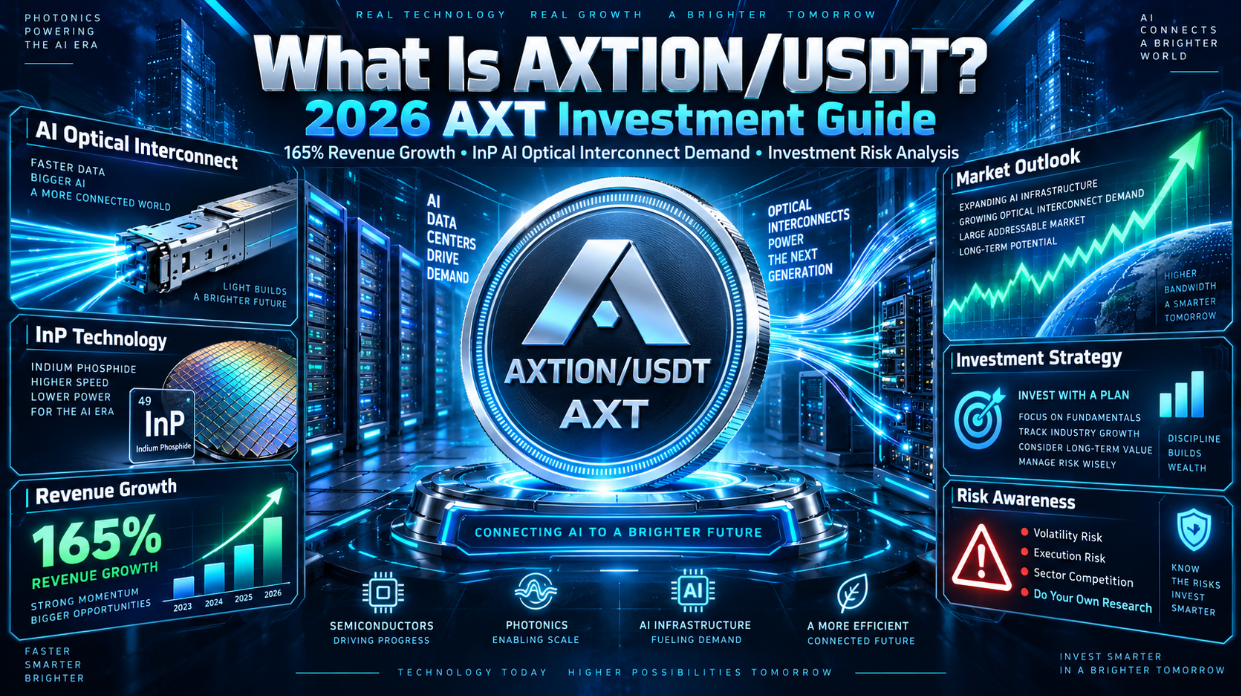
The real reason AXT is drawing market attention is that its indium phosphide (InP) wafer substrates sit upstream of high-speed optical interconnect in AI data centers. In the second quarter of 2026, the company generated $47.6 million in revenue, up 164.8% year over year; GAAP gross margin rose from 8.0% a year earlier to 44.9%; and the company swung from a $7 million net loss to $11.1 million in net income. Lumentum, Coherent, and Casela have also locked up InP capacity through long-term agreements and prepayments, turning “AI optical communications demand” from a concept into orders and customer cash commitments.
But that does not mean the risks have disappeared. Revenue growth was also driven by an increase in Chinese export licenses, and all of the company’s wafer substrate manufacturing is concentrated in China. In April 2026, AXT also raised $632.5 million by issuing about 9.84 million shares, materially expanding its share count. What investors really need to judge is whether InP demand, capacity, and profit growth can continue to outrun export restrictions, expansion risk, valuation pressure, and per-share dilution.
Investors can check the token price and trading depth through AXTION live quotes, but before trading they should also compare the same-time price of Nasdaq AXTI to avoid paying a clear premium when HIBT liquidity is thin.
Risk notice: The data in this article is updated as of September 16, 2026, and is intended only for information organization and investment research. It does not constitute investment advice, a return promise, or a trading recommendation. AXTION simultaneously carries AXTI stock risk, Ondo issuance structure risk, Ethereum smart contract risk, platform liquidity risk, and regional regulatory restrictions.
Key Takeaways: 8 Things to Know Before Investing in AXTION
- AXT is the company name; AXTI is the Nasdaq stock ticker. AXTIon is a common notation on Ondo pages, while AXTION is the HIBT trading code.
- AXTION is an Ondo tokenized stock. It is not a crypto token issued by AXT, and it is not equivalent to directly owning AXTI common stock.
- AXT’s core AI logic is not manufacturing GPUs. It is supplying InP wafer substrates used upstream in high-speed optical devices.
- Q2 revenue rose 164.8% year over year, gross margin climbed to 44.9%, and revenue, profitability, and net income improved together.
- Growth came from both data center and PON demand and from more Chinese export licenses being approved. It cannot be attributed entirely to AI.
- Long-term agreements with Lumentum, Coherent, and Casela improve demand visibility, but customer prepayments are not current revenue.
- 6-inch InP and large-scale capacity expansion could open up growth, but they could also create excess capacity if demand slows.
- In 2026, about 9.84 million shares were issued and total shares outstanding increased materially. The investment case must shift from “total revenue growth” to “earnings-per-share growth.”
1. What Is AXTION/USDT? The Product Identity in 300 Words
According to the HIBT listing announcement, AXTION’s full name is AXT Tokenized Stock (Ondo), its trading pair is AXTION/USDT, it opened for trading on September 15, 2026 at 14:30 UTC+8, its network is Ethereum, and its contract address is:
0x6a3e77d984e22bed6a036d3da79d7857936a593f
The underlying company referenced by the product is AXT, Inc., whose common stock is listed on Nasdaq under the ticker AXTI. USDT is merely the quote asset in the HIBT market. If AXTION/USDT prints 60, it means the market is quoting one AXTION at about 60 USDT. It does not mean AXT issued a corporate coin called “AXTION.”
To understand this product, investors should confirm five layers of information in order:
- Company: AXT, Inc.
- Underlying ticker: Nasdaq AXTI.
- Token product: an AXT tokenized asset within the Ondo Stocks system.
- Exchange ticker: HIBT uses AXTION.
- Chain and contract: Ethereum and the contract address in the official announcement.
Only when all five match can investors avoid confusing a same-name token, a traditional stock, and a tokenized stock.
2. What Is the Difference Between AXTION, AXTIon, AXTI, and AXT?
AXT is the company’s abbreviated name. AXT, Inc. is a compound and elemental semiconductor substrate manufacturer whose main products include InP, gallium arsenide (GaAs), and germanium (Ge) wafer substrates.
AXTI is the company’s Nasdaq common stock ticker. When searching for US stock prices, SEC filings, earnings reports, or analyst estimates, investors should use AXTI, not AXT.
AXTIon is the common token symbol notation on Ondo asset pages, where “on” identifies the Ondo Stocks system.
AXTION is the trading ticker used by HIBT. When it points to the same Ondo product, investors should still verify the network and contract rather than relying on the name alone.
The most important SEO conclusion from this set of names is: AXTION corresponds to AXT the company, but the underlying US stock ticker is AXTI. The claim that “AXT’s stock ticker is AXT” is factually wrong.
3. Does Buying AXTION Mean Directly Buying AXTI Stock?
No. The two may provide highly correlated price exposure, but the legal asset, holding path, and associated risks are different.
In its official legal disclaimer, Ondo states that Ondo Stocks provide holders with economic exposure related to the value of the underlying publicly traded asset, including dividend value after applicable taxes. However, the token itself is not a stock or ETF, and it does not give holders the right to directly hold or obtain the corresponding underlying asset.
Therefore, AXTI common stock and AXTION differ in at least the following ways:
- AXTI is registered in the traditional securities and custody system; AXTION exists in Ethereum and the crypto trading environment.
- AXTI shareholder rights are determined by corporate law and the securities account structure; AXTION holders do not automatically receive direct voting rights merely because the price is linked.
- How AXTION reflects the economic value of dividends depends on Ondo’s applicable terms, tax treatment, and product mechanics.
- Whether ordinary users can directly mint, redeem, or exchange into AXTI depends on eligibility, region, and issuer processes. It cannot be inferred simply from “1:1 backed.”
- In addition to AXTI stock price risk, AXTION adds issuance, custody, smart contract, Ethereum, trading platform, and regulatory risks.
“Close economic exposure” is not the same as “identical legal rights.” This is the most important trust boundary when analyzing any tokenized stock.
4. How Does Ondo Make AXTION Track AXTI? What Does 1:1 Backed Mean?
The basic logic of Ondo Global Markets is to acquire or manage assets corresponding to public securities through traditional financial infrastructure, then issue transferable on-chain tokens so eligible non-US investors can obtain economic exposure to the underlying securities.
The simplified chain is: the underlying AXTI securities are handled by traditional brokers and custodians; the issuance structure creates corresponding economic rights; Ondo issues an Ethereum token; and AXTION then enters secondary markets such as HIBT.
“1:1 backed” generally means the issuance structure intends for each token to be supported by a corresponding value of underlying assets. But it does not mean:
- The token is a share of AXTI registered in the holder’s name;
- All users in all regions can redeem 1:1 at any time;
- AXTION will always trade at exactly the same price as AXTI on every trading platform;
- The issuer, custodian, and smart contracts have no risk;
- There can be no premium or discount when markets are closed, during extreme conditions, or when redemption is restricted.
So 1:1 backing solves the question of the direction of value support. It does not eliminate all legal, operational, and liquidity risks.
5. What Does AXT Actually Do? It Is Not an AI Chip Company, but an Upstream Optical Communications Materials Supplier
AXT produces wafer substrates such as InP, GaAs, and Ge. These materials are used in optoelectronic or semiconductor devices where ordinary silicon substrates cannot meet performance requirements.
In AI data centers, GPUs handle computing and HBM handles high-speed memory. But thousands of GPUs still need to exchange enormous amounts of data across servers, racks, and data centers. As cluster scale expands, copper interconnect increasingly struggles to carry all traffic in terms of distance, bandwidth, and energy consumption, making high-speed optical interconnect more important.
AXT’s AI value chain can be broken down as follows:
AI models and GPU clusters expand, driving growth in rack-to-rack data transmission; networks upgrade from 400G to 800G, 1.6T, and higher speeds; lasers and photonic devices require materials capable of high-speed light emission; these devices use InP wafer substrates; AXT sells InP substrates to device and optical communications supply chains.
In one sentence: AXT does not sell AI compute chips. It sells upstream materials for optical devices required for high-speed AI data transmission.
6. What Is InP? Why Can’t Ordinary Silicon Fully Replace It?
InP is indium phosphide, a III-V compound semiconductor material. It has performance characteristics in light emission, high-speed communications, and certain optoelectronic devices that silicon cannot fully replace.
There is no need to turn this into a materials science paper. Investors only need to understand three points.
First, silicon is excellent for large-scale logic computing, but it is not naturally good at efficient light emission. Data center optical communications require laser sources and high-speed optoelectronic devices, and InP plays an important role in these areas.
Second, 800G and 1.6T are not simply a matter of running existing devices faster. They place higher demands on lasers, modulation, power consumption, yield, and packaging. Higher optical communications equipment shipments and higher optical content per unit could both increase InP demand.
Third, substrate quality affects the yield and performance of downstream devices. When choosing suppliers, customers look not only at theoretical material parameters but also at crystal defects, dimensional consistency, mass production capability, and on-time delivery.
In its Q1 2026 earnings report, AXT directly described InP substrates as important materials for high-speed optical data transmission in AI data centers, and pointed its financing toward InP capacity expansion and 6-inch InP R&D. This gives its AI logic a clear product connection rather than simply borrowing the “semiconductor” label.
7. Why Could the 800G and 1.6T Upgrade Expand AXT’s Market?
In AI clusters, a growing share of traffic is East-West traffic between servers and between GPUs. When training and inference tasks span more compute nodes, insufficient network bandwidth can make expensive GPUs wait for data, reducing the utilization efficiency of the entire data center.
Upgrading from 400G to 800G and then to 1.6T means more data must be transmitted per unit of time, which may also increase demand for high-speed optical modules, lasers, and photonic devices. If optical connections move closer to the board level or chip level from rack-to-rack links, optical content per data center may also rise.
However, “faster network speeds” cannot be directly equated with “AXT revenue growing by the same percentage.” In between, it still depends on:
- How many InP devices each module generation uses;
- The mix of silicon photonics, EML, and other technology paths;
- Customer inventory and price changes;
- AXT’s share of the substrate market;
- Product size, yield, and unit selling price;
- Whether export licenses are obtained on time.
Credible validation comes from customer orders, prepayments, InP revenue, capacity utilization, and gross margin, not from the mere presence of 800G or 1.6T keywords.
8. How Strong Was Q2 Revenue Growth of 165%?
According to AXT’s Q2 2026 earnings report, quarterly revenue was $47.589 million, compared with $26.9 million in Q1 and $17.974 million in the year-ago period.
That represents 164.8% year-over-year growth and approximately 76.9% sequential growth. More importantly, the growth flowed into the income statement at the same time:
- GAAP gross margin was 44.9%, compared with 29.6% in Q1 and only 8.0% a year earlier.
- GAAP operating income was $10.423 million, compared with an operating loss of $6.745 million a year earlier.
- GAAP net income attributable to AXT was $11.128 million, compared with a net loss of $7.008 million a year earlier.
- GAAP diluted EPS was $0.17, compared with negative $0.16 a year earlier.
- Non-GAAP net income was $11.89 million, with diluted EPS of $0.19.
Revenue, gross margin, operating income, and net income improved simultaneously, suggesting that Q2 was not merely low-quality sales volume. It was the result of capacity utilization, product mix, license releases, and operating leverage working together.
But a single quarter of “step-function growth” cannot be directly extrapolated for years. Mechanically annualizing Q2 sequential growth would overstate growth; gross margin can also be affected by product mix, yield, utilization, raw materials, and export timing. The key next question is whether Q3 and Q4 can maintain high revenue and high gross margin without a large one-time release of backlog orders.
9. Why Is Gross Margin Rising from 8% to 44.9% More Important Than Revenue Growth?
Revenue growth tells investors that more products were sold. Gross margin reflects how much value remains from each dollar of revenue after direct costs.
Rising from 8.0% to 44.9% may mean several operating variables improved at once: higher-margin InP accounted for a larger share; capacity utilization increased; unit fixed costs fell; product yield improved; pricing or supply tightness created better commercial terms; and more export licenses allowed high-demand orders to be delivered.
This is also one of the data points most likely to be over-extrapolated. In SEC filings, AXT warns that gross margin can be affected by demand, product mix, raw materials, utilization, yield, tariffs, and other factors. If Q2 included concentrated recognition of high-margin backlog orders, 44.9% may not be a permanent baseline in future quarters.
To judge whether gross margin is sustainable, investors should track:
- InP as a percentage of substrate revenue;
- Depreciation and yield during the early ramp of new capacity;
- Pricing and cost pass-through in long-term customer agreements;
- Raw material prices and export compliance costs;
- Whether the company is cutting prices to gain volume;
- Whether gross margin improvement is accompanied by operating cash flow.
10. How Much of the 165% Growth Came from AI, and How Much from Export License Recovery?
This is the most important question for assessing growth quality.
In its Q2 2026 10-Q, AXT explained that the revenue increase mainly came from higher demand for InP wafer substrates in data center applications and passive optical networks (PON), and was also related to more export licenses granted by the Chinese government.
Therefore, Q2 growth was composed of at least two parts:
The first part is organic demand growth. AI data centers, optical connectivity, and PON generated real incremental InP demand.
The second part is a permit recovery effect. Orders that previously could not be exported or recognized on time were released into revenue after more licenses were obtained.
The two have different implications for valuation. Sustained end demand can support multi-year growth and capacity expansion; backlog release is more like a one-time timing improvement and cannot be extrapolated at the same rate.
Going forward, three methods can be used:
- If export license volumes remain stable and InP revenue still grows consecutively, organic demand is stronger.
- If revenue falls sharply after a cluster of license approvals, Q2 may have included a large backlog release effect.
- If customer prepayments, long-term contracts, capacity utilization, and new orders all increase together, demand sustainability is more credible.
11. What Does the Lumentum Long-Term Agreement Validate?
In July 2026, AXT signed an InP wafer substrate supply and capacity reservation agreement with Lumentum, running through December 31, 2031. According to the AXT official announcement, Lumentum agreed to pay an initial $43.5 million capacity prepayment and plans to pay a second $43.5 million in 2028 under terms and conditions to be determined later.
For AXT, whose Q2 revenue was only $47.6 million, a customer funding commitment of up to $87 million is significant. It shows that a large optical communications customer is not merely expressing demand verbally but is willing to use prepayments to lock up future capacity.
But the $87 million is not immediately recognized revenue. The prepayment will be gradually applied as a purchase credit as future products are shipped, and the timing and conditions of the second payment still need to be determined. What the agreement validates is capacity scarcity and customer commitment, not current profit.
Investors should continue to watch minimum purchase commitments, actual shipments, prepayment balances, contract prices, fulfillment costs, and whether Lumentum’s own end demand changes.
12. Why Is Coherent’s 6-Inch InP Agreement Critical?
In June 2026, an AXT subsidiary signed a three-year 6-inch InP development and supply agreement with Coherent. According to the SEC 8-K, AXT committed to increasing relevant capacity at its Beijing plant in 2026–2028, and Coherent provided a $22.2885 million prepayment.
The potential value of 6-inch substrates is that a larger area may allow more devices to be manufactured on a single wafer and provide room for future scale production and unit cost improvement. But scaling up also increases difficulty in crystal defect control, uniformity, yield, equipment, and customer qualification.
The agreement also includes refund and minimum order arrangements: if the prepayment is not fully applied by expiration or termination, Coherent may under certain circumstances require a refund; if AXT cannot meet capacity commitments for six consecutive months, the customer also has corresponding rights.
So the Coherent agreement is not proof that “6-inch has already been commercially successful.” It is a strong validation of development, expansion, and joint customer investment. What really needs to be watched next is qualification, yield, volume production, customer acceptance, and shipment timing.
13. What Does the $25.4 Million Casela Contract Show?
Casela signed a long-term InP purchase agreement for 2027 with an AXT subsidiary. According to SEC disclosure, the total contract price is RMB 173 million, or about $25.4 million; the customer must pay 50% after signing, with the remaining 50% paid before the end of 2026, and has committed to purchasing at least a fixed quantity representing 80%.
For a company with quarterly revenue of $47.6 million, a $25.4 million annual contract has visibility value. It also reduces concerns that all demand depends only on Lumentum or Coherent.
However, the contract amount still needs to be recognized as revenue gradually in 2027 according to delivery and accounting rules. Customer payment does not mean AXT has completed production, nor does it mean gross margin will necessarily reach Q2 levels. Raw materials, licenses, yield, delivery, and customer credit can still affect final profit.
Lumentum, Coherent, and Casela together show that InP shortages and long-term planning are not a single-customer narrative, but the three contracts still cannot replace verification of actual quarterly revenue and cash flow.
14. Will Long-Term Agreements Make AXT More Predictable?
Traditional purchase orders usually have short cycles and are easily affected by inventory and customer budgets. Capacity reservations, minimum purchase volumes, and prepayments can improve demand visibility and help AXT decide whether to expand crystal growth, processing, and inspection capacity.
The value of long-term agreements includes:
- Customers express real commitment with capital;
- AXT can plan equipment, raw materials, and personnel earlier;
- Capacity utilization may be more stable;
- Customer qualification creates deeper supply relationships;
- The visible range of future revenue improves.
But it does not eliminate risk. Contracts may include refund, minimum purchase, price adjustment, customer termination, AXT delivery failure, and force majeure clauses. Prepayments may also create liabilities or future delivery obligations rather than free cash.
Therefore, the correct conclusion about long-term agreements is that they “reduce some demand uncertainty,” not that they “guarantee future revenue and profit.”
15. Is the $632.5 Million Financing Growth Capital or Massive Dilution?
Both.
In April 2026, AXT issued 8,560,311 shares at $64.25 per share, and underwriters fully exercised an over-allotment option for another 1,284,046 shares, for a total of 9,844,357 shares. Gross proceeds were about $632.5 million, and net proceeds after fees were about $600.1 million.
The funds are intended to support Tongmei’s expansion of InP substrate capacity, new products and 6-inch InP R&D, working capital, and general corporate purposes. By raising large capital during a supply shortage, the company has an opportunity to build capacity barriers earlier.
The cost is a materially larger share count. SEC filings show that common shares were about 55.337 million at the end of 2025 and about 65.570 million at the end of June 2026, an increase of about 18.5%. Q2 diluted EPS used a weighted average share count of 63.474 million, compared with 43.710 million a year earlier; the latter was also affected by earlier financing, options, and other factors.
This means shareholders cannot look only at total company revenue and total profit. They must look at per-share economic value. If future net income grows 20% but the share count grows 25%, EPS could actually decline.
16. How Can Investors Judge Whether Expansion Outruns Share Dilution?
The most direct method is to build a Per-Share Growth Tracker and record each quarter:
- Total revenue growth rate;
- InP revenue growth rate;
- Operating income and net income growth rates;
- Basic and diluted share counts;
- GAAP and normalized EPS;
- Free cash flow per share;
- New capacity and utilization;
- Capital expenditures and customer prepayment balances.
The ideal scenario is revenue growing faster than share count, profit growing faster than revenue, and EPS and free cash flow per share continuing to rise.
The dangerous scenario is a company that keeps expanding and growing total revenue, but new capacity depreciation and low utilization pressure gross margin, while continued share issuance causes EPS growth to lag significantly or turn negative.
For AXTION holders, underlying per-share value is the long-term anchor. Token count or on-chain trading volume cannot offset dilution at the AXTI shareholder level.
17. Could Expansion Turn Today’s Shortage into Future Overcapacity?
Materials industries often go through the same cycle: demand rises rapidly, prices and gross margins improve, suppliers finance expansion; two or three years later, new capacity comes online in a cluster, and if end-demand growth slows, utilization and prices fall.
AXT’s $632.5 million financing is very large relative to its historical revenue. Long-term contracts provide a demand basis for expansion, but they do not mean all planned capacity has guaranteed customers.
To judge overcapacity risk, investors should watch:
- Whether new customers appear beyond Lumentum, Coherent, and Casela;
- Actual 800G and 1.6T shipments, not just roadmaps;
- The expansion pace of AXT and other InP substrate suppliers;
- Whether 6-inch yield truly lowers unit costs;
- Whether inventory grows faster than revenue;
- Whether gross margin and capacity utilization decline together;
- Whether long-term customers delay or reduce offtake.
Today’s capacity shortage could become a moat, or it could become tomorrow’s overcapacity risk. The difference depends only on whether demand growth can absorb new supply.
18. Why Are Chinese Export Licenses One of AXT’s Biggest Structural Risks?
AXT’s wafer substrate manufacturing is concentrated in China. Since February 2025, China has included InP substrates within the scope of export licensing, and Tongmei’s InP, GaAs, and Ge products all require relevant licenses before export.
AXT has said that some licenses for Europe and Japan have been obtained, but orders remain awaiting approval, and the company cannot predict when each application will be approved. The timing of InP export licenses for the United States also remains uncertain.
This adds an extra constraint to AXT’s revenue chain compared with ordinary AI hardware companies: customer demand and purchase orders are not enough. Products also need to be manufactured, licensed, exported, delivered, and meet revenue recognition conditions.
As a result, the following can occur:
- Orders grow but revenue is delayed;
- A quarter with concentrated approvals produces abnormally high revenue;
- The next quarter sees an apparent growth collapse because fewer licenses are granted;
- Customers seek a second supplier due to supply uncertainty;
- Licensing, tariffs, and compliance costs pressure gross margin.
Investors must look at an Export Permit Tracker alongside InP orders. They cannot infer revenue solely from end demand.
19. Why Are 99% International Sales and China Manufacturing Both an Advantage and a Risk?
AXT’s 10-Q shows that about 99% of revenue comes from international sales, with major markets including China, Japan, Taiwan, Europe, and other Asia-Pacific regions; manufacturing bases and multiple upstream investments are also concentrated in China.
The advantage is that AXT can leverage the local compound semiconductor supply chain, raw materials, crystal growth experience, and manufacturing talent, while being close to some Asian customers.
The risks include export controls, US tariffs, US-China relations, logistics, foreign exchange, regulatory changes, and customer de-risking. High geographic concentration means a single policy change could affect raw materials, manufacturing, and delivery at the same time.
This structure cannot simply be labeled a cost advantage or a geopolitical defect. The real question is whether the company can maintain the efficiency of its Chinese supply chain while building licensing certainty, customer trust, and necessary geographic backups.
20. Is Vertical Integration of Raw Materials a Real Moat?
AXT has invested in several Chinese raw material companies involved in high-purity gallium, arsenic, germanium, germanium oxide, pyrolytic boron nitride crucibles, and boron oxide. Some materials are used internally, while some are sold to third parties by the related companies.
This vertical integration can provide three potential advantages:
- Control over availability of high-purity raw materials;
- Earlier detection of purity, cost, and supply changes;
- Reduced dependence on a single external supplier during rapid demand growth.
But it also increases China geographic concentration and related-investment risk. The profitability, governance, environmental issues, policies, and minority equity value of upstream companies can affect AXT, and it does not mean the company has complete control over all key raw materials.
Therefore, vertical integration should be understood as both a moat and a concentration risk, not an unconditional advantage.
21. Is AXT’s Biggest Competitive Advantage Technology, Yield, or Capacity?
All three are necessary.
AXT uses proprietary Vertical Gradient Freeze technology to grow compound semiconductor crystals. Technology determines whether substrates can meet customer requirements, yield determines unit cost, and capacity determines whether the company can turn orders into revenue.
During rapid AI optical interconnect expansion, customers often care not only about lab parameters but also about whether a supplier can consistently provide qualified, uniform, traceable wafers and deliver on time across multiple quarters.
Investors can judge whether the moat is strengthening through the following evidence:
- Whether customer qualification cycles proceed smoothly;
- Whether the number and duration of long-term agreements increase;
- Whether 6-inch substrate yield improves;
- Whether gross margin can be maintained after capacity expansion;
- Whether customers are willing to continue prepaying funds;
- Whether AXT wins new customers rather than only expanding orders from existing ones.
A true moat is not a single item among patents, capacity, or raw materials. It is the combination of technology + yield + raw materials + capacity + customer qualification.
22. Is AXTI Expensive Now? Why Static P/E Can Be Misleading
As of September 16, 2026, AXTI was about $57.7, with a total market capitalization of about $3.66 billion. The static P/E shown by public quotes may be as high as several thousand times because trailing 12-month earnings have only just turned positive from a low base and near losses. Using an extremely small trailing EPS as the denominator creates a distorted valuation multiple.
Annualizing Q2 revenue of $47.6 million gives about $190.4 million, implying an annualized price/sales ratio of about 19x at the current market cap. If we roughly subtract about $412 million in cash and $5.03 million in short-term investments from market cap as of the end of June and add back about $84.2 million in short-term loans, enterprise value relative to annualized Q2 revenue is still in a high range. This method does not fully account for restricted cash, long-term investments, minority interests, and future cash uses. It is only a valuation stress test, not a substitute for a formal model.
More reasonable valuation inputs include:
- InP revenue over the next 12 months, not mechanical annualization of one quarter.
- Sustainable gross margin after expansion, not an assumption that 44.9% remains permanent.
- Normalized operating income and EPS.
- Diluted share count at the end of 2026 and in 2027.
- The portion of net cash that is truly freely available.
- Future delivery obligations corresponding to customer prepayments.
- Risk discount for export licensing and China manufacturing.
AXT can be valued by the market as a traditional compound semiconductor materials cyclical stock, or it can receive a growth premium because of AI optical infrastructure. The core of the valuation difference is not giving the company a new label, but how many years AI optical interconnect growth can last and how much share and profit AXT can capture.
23. Why Does AXT Have Higher Risk and Higher Upside Than TSMC?
What Is TSM/USDT refers to TSMC, which has greater scale, more customers, and more diversified exposure to GPUs, CPUs, ASICs, and mobile chips. Its core capability is advanced wafer manufacturing and packaging.
AXT is smaller, and its products and growth logic are more concentrated in InP and optical connectivity. A small base makes it easier for revenue to double, but changes in customers, licenses, yield, or a single product can also amplify performance volatility.
The two can be understood as follows: TSMC is an AI Silicon Platform, while AXT is more like an AI Optical Material Bottleneck Bet. The former has relatively diversified risk; the latter has greater potential growth elasticity but requires bearing higher execution, cyclical, and valuation risk.
24. What Three Layers of AI Hardware Do AXTION, XMUU, and XKORU Represent?
AI servers need not only compute chips but also memory and networking.
What Is XMUU/USDT corresponds to assets related to Micron’s 2x leveraged ETF, with the core being HBM and the memory cycle; AXTION corresponds to InP and optical connectivity, solving the data transmission bottleneck between compute nodes.
What Is XKORU/USDT provides 3x daily leveraged exposure to the Korean market, where Samsung and SK hynix are affected by the AI memory cycle, but it also adds Korean index, foreign exchange, and daily leveraged compounding risks.
When real orders appear simultaneously in memory, optical, server, and foundry segments, it can strengthen confidence in AI infrastructure momentum; but these assets are highly exposed to the same AI capital expenditure cycle, and investors cannot assume the portfolio is fully diversified just because the tickers are different.
25. Why Do BTC and ETH Still Affect AXTION Trading?
AXTI’s long-term value is determined by InP demand, profit, share count, and valuation. BTC does not directly increase AXT revenue. However, BTC price prediction reflects crypto risk appetite, stablecoin liquidity, and deleveraging cycles, which can affect HIBT trading volume, spreads, and short-term premiums or discounts.
ETH has a more direct product-layer connection with AXTION. AXTION is an Ethereum ERC-20 asset, and ETH price prediction and Ethereum network conditions affect on-chain transfer costs, RWA market activity, and use of tokenized stock infrastructure. But a higher ETH price does not automatically increase AXT’s InP orders.
The correct distinction is: AXTI fundamentals determine the long-term value anchor, BTC affects crypto market risk appetite, and Ethereum provides part of AXTION’s on-chain infrastructure.
26. Why Can AXTION Briefly Trade at a Different Price from Nasdaq AXTI?
AXTI’s trading hours, participants, and liquidity on Nasdaq differ from AXTION/USDT on HIBT. When US markets are closed, on weekends, during earnings releases, or when major order or export news appears, crypto markets may price-discover first, or may form incorrect prices because of insufficient depth.
Investors can build an AXTION Premium Tracker:
Premium/discount rate = (AXTION/USDT price - AXTI same-time reference price) ÷ AXTI reference price × 100%
For example, if AXTI is $57.70 and AXTION is 59.00 USDT, ignoring any USDT deviation from the dollar, the token premium is about 2.25%. If AXTION is 56.00, the discount is about 2.95%.
When calculating, investors must ensure timestamps match and simultaneously check:
- Whether Nasdaq is in regular trading, pre-market, after-hours, or closed;
- Whether USDT is close to $1;
- HIBT bid/ask depth and large-order slippage;
- Whether Ondo primary mint/redeem is open;
- Whether ordinary users are eligible to redeem;
- Whether Ethereum deposits, withdrawals, and transfers are functioning normally;
- Whether the issuer and market makers can effectively arbitrage.
A clear price gap does not equal risk-free arbitrage. If the underlying cannot be directly redeemed, trading hours differ, or the market gaps when it reopens, the deviation may persist or even widen.
27. AXTION Price Prediction: Bull, Base, and Bear Scenarios
Investors can refer to AXTION price prediction to observe trends, but fixed 2027 or 2030 target prices easily create false precision. A more reasonable approach is to set verifiable conditions first.
Bull Case: AI Optical Supercycle and Expansion Both Deliver
This requires 800G and 1.6T to continue ramping, InP to remain in short supply, Lumentum, Coherent, and Casela agreements to be executed as planned, and new customers to continue locking capacity with prepayments; 6-inch InP to complete qualification and enter volume shipment, export licenses to remain stable, and new capacity to quickly raise utilization.
Most importantly, revenue and net income growth must be significantly faster than diluted share count growth, allowing EPS and free cash flow per share to rise continuously. In this scenario, AXT may sustain an AI optical interconnect growth valuation.
Base Case: Strong Growth Gradually Normalizes
AI optical connectivity demand continues to grow, long-term agreements bring revenue, but Q2’s backlog release effect gradually fades; gross margin normalizes from the 44.9% high; expansion proceeds as planned; and export licensing occasionally causes quarterly volatility.
The company can still increase revenue and EPS, but stock returns increasingly depend on the valuation at which investors buy. If the market has already priced in years of high growth, even if fundamentals continue to improve, the token and stock may enter a wide trading range.
Bear Case: Demand, Licenses, Capacity, and Valuation All Come Under Pressure
Delays in 1.6T adoption, rising customer inventory, falling InP prices, or faster adoption of alternative technologies would weaken demand; license backlogs and China manufacturing risk could prevent orders from converting into revenue; and 6-inch yield missing expectations or expansion running ahead of demand would pressure utilization and gross margin.
If the company raises large amounts of capital again, EPS would be further diluted. At a high sales multiple, lower revenue expectations and multiple compression could occur simultaneously.
28. When Should Investors Admit the AXTION Bull Thesis Has Failed?
The following signals matter more than a one-day stock price decline:
- InP revenue declines for two or more consecutive quarters.
- Data center optical communications demand slows markedly, and major customers begin destocking.
- Lumentum, Coherent, or Casela reduces purchases, delays delivery, or requests refunds.
- Gross margin falls sharply again and cannot be explained by planned expansion ramp.
- New capacity utilization remains below expectations for a long time, and inventory growth continues to outpace revenue.
- 6-inch qualification, yield, or volume production timelines are repeatedly delayed.
- Export license backlogs continue to expand, and orders cannot convert into revenue.
- The company continues to issue large amounts of new stock while new revenue and profit are insufficient to cover dilution.
- Revenue growth lags shares outstanding growth for a prolonged period.
- AXTION maintains a clear premium for a long time, or HIBT liquidity deteriorates significantly.
“AI needs more data transmission over the long term” cannot be used as an excuse to ignore deteriorating company execution and per-share value.
29. AXTION Investment Strategy: What to Watch in the Short, Medium, and Long Term
Short-Term Event Trading
In the short term, watch AXTI earnings, export licenses, customer agreements, 800G/1.6T orders, AXTI pre-market and after-hours prices, and AXTION volume and premium/discount. When a newly listed token has limited depth, investors should prioritize limit orders and slippage rather than simply chasing gainers.
Medium-Term Fundamental Trend
Medium-term investors should confirm whether InP revenue, gross margin, contract fulfillment, and export licenses improve together. A single large customer announcement can easily create a short-term move; multiple quarters of revenue, cash flow, and EPS determine whether the trend can continue.
Long-Term Expansion Logic
Long-term investment bets on AI data center optical connectivity growth, AXT’s capacity and technology leadership, and 6-inch InP commercialization. The core question is not whether the company can become larger, but whether revenue per share, profit per share, and free cash flow per share can increase.
Scaling and Position Sizing
AXTI is a high-volatility small-cap growth stock, and AXTION adds token liquidity risk. Investors can first use a tracking position to verify price deviations, earnings, and license information before deciding whether to add. Position limits should be determined by maximum tolerable loss and actual exit depth, not by target prices.
30. HIBT AXTION 9-Factor Investment Framework
To judge whether AXTION is worth researching, use a nine-factor framework:
- AI Optical Demand: Are 800G, 1.6T, and data center optical connectivity still growing?
- InP Revenue: Is the most direct evidence of AI demand continuing?
- Long-Term Contracts: Are order visibility and customer prepayments increasing?
- Capacity Expansion: Can new capacity be delivered on time and with high yield?
- Gross Margin: Does revenue growth have profit quality?
- Export Permits: Can orders be exported and recognized as revenue?
- Dilution: Can EPS growth outrun share count growth?
- Valuation: How much success is already priced in?
- Ondo Wrapper Risk: Are issuance structure, Ethereum, liquidity, and premium/discount acceptable?
Each item can be rated Strong, Neutral, or Weak. If demand is strong but licenses, dilution, and valuation are all Weak, investors cannot conclude that it is “worth buying” simply because the AI narrative is good.
31. The 14 Biggest AXTION Risks
- Small-cap Risk: The company is small, and performance and share price are more volatile.
- InP Concentration Risk: AI growth is increasingly dependent on a single material direction.
- Optical Cycle Risk: Optical communications also has inventory and capital expenditure cycles.
- Customer Concentration Risk: Changes in large customer orders have a significant impact.
- Capacity Execution Risk: Expansion may be delayed, over budget, or suffer from insufficient yield.
- 6-Inch Technology Risk: Qualification, yield, and mass production still need validation.
- Export Permit Risk: Chinese licenses determine whether orders can convert into export revenue.
- China Manufacturing Risk: Manufacturing and supply chain are geographically concentrated.
- Raw Material Risk: Gallium, indium, arsenic, and germanium face price and policy changes.
- Dilution Risk: New share issuance reduces existing shareholders’ per-share interests.
- Overcapacity Risk: Today’s shortage may become tomorrow’s excess supply.
- Valuation Risk: The market may have already priced in a multi-year AI supercycle.
- Ondo Token Risk: The token is not the underlying stock and carries issuance and regulatory risk.
- Liquidity/Premium Risk: AXTION and AXTI do not share the same order book.
32. 15 Final Checks Before Investing in AXTION
Before placing an order, investors should check the following in order:
- AXTI real-time price: confirm the direction of the underlying asset.
- AXTION/USDT price: confirm the token market quote.
- Premium/Discount: determine whether you are paying an extra premium.
- HIBT volume, spread, and slippage: confirm actual exit capacity.
- Total revenue growth: judge company scale expansion.
- InP revenue: verify core AI optical connectivity demand.
- Gross margin: judge growth quality.
- Operating income and net income: confirm operating leverage.
- Actual shipments under long-term contracts: verify whether orders can be fulfilled.
- Customer prepayment balance: distinguish cash commitments from revenue recognition.
- New InP capacity and utilization: judge supply capability and overcapacity risk.
- 6-inch qualification and yield: confirm new technology progress.
- Export licenses and backlog orders: judge revenue timing.
- Basic and diluted share counts: quantify share dilution.
- Normalized EPS and valuation: judge whether per-share growth justifies the current price.
The five most important items to track over the long term are: InP Demand, Gross Margin, Capacity, Export Permits, and Dilution.
33. Is AXTION Worth Investing In?
AXTION is more suitable for investors who already understand US small-cap growth stocks, AI optical communications, and tokenized stock structures, and who can continuously track earnings, export licenses, and customer contracts.
Relatively positive conditions include: InP revenue continues to grow after backlog release; gross margin remains healthy; long-term customers take delivery as planned; 6-inch qualification proceeds smoothly; new capacity quickly raises utilization; license predictability improves; EPS growth is significantly faster than share count growth; and neither AXTI valuation nor AXTION premium is excessive.
Conditions that warrant waiting or reducing risk include: the price already reflects years of perfect growth; AXTION trades at a clear premium to AXTI; Q2’s high growth was mainly a one-time license release; inventory and capacity are increasing faster than orders; the company raises capital again; customers delay offtake; and export license uncertainty expands.
The final judgment is not “whether AI optical communications has a future,” but whether AXT can convert that future into per-share profit at a reasonable cost and with limited dilution; and whether AXTION’s trading convenience is enough to compensate for the additional product and liquidity risks compared with directly holding AXTI.
34. FAQ: Common Questions About AXTION and AXT Investing
What is AXTION?
AXTION is AXT Tokenized Stock (Ondo), traded on HIBT against USDT and running on Ethereum. It provides economic price exposure related to AXT’s Nasdaq stock, AXTI.
What does AXTION/USDT mean?
It represents the trading market that quotes AXTION in USDT. For example, a quote of 58 means one AXTION has a market price of about 58 USDT.
What stock does AXTION correspond to?
It corresponds to AXT, Inc.’s Nasdaq common stock, with the underlying ticker AXTI.
Why is AXT’s stock ticker AXTI?
AXT is the company abbreviation, and AXTI is the trading code assigned by Nasdaq to its common stock. Investors should use AXTI when searching for earnings reports and US stock quotes.
What is the difference between AXTION and AXTIon?
AXTIon is the common token symbol notation on Ondo pages, while AXTION is the HIBT trading ticker. To confirm whether they are the same asset, investors should verify the Ethereum network and contract address.
Is AXTION a real AXT stock?
No. It is not AXTI common stock in a traditional securities account. Ondo states that its token provides economic exposure to the underlying asset, but the token itself is not a stock and does not give the right to directly obtain the underlying stock.
Does Ondo AXT Tokenized Stock have underlying asset backing?
Ondo describes its Global Markets products as backed by corresponding underlying assets, but specific holder rights, redemption eligibility, custody, and regional restrictions should be governed by the product terms. 1:1 backing does not mean the token is the stock itself.
What is InP?
InP is indium phosphide, a compound semiconductor material used in high-speed optical communications, lasers, and other optoelectronic devices.
Why do AI data centers need InP?
Large GPU clusters need to transmit data at high speed and low latency. High-speed optical modules and lasers may use InP devices, and the upstream of these devices requires high-quality InP wafer substrates.
Why did AXT’s revenue suddenly grow 165% in 2026?
The company disclosed that the main reasons were higher demand for InP substrates from data centers and PON, along with more Chinese export licenses being approved, allowing orders to be delivered and revenue to be recognized.
What contract did AXT sign with Lumentum?
The two signed an InP supply and capacity reservation agreement running through the end of 2031. Lumentum made an initial prepayment of $43.5 million and plans to pay a second $43.5 million in 2028 under later conditions.
What does AXT’s cooperation with Coherent mean?
The two are jointly advancing 6-inch InP development and supply, with Coherent providing about $22.29 million in prepayment. This is a strong validation of customer participation in expansion, but qualification, yield, and volume shipment still need to prove commercial success.
Why did AXT issue more than $600 million in stock?
The funds are mainly used for Tongmei’s InP capacity expansion, new products and 6-inch InP R&D, working capital, and general corporate purposes.
Will AXT’s share issuance dilute shareholders?
Yes. In April 2026, about 9.84 million shares were issued, and common shares increased about 18.5% from the end of 2025 to the end of June 2026. Going forward, the key is whether EPS and free cash flow per share can grow.
Why do Chinese InP export licenses affect AXT?
AXT’s substrate manufacturing is concentrated in China, and InP exports require licenses. Without timely approval, revenue may be delayed even if customers have already placed orders.
Is AXTION suitable for long-term holding?
It depends on InP demand, long-term contracts, 6-inch volume production, export licenses, gross margin, expansion efficiency, share dilution, and the valuation at which investors buy. Token holders also bear additional Ondo and HIBT market risks.
What should investors watch for AXTION price prediction?
Core inputs include InP revenue, total revenue, gross margin, capacity, long-term contracts, export licenses, diluted share count, normalized EPS, AXTI valuation, and AXTION’s premium/discount to the underlying.
35. Conclusion: Is AXTION Worth Buying? The Core Question Is Whether InP Growth Can Outrun Expansion, Licensing, and Dilution
From a fundamental perspective, AXT did show a clear operating inflection in 2026. Q2 revenue reached $47.6 million, up 164.8% year over year; gross margin rose from 8.0% a year earlier to 44.9%; and the company swung from a $7 million net loss to $11.1 million in net income. Lumentum, Coherent, and Casela locking InP capacity through long-term agreements and prepayments shows that AI data center high-speed optical interconnect demand has moved from narrative into real customer planning.
But Q2 growth did not come entirely from new AI demand. More export licenses also released previously restricted orders. AXT’s manufacturing is concentrated in China, and InP export licenses remain a key variable in converting orders into revenue. At the same time, the company has just raised $632.5 million by issuing about 9.84 million shares. Whether future expansion succeeds ultimately depends on per-share profit growth, not just company size.
So the most important question for AXTION is not predicting exactly how high it can go, but answering four questions:
First, will 800G, 1.6T, and AI optical interconnect continue to drive real InP demand?
Second, can long-term contracts, 6-inch R&D, and new capacity be converted into revenue, gross profit, and cash flow on time?
Third, can export licensing and China manufacturing concentration risk be managed stably?
Fourth, can revenue and profit growth outrun share dilution while current valuation and AXTION premium have not already discounted the future?
The most suitable investment framework for this article is:
AI Optical Demand × InP Execution × Export Permits × Per-Share Growth × Ondo Wrapper Risk
Not “AI optical communications is good, so AXTION must rise.”
Publication Information
- Author: HIBT Research
- Fact-checking: HIBT Editorial Research
- First published: September 16, 2026
- Last updated: September 16, 2026
- Data scope: AXT Q1 and Q2 2026 earnings, 10-Q as of June 30, 2026, related 8-K filings, Ondo legal documents, and HIBT listing announcement
- Next suggested update: After AXT reports Q3 2026 earnings, or after major progress in export licenses, long-term customers, or 6-inch InP
- Maintenance focus: InP revenue, Q3 gross margin, export license backlog, Lumentum and Coherent prepayments, 6-inch qualification, diluted share count, cash uses, AXTI valuation, and AXTION premium/discount