
Disclaimer: This article is for research purposes only and does not constitute investment advice regarding crypto assets, RWA, or tokenized stocks. AMZNB is a tokenized asset linked to Amazon; its specific rights, custody, redemption, trading hours, regulatory treatment, and risk profile are subject to platform rules, offering documents, and official disclosures. Holding AMZNB should not be construed as directly holding Amazon stock.
If you’ve searched “what is AMZNB” or “AMZNB coin,” the most common misconception is that it’s an official Amazon-issued cryptocurrency.
The answer is: it is not.
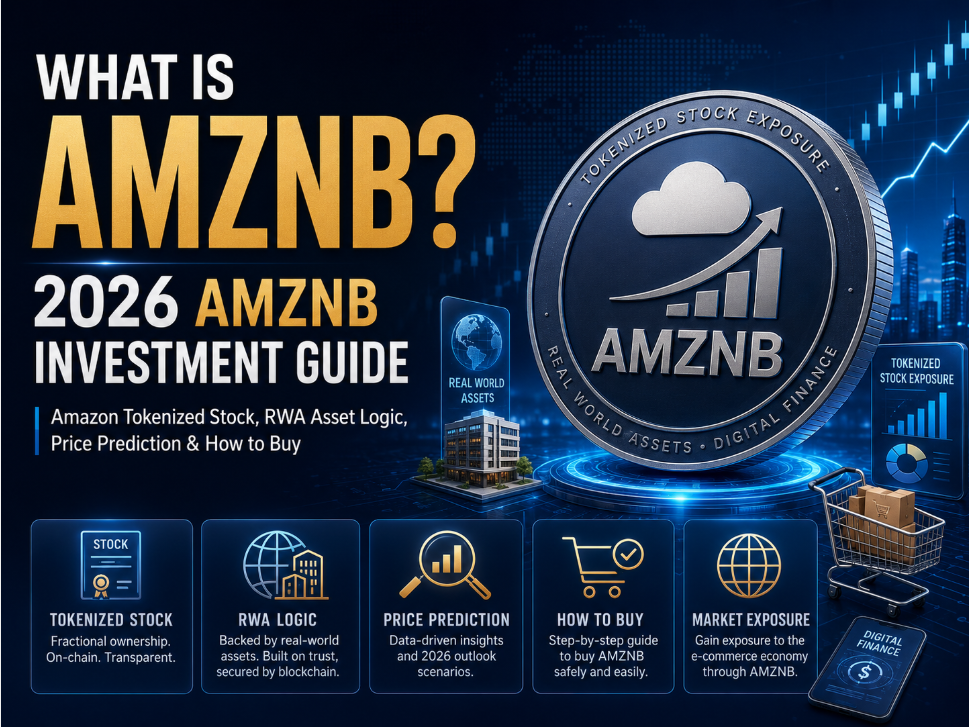
AMZNB is better understood as a tokenized stock – a digital asset whose price references Amazon’s stock, trading within crypto markets. It falls under the RWA (Real World Assets) umbrella – tokenization of traditional financial assets.
In short, AMZNB is not a native crypto like BTC or ETH, nor is it a blockchain token from Amazon. Its core logic is to give crypto users exposure to Amazon’s share price via a tokenized format.
But that does not mean buying AMZNB equals buying Amazon shares. As the U.S. Investor.gov explains for tokenized securities, these can be stocks, bonds, or fund shares recorded on a blockchain; however, the rights of token holders vary widely by structure – especially with synthetic tokenized securities, which may only offer price exposure without any claim on the underlying issuer.
Therefore, the key to researching AMZNB is not treating it as a “new coin,” but understanding its RWA structure, Amazon’s business fundamentals, the tokenized-stock mechanism, liquidity risks, and regulatory differences.
1. What Is AMZNB? Why Is Amazon Stock Entering Crypto?
AMZNB is a tokenized expression of Amazon-related financial assets.
It is not a standalone blockchain, not a meme coin, not a DeFi governance token – it’s more like a digital on-ramp to traditional stock exposure within crypto markets.
Users can view AMZNB/USDT live price, charts, and market data on HIBT to track real-time performance.
1.1 Basic Definition
AMZNB is a tokenized stock – specifically, an RWA asset. RWA means representing real-world assets (stocks, bonds, funds, real estate, gold, private credit, etc.) on-chain, allowing crypto users to gain exposure through blockchain or platform-based trading.
- AMZNB is not an official Amazon stock coin.
- It is not a blockchain token issued by Amazon.
- It is not a native crypto like BTC or ETH that derives value from its own network.
Rather, it is a digital gateway referencing Amazon’s stock price. As Kraken’s xStocks FAQ notes, holding xStocks does not equate to owning the underlying company’s shares – it provides price exposure without shareholder rights, voting rights, or legal claims on the company.
So the first and most important step is to distinguish: AMZNB is not Amazon stock itself; it’s a tokenized asset tied to Amazon’s stock performance.
1.2 How Does AMZNB Relate to Amazon Stock (AMZN)?
Traditional Amazon stock – ticker AMZN – trades on U.S. exchanges. Investors buying AMZN through a brokerage account hold shares with rights governed by securities regulations, custodians, and corporate governance.
AMZNB, on the other hand, is a tokenized trading form in crypto markets. It is typically priced in USDT or other digital assets, and users trade the AMZNB/USDT pair on crypto platforms – not through a traditional brokerage.
Their price logic is correlated. If Amazon’s business grows, profits improve, AWS performs well, or AI/cloud demand rises, AMZN may be repriced; AMZNB, as a tokenized reference, may also move with those fundamentals and market expectations.
But they are not interchangeable.
- Owning Amazon stock may involve shareholder rights, voting, brokerage custody, and traditional market oversight.
- Holding AMZNB depends on the token issuer, custody structure, redemption mechanics, platform rules, and specific product terms – some tokenized stocks only provide price exposure, not any traditional equity rights.
This distinction is critical for every AMZNB investor.
1.3 Why Are Traditional Stocks Becoming Tokenized?
Traditional stock trading relies on brokerages, exchanges, clearing houses, banking systems, and local regulations. This model is mature and stable but has limitations:
- High account-opening barriers.
- Inconvenient access for users in many countries.
- Trading hours restricted to traditional market sessions.
- Fund flows require banks, wire transfers, forex, and brokerage accounts.
- Poor composability across different asset classes.
Tokenized stocks address a different set of needs: bringing equity-like assets into crypto, enabling USDT/stablecoin purchases, global access, lower entry barriers, on-chain/platform settlement, compatibility with DeFi, and extended trading hours.
Kraken’s xStocks FAQ also mentions 24/7 trading on Kraken Pro and potential DEX integrations, while clarifying that xStocks cannot be transferred to traditional brokerages and do not represent ownership of the underlying shares.
On a broader trend, AMZNB exemplifies how traditional finance enters crypto. Ethereum remains a major smart-contract infrastructure for RWA; you may also check ETH price prediction to see how Ethereum ecosystem and RWA narratives interact.
2. The Amazon Investment Logic Behind AMZNB: Why the Market Cares
If AMZNB is tied to Amazon, then researching it means going beyond crypto charts – you must understand Amazon’s business fundamentals.
AMZNB is not a standalone story; its reference object is Amazon itself.
2.1 Why Amazon Is a Global Asset Giant
Amazon is one of the world’s most important tech and consumer internet companies, spanning e-commerce, AWS cloud, advertising, subscription services, logistics, hardware, and AI.
For full-year 2025, Amazon reported net sales of $716.9 billion, up 12% year-over-year. North America sales grew 10% to $426.3 billion, International sales +13% to $161.9 billion, and AWS sales +20% to $128.7 billion.
This shows Amazon is not a pure e-commerce play – it’s a composite tech powerhouse. For AMZNB investors, that matters because if AMZNB tracks Amazon’s stock, its drivers are not crypto “hype” but business growth, profit margins, AWS performance, AI investments, and Big Tech valuations.
2.2 Why AWS Is a Core Valuation Driver
AWS (Amazon Web Services) is Amazon’s most important profit engine. In 2025, AWS operating income reached $45.6 billion, up from $39.8 billion in 2024 – on sales of $128.7 billion.
This makes AWS not just a growth business but a critical component of Amazon’s profitability.
The AI era amplifies AWS’s importance. Companies training and deploying AI models need cloud compute, GPUs, data storage, inference, APIs, databases, security, and enterprise development environments. As a leading global cloud platform, AWS stands to benefit from enterprise AI adoption and data center demand.
However, risks exist: Amazon’s 2025 free cash flow fell to $11.2 billion, largely due to $50.7 billion in property and equipment purchases for AI investments – opportunity comes with capital-expenditure pressure.
Thus, investing in AMZNB requires not just “Amazon is big” but also assessing whether AWS growth sustains, AI investments pay off, margins remain stable, and the market accepts heavy CapEx.
2.3 How the AI Wave Affects Amazon’s Long-Term Value
AI impacts not only chipmakers but also cloud providers. NVIDIA supplies GPUs, Microsoft pushes Azure and AI software, Google develops AI models and cloud, while Amazon competes via AWS, cloud infrastructure, enterprise AI services, and internal efficiency gains.
Amazon’s long-term value may be shaped by:
- Sustained AWS cloud demand.
- AI deployments driving higher cloud consumption.
- In-house chips and AI infrastructure reducing costs.
- AI improving e-commerce, advertising, logistics, and customer service efficiency.
- Large AI CapEx potentially compressing free cash flow.
So studying AMZNB is essentially studying Amazon’s long-term competitiveness in the AI era.
2.4 AMZNB vs. Typical Crypto Assets
AMZNB is fundamentally different from BTC, ETH, meme coins, or privacy coins.
- BTC derives value from scarcity, digital gold narrative, and institutional allocation.
- ETH derives value from smart contracts, DeFi, Layer 2, RWA, and developer ecosystem.
- Meme coins rely on community, culture, and sentiment.
- AMZNB’s value comes from Amazon’s enterprise value, AMZN’s market performance, tokenization mechanics, and crypto trading demand.
To understand the contrast between native crypto and RWA, you might read what is XVG? Verge Crypto deep dive – XVG represents privacy payments, while AMZNB represents tokenized traditional equities; their underlying logic is completely different.
3. How Does AMZNB Work? The Mechanics of Tokenized Stocks
Many newcomers ask: how can a blockchain token represent stock value?
The answer depends on the issuance mechanism. Different tokenized stock products use different structures – some are asset-backed custody models, some are synthetic exposure, some are derivative-based, and some fall under securities regulation in certain jurisdictions.
3.1 How Does AMZNB Track Amazon?
AMZNB’s price is generally influenced by Amazon’s stock price, but it may not perfectly track AMZN in real time.
The typical price-mapping logic:
- Amazon’s stock price is the reference.
- The issuer or platform uses custody, contracts, pricing feeds, market-making, or other mechanisms to map that price to the token.
- Users trade AMZNB with USDT or other assets on crypto venues.
- Market supply/demand, liquidity, and platform rules affect the token’s price.
Thus, AMZNB price can be influenced by four factors:
- Amazon stock price – the primary reference.
- Token liquidity – shallow order books may cause deviations.
- Issuance mechanics – whether 1:1 asset backing, redemption, and proof-of-reserves exist, affecting trust.
- Trading demand – increased crypto user interest in U.S. equity tokens may boost activity.
3.2 Is AMZNB Backed by Real Amazon Stock?
This is the most critical question in RWA investing.
Investors must check:
- Who is the issuer?
- Is there underlying Amazon stock or related assets held in custody?
- Is the custodian regulated?
- Are proof-of-reserves publicly disclosed?
- Is redemption supported – and if so, is it cash or physical shares?
- Are there geographic restrictions?
- Do token holders have shareholder rights – voting, dividends, or liquidation claims?
Investor.gov distinguishes models: issuer-sponsored tokens may carry traditional rights; custodial tokens represent indirect interests through securities intermediaries; synthetic tokens may only offer price exposure without any claim on the issuer.
Therefore, AMZNB holders cannot assume “it is backed” or “it is not backed” – you must rely on the specific offering documents, platform disclosures, and contract terms.
3.3 AMZNB vs. Stock ETFs
ETFs are traditional fund products, issued by fund companies, traded on stock exchanges, regulated as securities, and hold baskets of assets.
Tokenized stocks are blockchain/crypto representations – they may track single stocks, ETFs, indices, bonds, or other assets.
Key differences:
- Trading system – ETFs via brokerage accounts; AMZNB via crypto platforms.
- Funding – ETFs with fiat or brokerage cash; AMZNB with USDT/digital assets.
- Trading hours – ETFs limited to exchange hours; tokenized stocks may offer extended hours.
- Rights – ETF rights defined by fund and securities rules; token rights depend on issuance structure and platform rules.
- Risk sources – ETFs face market, fund, and tracking error risks; AMZNB adds platform, custody, contract, regulatory, and liquidity risks.
Tokenization does not automatically reduce risk – it changes the access channel to crypto.
4. How to Buy AMZNB: A Beginner’s Guide
If you already understand AMZNB is not a typical crypto but a tokenized Amazon-related asset, then the next question is how to buy it.
4.1 What You Need Before Buying
Typically, four prerequisites:
- A crypto trading account – choose a platform that supports AMZNB/USDT, register, enable security settings, and complete required KYC.
- USDT funds – since AMZNB is usually priced in USDT, you need stablecoin balance.
- Identity verification – RWA and tokenized stocks may involve stricter regional restrictions and compliance; complete the platform’s verification.
- Risk assessment – be clear you are buying a tokenized exposure, not direct AMZN shares. Confirm you can tolerate price deviations, platform risks, and regulatory uncertainty.
4.2 Step-by-Step Purchase Process
For beginners:
- Sign up on a platform that lists AMZNB, enable 2FA, fund password, anti-phishing code, etc.
- Deposit USDT – verify the network, address, and supported chains; sending to the wrong network may cause loss.
- Search for AMZNB/USDT – go to the trading page, confirm the pair and ticker.
- Choose Market or Limit Order – Market for quick execution (watch for slippage), Limit for price control (may not fill immediately).
- After buying, track continuously – monitor not only AMZNB charts but also Amazon stock, tech sector conditions, RWA regulations, and token liquidity.
4.3 Key Trading Risks
Four major risk categories:
- Liquidity risk – token volume may be much lower than AMZN; large orders can cause significant slippage.
- Price deviation risk – AMZNB may diverge from AMZN due to crypto market supply/demand, liquidity, or market-making.
- Platform risk – exchange security, custody, withdrawal rules, technical failures, and compliance changes affect assets.
- Regulatory risk – different jurisdictions treat tokenized stocks differently; users must comply with local laws and platform rules.
RWA research also notes that while tokenization promises fractional ownership and global access, liquidity remains a key bottleneck – many RWA tokens have low volumes and thin secondary markets. This applies to AMZNB as well: tokenized assets must not only be issuable but also tradable, exitable, and price-discoverable.
5. AMZNB Price Prediction: Where Does Upside Come From?
When users search “AMZNB price prediction,” they really want to know: will it rise, and what drives it?
But AMZNB predictions cannot rely on meme-coin hype or Bitcoin cycles alone – they must simultaneously consider Amazon stock, U.S. tech environment, RWA adoption, and token trading structure.
5.1 Factors That Determine AMZNB Price
- Amazon stock performance – the most fundamental variable. If AMZN rises, AMZNB tends to get positive support; if AMZN falls, AMZNB likely faces pressure.
- AWS and AI cloud growth – AWS is the profit backbone. 2025 AWS sales grew 20% to $128.7B with operating income of $45.6B, reinforcing its valuation importance.
- U.S. equity market environment – interest rates, inflation, tech valuations, AI CapEx, and dollar liquidity all influence Amazon.
- RWA market development – if tokenized stocks become a major way for crypto users to access traditional assets, AMZNB may see higher demand.
- AMZNB’s own liquidity – even if Amazon rises, shallow depth or low demand may limit the token’s price performance.
5.2 How to Approach Price Prediction
Rather than asking “how many multiples,” ask:
- Is Amazon’s fundamental outlook improving?
- Is AWS growth sustainable?
- Is AI CapEx translating into revenue and profit?
- Is AMZN reasonably valued?
- Does AMZNB have sufficient liquidity?
- Is the token issuance and custody mechanism transparent?
- Is the platform stable in supporting AMZNB/USDT?
- Is the RWA sector continuing to expand?
You can check AMZNB price prediction for scenario analysis, but predictions are research tools, not guarantees.
True price judgment must combine Amazon fundamentals, token mechanics, and crypto liquidity.
6. Is AMZNB Worth Investing In? Full Pros and Cons
Whether AMZNB is worthwhile depends on your understanding of RWA, tokenized stocks, and Amazon’s long-term value.
6.1 Potential Advantages
- Exposure to a global tech leader – Amazon spans e-commerce, cloud, advertising, logistics, and AI. AMZNB offers crypto users a way to gain price-linked exposure.
- Participation in the RWA growth trend – tokenization of equities, bonds, funds, gold, real estate, and private credit is expanding.
- Crypto-native access to U.S. equities – for USDT holders, AMZNB provides a path to equity exposure without a traditional brokerage account.
- Familiar trading format – AMZNB/USDT matches crypto user habits, especially for stablecoin-based portfolios.
6.2 Major Risks
- Not Amazon stock itself – holding AMZNB usually does not make you a shareholder, nor grant voting, dividends, or traditional investor protections.
- Issuer/custodian credit risk – if AMZNB relies on third-party issuance, custody, or market-making, their solvency and trustworthiness are critical.
- Crypto market volatility – even if Amazon is stable, crypto sentiment can affect AMZNB’s price and liquidity.
- Regulatory changes – tokenized stocks may be classified as securities, derivatives, or other products across jurisdictions, affecting eligibility, KYC, and redemption.
- Price deviation and liquidity – AMZNB may temporarily diverge from AMZN; thin order books can cause slippage.
Thus, AMZNB suits investors willing to study RWA mechanics, understand Amazon’s business, and tolerate crypto risks – not beginners seeking short-term moonshots.
7. AMZNB vs. Other Crypto Assets and RWA Projects
To understand AMZNB, place it in the correct asset class rather than lumping it with all cryptos.
7.1 AMZNB vs. BTC/ETH
- BTC – digital gold; value from scarcity, decentralization, and institutional adoption.
- ETH – smart-contract infrastructure; value from network usage, developer ecosystem, DeFi, L2, and RWA applications.
- AMZNB – tokenized traditional equity; reference is Amazon stock and company fundamentals.
So AMZNB is neither BTC nor ETH – it’s an RWA asset within crypto trading.
7.2 AMZNB vs. SPCX
SPCX is another tokenized financial asset case. You can read what is SPCX to understand how assets related to private high-growth companies enter crypto.
Differences:
- AMZNB references publicly traded Amazon stock.
- SPCX leans toward private companies or special-financial exposures.
- AMZNB’s pricing is more transparent via public markets.
- SPCX may face more complex valuation, liquidity, and disclosure issues.
Both fall under RWA/tokenized asset frameworks, but their underlying assets and risks differ.
7.3 AMZNB vs. THETA and PIPEDOG
Crypto includes many asset types:
- THETA – decentralized video, AI compute, and edge infrastructure; value from network nodes, EdgeCloud, AI demand, and DePIN.
- PIPEDOG – meme/community-driven; price logic from culture, hype, sentiment, and liquidity.
- AMZNB – RWA tokenized stock; core value from Amazon’s reference price, fundamentals, token issuance, and crypto trading demand.
These three have completely different investment theses: THETA – application/infrastructure; PIPEDOG – community/meme; AMZNB – Amazon enterprise value + tokenization mechanics.
8. AMZNB Investment FAQ
Q1: What is AMZNB?
AMZNB is a tokenized stock asset linked to Amazon, providing crypto users with price exposure to Amazon shares. It is not a native crypto like BTC/ETH, but a tokenized representation of a traditional equity.
Q2: Is AMZNB issued by Amazon?
No. It is not an official Amazon-issued digital currency or stock token. It is typically offered by third-party financial infrastructure or trading platforms. Issuer, custody, and rights depend on platform disclosures and product documents.
Q3: Does buying AMZNB equal buying Amazon stock?
No. While prices may correlate, holding AMZNB does not mean owning Amazon shares, nor does it grant voting rights, dividends, or traditional brokerage protections. Token rights vary by issuance model and platform rules.
Q4: Can AMZNB be held long-term?
Long-term holding depends on Amazon’s fundamentals, AMZNB’s issuance structure, token liquidity, platform risk, and your personal risk tolerance. If you are bullish on Amazon but don’t understand tokenized-stock mechanics, research the product rules first – don’t treat AMZNB as a direct AMZN substitute.
Q5: Will AMZNB go up in the future?
Future price depends on Amazon’s stock performance, AWS/AI cloud growth, U.S. tech equity environment, RWA adoption, AMZNB liquidity, and trading demand. No prediction is a guarantee. You may refer to AMZNB price prediction but must independently assess risks.
Q6: Who is AMZNB suitable for?
It suits investors who already understand crypto trading, RWA, tokenized-stock mechanisms, and are willing to study Amazon’s fundamentals. It is not suitable for beginners with no knowledge of equities, token issuance, or those seeking short-term hype.
Q7: What is the biggest risk of AMZNB?
Key risks: it is not Amazon stock itself; issuer/custodian credit; price deviation; platform stability; liquidity; and regulatory changes. Always confirm the specific product structure and trading rules before investing.
9. Conclusion: AMZNB Represents a New Phase – Traditional Finance Meets Crypto
AMZNB is not an ordinary cryptocurrency.
It represents a new form of bringing traditional equity assets into crypto:
- Amazon-related asset exposure.
- Tokenized stock structure.
- Traded with USDT/digital assets.
- Offering crypto users access to U.S. equity price movements.
The emergence of such assets shows that crypto markets are expanding beyond native L1 tokens, meme coins, and DeFi – into stocks, ETFs, bonds, gold, and other real-world assets.
But investors must stay clear-headed:
- AMZNB is not official Amazon stock.
- AMZNB does not necessarily carry traditional shareholder rights.
- AMZNB price is influenced not only by Amazon’s stock but also by crypto liquidity, platform mechanics, and regulatory shifts.
Therefore, the focus of researching AMZNB is not hunting for “the next moonshot,” but answering three questions:
- What exactly is this asset?
- Where does its value come from?
- Where are the risks?
If you understand AMZNB’s RWA nature, Amazon’s fundamentals, tokenized-stock mechanics, and trading risks, then it serves as a valuable case study in the trend of traditional financial tokenization.
In the future, stock tokens, index tokens, bond tokens, gold tokens, and other RWA assets will likely continue expanding crypto’s boundaries. AMZNB’s significance lies in connecting a global tech powerhouse like Amazon with USDT trading, crypto capital, and on-chain financial markets.
That is the real reason AMZNB is worth studying.