
Risk Disclosure: This article is for research purposes only in the fields of Crypto, RWA, and Tokenized Stocks and does not constitute investment advice. AAPLB is an Apple-related tokenized stock asset. Specific rights, custody mechanisms, redemption rules, trading restrictions, applicable regulations, and risk structures shall be governed by the platform’s official documentation, offering materials, and disclosures. Holding AAPLB should generally not be construed as directly holding Apple stock.
If this is your first time searching “What is AAPLB?” or “What is AAPLB coin?” – the most common misconception is whether AAPLB is an official new cryptocurrency issued by Apple.
The answer is: No.
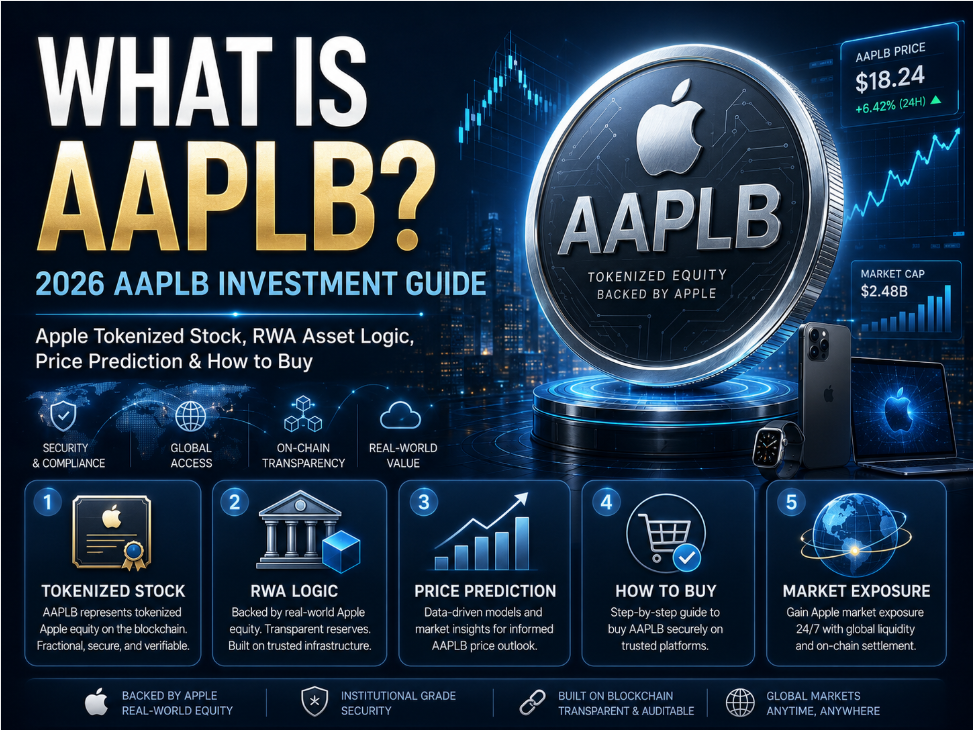
AAPLB is better understood as a tokenized stock asset whose price is linked to Apple’s stock price – a digital representation of a traditional equity asset entering the crypto market. It falls under the RWA (Real World Assets) umbrella – the tokenization of real-world assets.
Simply put, AAPLB is not a native crypto asset like BTC or ETH, nor is it a blockchain token issued by Apple itself. Its core logic is: to provide crypto users with price exposure to Apple’s stock via a tokenized format.
But that does not mean buying AAPLB is the same as buying Apple stock. The U.S. Investor.gov guidance on Tokenized Securities notes that tokenized securities can be financial instruments such as stocks, bonds, or fund shares recorded on a blockchain or distributed ledger as crypto assets. In the case of synthetic tokenized securities, investors may only obtain price exposure to the reference security without any rights against the issuer of that reference security.
Therefore, the key to researching AAPLB is not treating it as a “new coin,” but understanding the underlying Apple stock logic, tokenized stock mechanisms, RWA asset structure, liquidity risks, and regulatory differences.
1. What Is AAPLB? Why Tokenize Apple Stock?
AAPLB’s core positioning is a tokenized expression of Apple-related equity assets.
It is not an independent public blockchain, not a meme coin, and not an ordinary DeFi governance token. It is closer to a “digital trading gateway for traditional equity assets within the crypto market.”
Users can check AAPLB/USDT real-time price, trading data, and market trends on HIBT to view current prices, candlestick charts, and market activity.
1.1 Basic Definition of AAPLB
AAPLB belongs to the category of Tokenized Stocks – tokenized equity assets.
More specifically, it falls under RWA assets. RWA’s core idea is to represent real-world assets – such as stocks, bonds, funds, gold, real estate, private assets, or other financial products – through blockchain or digital asset formats, allowing crypto users to gain exposure to those assets.
AAPLB is not an official digital currency issued by Apple.
AAPLB is not a blockchain project token from Apple.
AAPLB is also not a native crypto asset like BTC or ETH, which derive value from their own blockchain networks.
It is closer to a digital asset that provides price exposure to Apple’s stock via blockchain-based representation.
In the tokenized stock market, similar products are commonly used to give users economic exposure to traditional equities. Kraken’s xStocks FAQ also emphasizes that holding xStocks does not equal buying shares of the underlying company; such products may provide exposure to stock value but do not carry shareholder rights, voting rights, or legal claims to the underlying company’s shares or liquidation proceeds.
Thus, the first and most important step with AAPLB is to distinguish clearly: it is not Apple stock itself, but an Apple-related tokenized stock asset.
1.2 What Is the Relationship Between AAPLB and Apple Stock (AAPL)?
Traditional Apple stock refers to Apple Inc. shares trading on NASDAQ under the ticker AAPL. Investors who buy AAPL through a traditional brokerage account typically hold Apple shares within the securities account system, with rights determined by brokers, custodians, securities market rules, and corporate governance.
AAPLB, by contrast, is a tokenized trading form within the crypto market.
It is usually priced and traded against digital assets like USDT, and users trade the AAPLB/USDT pair on crypto platforms rather than buying AAPL directly through a traditional brokerage account.
The price logic of the two may be correlated.
If Apple’s earnings grow, iPhone sales improve, services expand, AI strategy advances, and profit margins rise, Apple stock may be repriced by the market. As an Apple-related tokenized stock asset, AAPLB’s price may also be influenced by Apple’s stock performance, market expectations, and trading demand.
But they cannot be directly equated.
Holding Apple stock may involve traditional shareholder rights, corporate voting, securities account custody, and securities regulation.
Holding AAPLB depends on the token issuer, custody structure, redemption mechanisms, platform rules, and specific product terms. Some tokenized stocks may only offer price exposure without traditional equity shareholder rights.
This is the core distinction that AAPLB investors must understand.
1.3 Why Are More Traditional Assets Entering Crypto?
Traditional stock trading typically relies on investors, brokers, stock exchanges, clearinghouses, banking systems, and local regulatory frameworks.
This model is mature but has certain limitations:
- High barriers to account opening.
- Inconvenient access to U.S. stocks for users in some regions.
- Trading hours restricted by stock exchange schedules.
- Funds must go through banks, forex, wire transfers, or brokerage accounts.
- Equities are difficult to directly integrate with crypto wallets, stablecoins, and DeFi ecosystems.
Tokenized stocks attempt to address a different set of needs: enabling equity-like assets to enter the crypto market in token form, allowing users to gain exposure to traditional financial assets using USDT, stablecoins, or other digital assets.
Potential advantages include global accessibility, on-chain settlement, more flexible trading, lower entry barriers, and possible integration with DeFi protocols.
Kraken’s xStocks FAQ indicates that certain tokenized stocks can be traded 24/7 on Kraken Pro and, where supported, can interact with compatible wallets, DEXs, and DeFi protocols via on-chain methods – but the same disclosure emphasizes that holding xStocks does not equate to buying shares of the underlying company.
From a broader trend, AAPLB represents the movement of traditional financial assets into the crypto market. Ethereum, as the most significant smart contract ecosystem today, is also a key infrastructure for RWA development. Users can monitor ETH price predictions to observe market relationships between the Ethereum ecosystem and the RWA narrative.
2. Why Pay Attention to Apple? The Underlying Business Value Behind AAPLB
If AAPLB is tied to Apple, then researching AAPLB cannot be limited to crypto price charts – you must also understand Apple’s intrinsic business value.
AAPLB is not a standalone narrative asset; its core reference is Apple as a company.
2.1 What Is Apple’s Core Business Model?
Apple is one of the world’s most important consumer technology companies. Its business model is not simply selling phones – it is built on hardware, software, services, ecosystem, and brand pricing power.
Apple’s hardware ecosystem includes iPhone, Mac, iPad, Apple Watch, AirPods, and other devices. The iPhone remains Apple’s most critical product – it not only contributes revenue but also serves as the gateway for services like App Store, iCloud, Apple Pay, Apple Music, and Apple TV+.
Apple’s services business includes App Store, iCloud, Apple Music, Apple TV+, Apple Pay, AppleCare, advertising, and other subscription offerings. Compared to hardware, services typically have higher recurring revenue and gross margins, making services growth crucial to Apple’s long-term valuation.
Apple’s FY2025 annual report showed the company achieved $416 billion in revenue and double-digit EPS growth for the fiscal year; in the same fiscal year, Apple also reported quarterly revenue records for iPhone and all-time revenue records for Services.
This demonstrates that Apple is not a pure hardware company, but a consumer technology platform supported by device volumes, ecosystem stickiness, service revenue, brand premium, and a global user base.
For AAPLB investors, this is critical. Because if AAPLB tracks Apple’s stock price logic, the ultimate drivers are not crypto community hype, but Apple’s business growth, margins, product innovation, services expansion, and the market’s valuation of AAPL.
2.2 How Will the AI Era Affect Apple’s Value?
AI’s impact on Apple may not be as direct as Nvidia’s GPU sales or cloud companies’ enterprise compute demand. Apple’s AI angle leans more toward on-device experiences, operating systems, user ecosystems, and privacy-preserving computing.
AI could influence Apple in several directions:
First, smart device upgrade cycles. If AI features meaningfully enhance the experience of iPhone, Mac, iPad, and wearables, they could drive replacement demand.
Second, software ecosystem stickiness. If AI capabilities are deeply integrated with iOS, macOS, Siri, App Store, iCloud, and native apps, they could improve ecosystem retention.
Third, privacy and on-device AI advantages. Apple has long emphasized privacy and hardware-software integration. If more AI processing happens on-device, Apple’s chips, OS, and device ecosystem could become a differentiator.
Fourth, services growth. AI could enable smarter subscription services, content recommendations, productivity tools, and developer ecosystems, thereby strengthening services revenue.
In its Q2 FY2026 announcement, Apple reported its best March quarter ever, with $111.2 billion in revenue, double-digit growth across all geographic segments, and a March quarter revenue record for iPhone. This shows that even amid debate over Apple’s AI progress, its devices and ecosystem remain commercially robust.
Of course, AI also brings risks. If Apple lags competitors in AI experiences, developer tools, cloud-based AI capabilities, or smart hardware innovation, the market may downgrade growth expectations for AAPL. AAPLB, as an Apple-related tokenized stock asset, could be indirectly affected.
2.3 How Apple Differs from Other Tech Companies
Understanding AAPLB also requires placing Apple within the tech industry landscape.
- Nvidia is more about AI chips and GPU infrastructure.
- TSMC focuses on advanced process nodes and semiconductor manufacturing.
- Applied Materials is in semiconductor equipment.
- Amazon and Microsoft lean toward cloud computing and enterprise AI services.
- Apple, by contrast, is a global consumer tech endpoint, operating systems, application ecosystems, and services revenue.
Thus, AAPLB is not an “AI chip asset” nor a “cloud computing asset” – it is a tokenized expression of a global consumer tech leader.
That means AAPLB’s long-term price logic should focus on Apple’s product cycles, user ecosystem, services business, AI device experience, global consumer demand, and U.S. tech sector valuations – not just crypto market sentiment.
3. How Does AAPLB Work? Tokenized Stock Mechanisms Explained
Many newcomers ask: how can a token represent stock value?
The answer depends on the issuance mechanism, asset custody, pricing rules, and trading platform structure.
Different tokenized stock products may use different models. Some may be 1:1 asset-backed, some may be synthetic exposures, some may be derivative structures, and some may be subject to securities regulations in specific jurisdictions.
3.1 How Does AAPLB Track Apple’s Stock Price?
AAPLB’s price is generally influenced by Apple’s stock price, but it may not be perfectly synchronized with AAPL.
Typically, the pricing mapping logic for tokenized stocks works as follows:
- Apple’s stock price serves as the underlying reference.
- The issuer or platform uses custody, price feeds, market-making, on-chain certificates, or derivative structures to reflect Apple’s stock price into the token’s price.
- Users buy and sell AAPLB in the crypto market using USDT or other assets.
- Market supply/demand, liquidity, trading hours, and platform rules affect AAPLB’s execution price.
Therefore, AAPLB’s price may be influenced by four factors:
- Apple’s stock price – the most fundamental reference.
- Token market liquidity – thin trading depth can cause short-term deviations from AAPL.
- Issuance mechanism – whether real asset custody exists, whether proof is public, and whether redemption is supported affect market trust.
- Trading demand – if crypto users show rising demand for U.S. equity tokens, AAPLB may gain attention and trading activity.
3.2 Is AAPLB Backed by Real Apple Stock?
This is the most critical question in RWA investing.
Investors must verify:
- Who is the issuer?
- Is there actual Apple stock or related financial assets held in custody?
- Is the custodian regulated and compliant?
- Are reserve proofs or audit reports publicly available?
- Is redemption supported – and if so, is it cash redemption, share redemption, or only in-platform selling?
- Are there geographic restrictions?
- Do token holders have shareholder rights?
- Are there voting rights, dividend rights, or traditional securities investor protections?
Investor.gov distinguishes between multiple tokenized security models, noting that synthetic tokenized securities may only provide price exposure to the reference security with no rights against the issuer, while custodial tokenized securities may involve securities intermediaries or custody structures.
Thus, AAPLB investors should not assume “it must be backed by real stock” nor “it must not be backed.” The answer depends entirely on the specific offering documents, platform disclosures, and product rules.
The essence of RWA investing is not just price – it is asset authenticity, issuance transparency, custody safety, and redemption mechanisms.
3.3 What’s the Difference Between AAPLB and an ETF?
ETFs are fund products in traditional financial markets. They are typically issued by fund companies, traded on stock exchanges, regulated under securities frameworks, and hold a basket of assets via fund structures.
AAPLB is a tokenized stock asset in the blockchain or crypto market. It may track Apple’s stock price or provide Apple-related exposure through various mechanisms.
Key differences lie in trading systems, funding paths, rights structures, and risk sources.
- ETFs trade through brokerage accounts; AAPLB trades through crypto platforms or wallets.
- ETFs are typically bought with fiat or securities-account funds; AAPLB is typically traded with USDT or other digital assets.
- ETF holder rights are governed by fund documents and securities rules; AAPLB holder rights depend on the token’s issuance structure and platform rules.
- ETFs face market risk, tracking error, and securities market risk; AAPLB may also face platform risk, custody risk, smart contract risk, regulatory risk, liquidity risk, and price deviation risk.
So, tokenization does not automatically reduce investment risk. It only changes the method by which an asset enters the crypto market.
4. How to Buy AAPLB? A Step-by-Step Guide for Beginners
If you already understand that AAPLB is not an Apple-issued cryptocurrency and is not directly equivalent to AAPL stock, then we can address the “how to buy” question.
4.1 What Do You Need to Invest in AAPLB?
Before buying AAPLB, you typically need four things:
- A crypto trading account – choose a platform that supports AAPLB/USDT trading, complete registration, security settings, and required KYC.
- USDT funds – AAPLB is usually priced in USDT, so you need to hold USDT.
- A platform that supports AAPLB – not all platforms offer tokenized stock trading. Confirm the platform supports AAPLB/USDT and whether your region allows trading such assets.
- Risk awareness – understand that you are buying an Apple-related tokenized stock asset, not Apple stock directly. Also confirm you can tolerate price deviations, illiquidity, platform risks, and regulatory uncertainty.
4.2 Step-by-Step Purchase Process
For beginners, follow these steps:
Step 1: Register on a platform that supports AAPLB trading. Complete account setup, enable two-factor authentication, fund passwords, anti-phishing codes, etc.
Step 2: Deposit USDT. Verify the deposit network, address, and supported chain. Do not send USDT to the wrong network, or you may lose funds.
Step 3: Search for AAPLB/USDT. Go to the trading page, find the AAPLB pair, and verify the pair name, price, and market data.
Step 4: Choose market order (buy at current price) or limit order (set your own price). Market orders are faster but may incur slippage; limit orders give price control but may not fill immediately.
Step 5: Confirm the trade and monitor it. After buying, track not only AAPLB’s price but also Apple’s stock performance, tech sector cycles, RWA regulatory changes, and token liquidity.
4.3 What Risks Should You Watch When Investing in AAPLB?
AAPLB trading risks include four main categories:
- Liquidity risk – token trading volumes may be much lower than Apple stock. If the order book is thin, large trades may cause significant slippage.
- Price deviation risk – AAPLB may be influenced by Apple’s stock price but can deviate due to crypto supply/demand, platform liquidity, trading hours, and market-making.
- Platform risk – the exchange’s security, custody arrangements, withdrawal rules, technical failures, and compliance changes can affect user assets.
- Regulatory risk – different jurisdictions have varying stances on tokenized stocks. Some may restrict trading; users must comply with local laws and platform rules.
While RWA assets offer a new path for traditional assets to enter crypto, “tradable” does not mean “low risk.” For AAPLB, investors must simultaneously understand equity risks and crypto market risks.
5. AAPLB Price Prediction: Where Does Future Value Come From?
When users search “AAPLB price prediction,” they really want to know: will AAPLB go up? Where does its upside come from?
But AAPLB price prediction cannot be reduced to “what price it will reach.” It requires looking at Apple’s fundamentals, U.S. tech cycles, AI trends, the RWA market, and token liquidity.
5.1 What Factors Affect AAPLB’s Price?
First, Apple’s fundamentals. Revenue growth, product sales, services expansion, margin changes, and free cash flow all affect AAPL’s market performance and may indirectly impact AAPLB.
Apple’s FY2025 Form 10-K disclosed that Americas net sales increased year-over-year, driven mainly by higher iPhone and Services net sales; the filing also noted foreign exchange negatively affected sales in some regions. This shows fundamentals are influenced by both product demand and currency factors.
Second, global tech sector cycles. As a major tech stock, Apple’s valuation is affected by Fed rates, inflation, dollar liquidity, risk appetite for tech, and consumer electronics cycles.
Third, AI industry trends. AI may affect iPhone upgrade cycles, device demand, software ecosystems, developer tools, and user experiences. If Apple’s AI capabilities drive upgrades and services growth, the market may revalue its long-term potential.
Fourth, RWA market development. If more crypto investors embrace stock tokenization, AAPLB’s attention and liquidity may increase.
Fifth, AAPLB’s own structure. Even if Apple stock rises, if AAPLB has poor liquidity, opaque issuance, or trading restrictions, its price may diverge.
5.2 How to Reasonably Analyze AAPLB’s Future Trajectory?
Rather than asking “how much will it rise?”, a better set of questions includes:
- Is Apple’s long-term competitiveness still strong?
- Is the iPhone upgrade cycle improving?
- Is services revenue continuing to grow?
- Can Apple’s AI capabilities translate into user experience and revenue?
- Is AAPL’s valuation reasonable?
- Does AAPLB have a clear token mechanism?
- Is AAPLB’s trading liquidity sufficient?
- Is the RWA market continuing to expand?
- Does the crypto market support demand for tokenized stock trading?
Users can view AAPLB price prediction pages, trend references, and scenarios. But price forecasts are research tools only – not guarantees of investment returns.
A real judgment on AAPLB should combine Apple’s stock fundamentals, tokenization mechanics, trading liquidity, and the broader crypto environment.
6. Is AAPLB Worth Investing In? A Full Analysis of Pros and Cons
Whether AAPLB is worth investing in depends on how you assess Apple’s long-term value, RWA asset structures, and tokenized stock risks.
6.1 Potential Advantages of AAPLB
- Access to a top-tier global tech asset. Apple has global brand power, a massive user ecosystem, strong cash flow, and a compelling device-and-services portfolio. AAPLB gives crypto users a way to gain Apple-related price exposure.
- Participation in the RWA growth trajectory. RWA is becoming a key crypto sector. Stocks, bonds, funds, gold, money market instruments, and other traditional assets may enter digital asset markets via tokenization.
- Crypto capital participating in traditional markets. For users already holding USDT, AAPLB may offer an entry point to Apple-related exposure without a traditional brokerage account.
- Trading style familiar to crypto users. The AAPLB/USDT pair fits the habits of crypto investors, especially those who prefer to allocate via stablecoins.
6.2 Risks of AAPLB
- AAPLB is not Apple stock. Holding AAPLB generally does not make you a direct Apple shareholder, nor does it necessarily confer voting rights, dividends, or traditional investor protections.
- Reliance on issuer and custodian. If AAPLB depends on third-party issuance, custody, market-making, or redemption, the creditworthiness of the issuer and custodian is paramount.
- Apple valuation risk. Even as a global tech leader, Apple faces growth slowdown, AI competition, regulatory pressure, consumer electronics cyclical downturns, supply chain risks, and valuation pullbacks.
- Crypto market volatility. Even if Apple stock is stable, crypto sentiment, stablecoin liquidity, platform liquidity, and trading demand can affect AAPLB’s price.
- Regulatory policy changes. Tokenized stocks may be treated as securities, derivatives, or other financial products in different jurisdictions. Regulatory changes could affect trading eligibility, listing scope, KYC requirements, and redemption mechanisms.
Thus, AAPLB is more suitable for users willing to study RWA mechanisms, understand Apple’s stock logic, and tolerate crypto market volatility – not for beginners seeking short-term moonshots.
7. How Does AAPLB Differ from Other Crypto Assets?
Understanding AAPLB requires proper asset classification. Different crypto assets cannot be analyzed with the same framework.
7.1 AAPLB vs BTC/ETH
- BTC’s value derives from digital scarcity, decentralized consensus, institutional allocation, and a store-of-value narrative.
- ETH’s value comes from smart contracts, DeFi, Layer 2, RWA, stablecoins, and developer networks.
- AAPLB’s value is rooted in Apple’s enterprise value, AAPL stock performance, tokenized stock mechanisms, and crypto market trading demand.
So, AAPLB is not BTC nor ETH. It belongs to the traditional equity tokenization space.
7.2 AAPLB vs SPCX
SPCX is also in the financial-asset tokenization direction. You can read What Is SPCX to understand another type of tokenized asset entering crypto.
The differences:
- AAPLB corresponds to listed company stocks like Apple.
- SPCX leans toward specialty financial assets or non-traditional public equity exposures.
- AAPLB’s pricing is more easily referenced against public stock markets.
- SPCX may involve different valuation, liquidity, and information transparency issues.
Both fit within RWA or tokenized asset frameworks, but their underlying assets, investment logic, and risk sources differ.
7.3 AAPLB vs XVG, THETA, PIPEDOG
The crypto market contains many asset types.
- XVG is a privacy-payment asset focused on payment privacy, low-cost transfers, and digital payment use cases.
- THETA is in Web3 video, AI compute, and DePIN infrastructure – focused on edge nodes, AI compute resources, and decentralized content delivery.
- PIPEDOG is more of a meme-community asset – driven by community virality, meme culture, market sentiment, and liquidity.
AAPLB, by contrast, is an RWA asset – driven by Apple’s enterprise value, stock price exposure, token issuance mechanisms, and trading risks.
These assets have completely different logics. XVG is about privacy payments. THETA is about infrastructure. PIPEDOG is about community hype. AAPLB is about Apple’s fundamentals and RWA mechanics.
The biggest mistake newcomers make is treating all crypto assets as “coins.” A mature approach is to first identify the asset class, then apply the corresponding analytical framework.
8. AAPLB Investment FAQ
Q1: What is AAPLB?
AAPLB is an Apple-related tokenized stock asset – an RWA that provides price exposure to Apple’s stock via blockchain or crypto market formats. It is not a native crypto asset like BTC or ETH, but a tokenized representation of a traditional equity.
Q2: Is AAPLB issued by Apple?
No. AAPLB is not an official cryptocurrency from Apple, nor is it a blockchain project token from the company. It is generally a stock-tokenization product provided by third-party financial infrastructure or trading platforms. The specific issuer and product structure should be verified through platform disclosures.
Q3: Does buying AAPLB equal buying Apple stock?
No. AAPLB’s price may track Apple’s stock, but holding AAPLB typically does not mean directly owning Apple equity, nor does it necessarily grant voting rights, dividends, or traditional securities account entitlements. Tokenized stock rights depend on the issuance model and platform rules.
Q4: Is AAPLB suitable for long-term investment?
That depends on Apple’s fundamentals, RWA mechanisms, token liquidity, issuer credibility, regulatory environment, and your own risk tolerance. If you are bullish on Apple’s long-term value but do not understand tokenized stock structures, research the product rules first – do not treat AAPLB as a direct substitute for AAPL.
Q5: Will AAPLB go up in the future?
AAPLB’s future trajectory is affected by Apple’s operational performance, tech sector cycles, AI device trends, RWA market growth, and crypto market conditions. No price prediction guarantees returns. You may refer to AAPLB price prediction, but always make independent judgments based on risk.
Q6: Who is AAPLB suitable for?
AAPLB is better suited for investors who already understand crypto trading, USDT transactions, RWA assets, tokenized stock mechanisms, and are willing to research Apple’s fundamentals. It is not for those completely unfamiliar with stocks, token issuance structures, unable to handle volatility, or simply chasing short-term pumps.
Q7: What is the biggest risk of investing in AAPLB?
The biggest risks include: AAPLB is not Apple stock itself, issuer credit risk, custody risk, price deviation risk, platform risk, liquidity risk, and regulatory changes. Before investing, confirm AAPLB’s specific product structure, trading rules, and applicable requirements in your jurisdiction.
9. Conclusion: AAPLB Represents One Way Apple’s Ecosystem Enters the Crypto-Finance Era
AAPLB is not an ordinary cryptocurrency.
It represents a new form of traditional equity assets entering the crypto market:
- Apple-related equity exposure
- Digitized through a tokenized stock structure
- Traded against digital assets like USDT
- Providing crypto users with Apple-related price exposure
The emergence of such assets shows that the crypto market is expanding beyond native blockchain tokens, meme coins, and DeFi assets – into stocks, ETFs, bonds, gold, and other real-world assets.
But investors must remain clear-eyed.
- AAPLB is not Apple’s official stock.
- AAPLB does not necessarily carry traditional shareholder rights.
- AAPLB’s price is influenced not only by Apple’s stock but also by crypto market liquidity, platform mechanisms, and regulatory changes.
Thus, the focus of researching AAPLB is not hunting for “the next moonshot,” but answering three questions:
- What exactly is this asset?
- Where does its value come from?
- Where are its risks?
If you can understand AAPLB’s RWA nature, Apple’s fundamentals, tokenized stock mechanics, and trading risks, then AAPLB serves as a valuable case study in the tokenization of traditional financial assets.
In the future, stock tokens, index tokens, bond tokens, gold tokens, and other RWA assets will likely continue expanding the boundaries of crypto markets. AAPLB’s significance lies in connecting a global consumer tech giant like Apple with USDT trading, crypto capital, and on-chain financial markets.
For crypto newcomers, understanding the asset logic behind AAPLB is more important than simply trying to predict its price.