
Disclaimer: This article is for educational and informational purposes only and does not constitute investment advice. AIOZ is a Web3 infrastructure, DePIN, decentralized storage, and content delivery project. Its price is influenced by multiple factors including market cycles, adoption rates, node growth, tokenomics, and competitive dynamics. Always conduct your own research on fundamentals, liquidity, and your personal risk tolerance before investing.
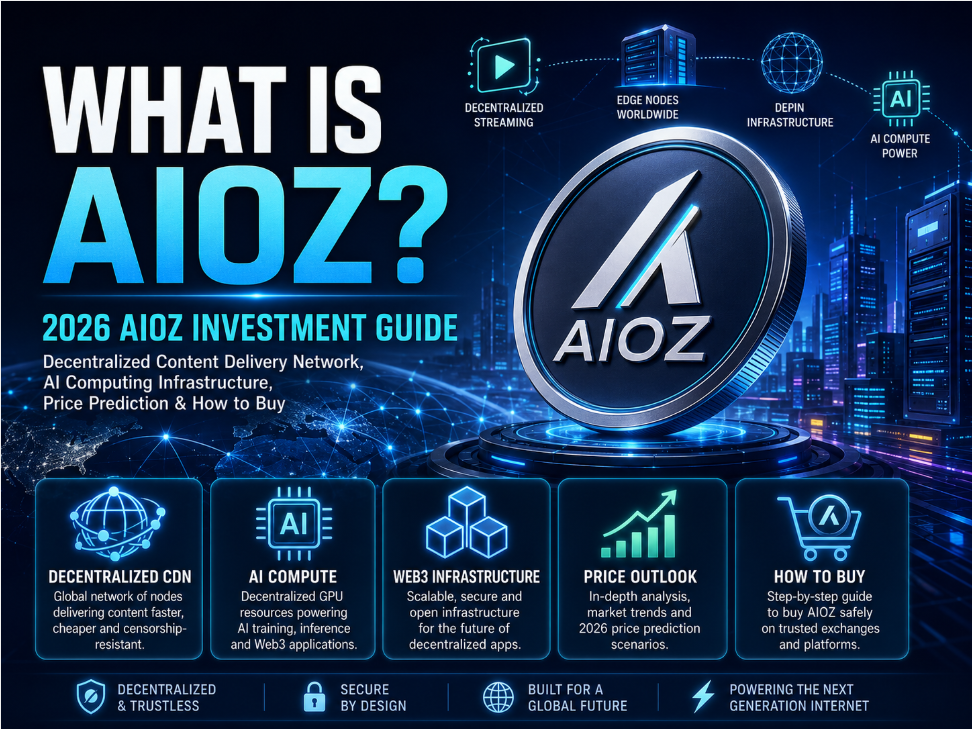
If you’re searching for “what is AIOZ” or “what is AIOZ coin” for the first time, it’s easy to dismiss it as just another altcoin. More accurately, AIOZ Network is an infrastructure layer for Web3 content delivery, decentralized storage, streaming, and AI computing.
AIOZ’s official documentation positions it as Web3 infrastructure for AI, Storage, and Streaming, noting that the AIOZ Blockchain is a Cosmos-based, EVM-compatible chain; the AIOZ DePIN powers decentralized storage, content distribution, and media streaming applications.
This means AIOZ is not a meme coin or a pure speculation token with no use case. Its core logic is to convert traditional internet resources—content delivery, storage, bandwidth, and compute—into a decentralized network powered by global node operators.
Traditional internet infrastructure relies on centralized servers, cloud providers, and CDN companies. AIOZ uses token incentives to let everyday users contribute bandwidth, storage, and computing power from their own devices, building a Web3‑native content and AI infrastructure network.
This guide covers: what AIOZ is, what problem AIOZ Network solves, how its decentralized CDN works, the utility of the AIOZ token, how it compares to THETA and Filecoin, key price drivers, and how beginners can check AIOZ price and buy it.
1. What Is AIOZ? Why Is It Gaining Attention in Crypto?
Most newcomers ask: “Is AIOZ just another ordinary altcoin?”
Simply put, AIOZ Network is an infrastructure project that combines decentralized content distribution, Web3 storage, media streaming, and AI compute. It sits at the intersection of Layer‑1 infrastructure, DePIN, Web3 CDN, decentralized storage, and distributed computing.
AIOZ’s official homepage describes it as a DePIN network for Web3, AI, Streaming, and Storage, and states that AIOZ DePIN provides dApps with AI computation, data storage, and seamless media video streaming.
1.1 Basic Definition of AIOZ
AIOZ Network can be seen as a combination of three infrastructure layers:
- Decentralized Content Delivery Network (dCDN) – Instead of relying on centralized data centers, AIOZ uses a global network of nodes to store, transcode, transmit, and distribute content.
- DePIN Infrastructure – DePIN (Decentralized Physical Infrastructure Network) uses token incentives to mobilize real‑world physical resources. AIOZ leverages users’ spare storage, bandwidth, computing power, and even AI‑ready GPU resources.
- Web3 Storage & Streaming Network – AIOZ handles not only file storage but also video, media, dApp data, NFT media assets, and AI training datasets.
The AIOZ token serves as the network’s payment method, node incentive, and settlement currency for ecosystem services. According to the official tokenomics, AIOZ tokens are used as payment by dApps on the network, enabling value flow among developers, users, and service providers.
So AIOZ is not a meme coin, not a pure governance token, and not a speculative asset without real application. It’s best understood as a Web3 network for content delivery, storage, and AI compute infrastructure.
You can check live AIOZ/USDT price, charts, and market data at any time.
1.2 What Problem Does AIOZ Network Solve?
Traditional internet content delivery relies heavily on centralized servers and CDN providers. When users access video, images, files, or app content, it typically travels from central servers or CDN edge nodes to the end user. This model is mature and efficient, but has clear drawbacks:
- High costs – Video, live streaming, AI‑generated content, gaming assets, and large file transfers consume massive bandwidth, forcing platforms to pay significant fees to cloud and CDN vendors.
- Centralized control – A handful of companies control most servers and CDN nodes. The more platforms depend on these providers, the more they are exposed to pricing changes, regional coverage gaps, censorship, outages, and congestion.
- Uneven global delivery – Users far from major server hubs often experience higher latency and poorer quality. For global content platforms, low‑cost, low‑latency distribution remains a persistent challenge.
AIOZ’s goal is to use a worldwide network of nodes to provide storage, bandwidth, and compute, forming a decentralized CDN. The AIOZ FAQ explains that the AIOZ dCDN is a peer‑to‑peer distributed network, where Edge Nodes earn rewards for storing, transcoding, and streaming digital media. The node application uses a device’s idle compute, bandwidth, and storage.
This is why AIOZ attracts attention: it turns spare resources into incentivized, coordinated, and tradable Web3 infrastructure.
1.3 Why Is DePIN Becoming a Major Crypto Trend?
DePIN gains traction because it moves crypto beyond pure financial trading into real‑world infrastructure.
In the past, many crypto assets revolved around trading, DeFi, memes, and financial narratives. DePIN applies token incentives to physical resource networks—storage, bandwidth, wireless, GPU compute, geospatial data, sensors, energy, and more.
AIOZ is an infrastructure‑focused DePIN project. Its goal is not just creating a new financial token, but enabling users worldwide to contribute tangible resources to run the network.
Academic research highlights that infrastructure token economies differ from standard tokens: they require continuous incentives for resource providers while balancing rewards with actual demand. Without that balance, inflation, misaligned incentives, or underutilization can occur.
This is crucial for AIOZ. Its future value depends not only on token price but on real network usage, sustained node participation, developer adoption, and a healthy equilibrium between token rewards and genuine service demand.
2. How Does AIOZ Network Work? Unpacking the Decentralized Content Mechanism
To understand AIOZ, you must first grasp its node mechanism. AIOZ is not just an on‑chain token—it’s a distributed network powered by global nodes.
2.1 What Are AIOZ Nodes?
AIOZ nodes are resource providers in the network. Anyone can run the AIOZ node application (or related tools) to contribute bandwidth, storage, and compute capacity. The FAQ states that AIOZ Nodes are the backbone of the distributed CDN, operated by everyday users who store and deliver content from their own devices.
Resources provided by nodes include:
- Bandwidth – for content transmission and media delivery.
- Storage – for caching, preserving, or distributing data.
- Compute – for transcoding, AI tasks, or other network processing.
Node operators earn AIOZ tokens as rewards. Official docs and blog posts confirm that users are rewarded for contributing resources, and those resources are used for storage, transcoding, streaming, and decentralized AI computation.
This creates a virtuous cycle: resource supply → network service → token incentives.
2.2 How Does AIOZ Handle Content Delivery?
In the traditional CDN model, content platforms upload videos, images, files, etc. to centralized servers or CDN nodes, and users retrieve them from the nearest or most optimal server.
In the AIOZ model, content is distributed across multiple nodes. When a user requests content, it is served by the node that is geographically closer or best suited for delivery.
Potential advantages include:
- Lower latency.
- Improved global distribution.
- Reduced dependence on centralized servers.
- Utilization of idle resources for content delivery.
- A more decentralized data and media infrastructure for Web3 apps.
The AIOZ documentation explains that AIOZ Storage leverages a global network of peer‑to‑peer nodes to deliver data from nearby nodes, with built‑in CDN capabilities, so developers don’t need to pay separately for CDN services.
This shows AIOZ aims to be more than “put files on chain”—it’s building a storage, distribution, and access layer for Web3 applications.
2.3 AIOZ vs. Traditional CDN
Traditional CDNs are owned and operated by corporations, relying on centralized data centers and proprietary networks. Their strengths are maturity, stability, and service‑level guarantees; their weaknesses are high cost, centralization, and vendor lock‑in.
AIOZ attempts to provide content delivery through a global node network, token incentives, and decentralized architecture.
Key differences:
- Resources come from global nodes, not a single company.
- Nodes are rewarded with tokens.
- The network serves Web3 dApps, media content, AI data, and decentralized storage.
- Infrastructure is open‑participation and distributed.
However, this doesn’t mean AIOZ is inherently superior. Traditional CDNs remain far ahead in stability, enterprise SLAs, global optimization, and commercial maturity. For AIOZ to become competitive, it must prove cost‑effectiveness, reliability, developer experience, and sustained adoption.
Industry and academic research have long explored P2P distribution to reduce CDN costs. For example, studies at ByteDance noted that as business scales, centralized CDN costs become very high, and P2P networks can lower those costs—but decentralized P2P also brings performance variability and scheduling challenges.
This confirms that AIOZ addresses a real need, but execution is far from trivial.
3. What Are the Applications in the AIOZ Ecosystem? Why Might the AI Era Need It?
AIOZ’s long‑term value depends not on the catchphrase “decentralized CDN is promising,” but on real demand in Web3 content, storage, AI compute, and DePIN use cases.
3.1 Web3 Content Applications
The most direct use cases include:
- Video distribution.
- Media content storage.
- NFT image, video, and metadata storage.
- Decentralized application data storage.
- File sharing and content delivery.
- Live streaming, short‑form video, and streaming media.
As internet content continues to grow—video, images, AI‑generated content, and real‑time interactions—bandwidth and storage consumption will skyrocket. Web2 platforms lean on large cloud and CDN providers, while Web3 apps need more open, verifiable, and composable infrastructure.
AIOZ DePIN docs mention that it addresses file storage, distribution, and media streaming challenges for Web3 dApps, offering high bandwidth, low latency, and cost‑effective content delivery—suitable for decentralized video streaming, VR world rendering, and NFT storage with media content.
So AIOZ’s scope extends beyond “video playback” to multimedia Web3 and data infrastructure.
3.2 How Does AIOZ Relate to AI Computing?
The AI era introduces new infrastructure demands. Training and inference require massive datasets, storage, GPU compute, and network bandwidth. AI agents, generative video, image models, voice models, and multimodal applications further increase storage and distribution needs.
AIOZ’s homepage states that AIOZ DePIN provides AI computation, data storage, and seamless media streaming for dApps within the network. The ecosystem also describes AIOZ AI as an AI‑as‑a‑service platform driven by DePIN GPUs and Web3 incentives, plus a collaborative AI marketplace and AI data storage.
Thus, AIOZ is not building its own AI models; instead, it aims to provide a portion of the infrastructure that AI applications need: data storage, content delivery, distributed compute, and resource orchestration.
If future AI apps increasingly require decentralized data services, distributed inference, generative video delivery, or AI agent resource scheduling, networks like AIOZ could gain more attention.
But investors should note: AI narrative ≠ real adoption. Whether AIOZ transitions from an “AI infrastructure concept” to a “network actually used by AI applications” must be validated through node metrics, customer case studies, developer adoption, and on‑chain revenue.
3.3 How Does AIOZ Differ from Theta Network?
Both AIOZ and Theta operate in the Web3 video, content, and compute infrastructure space, but their emphasis differs.
Theta gained early prominence in decentralized video streaming and edge computing, later expanding to AI compute and EdgeCloud. Theta’s docs describe it as a blockchain and decentralized cloud infrastructure for AI, media, and entertainment, with Edge Nodes used for AI edge computing, data storage, and content delivery.
AIOZ places stronger emphasis on decentralized CDN, Web3 storage, multimedia infrastructure, and AI compute resource networks.
In simplified terms:
- Theta focuses more on video streaming ecosystems, edge nodes, and AI compute marketplaces.
- AIOZ focuses more on decentralized CDN, storage, content delivery, and Web3 multimedia infrastructure.
Both are infrastructure‑oriented, but they are not identical. You can read What Is THETA Coin? An Analysis of Theta Network’s Future Value to understand different paths in the video and AI compute infrastructure sector.
4. What Is the Value of the AIOZ Token? Why Does the Network Need It?
Understanding the AIOZ token requires looking beyond price volatility to its actual utility within the network.
4.1 Primary Use Cases of AIOZ Token
The AIOZ token has three main purposes:
- Network payments – dApps and services within the ecosystem can use AIOZ as a medium of exchange. Official tokenomics docs confirm that the token serves as payment for dApps, enabling value flow among developers, users, and the ecosystem.
- Node rewards – Nodes providing storage, bandwidth, and compute for content delivery, streaming, data storage, and AI compute earn AIOZ rewards. The FAQ also states that running an AIOZ Node and participating in the network yields token rewards.
- Ecosystem participation – The token facilitates value exchange, node incentives, and service fee settlement. As more dApps, developers, and users join, the token’s use cases may expand.
4.2 Where Does the Token’s Value Come From?
AIOZ token value can be understood through this logic chain:
- Increased network demand → developers and apps need storage, CDN, AI compute, and media services.
- Nodes provide more resources → users and dApps pay service fees.
- Token usage rises → the ecosystem forms a stronger feedback loop.
However, this chain holds only if real usage exists. If the network lacks sufficient applications, customers, and ongoing content/compute demand, the token’s value will be more susceptible to market sentiment.
Therefore, researching AIOZ involves looking beyond “DePIN is hot” to tracking:
- Node growth.
- dApps integrating AIOZ services.
- Real demand for storage and content delivery.
- Adoption of AI compute services.
- Whether token rewards align with actual revenue or demand.
4.3 How Does AIOZ Differ from Typical Crypto Projects?
Many tokens are driven primarily by sentiment, short‑term hype, exchange listings, and community buzz. AIOZ’s value logic is more grounded in infrastructure usage demand. If more Web3 apps, AI services, content platforms, and node users rely on the network, the token gains fundamental support.
This is fundamentally different from privacy payments, meme communities, or RWA assets. For instance, What Is XVG Coin? A Deep Dive into Verge Crypto focuses on digital payment privacy and low‑cost transfers; AIOZ is about content delivery, storage, node resources, and AI infrastructure.
Different token types require different analytical frameworks. AIOZ is not a privacy token or a meme token—it’s a Web3 infrastructure token.
5. How to Buy AIOZ: A Beginner’s Step‑by‑Step Guide
Once you understand AIOZ’s positioning, the next practical question is how to buy it.
Beginners should not buy solely based on short‑term pumps, community recommendations, or AI hype. A sensible process: understand the project → check the market → assess risks → start with a small position.
5.1 What Do You Need Before Buying AIOZ?
Typically, you’ll need four things:
- A crypto trading account – Choose a platform that supports the AIOZ/USDT pair, complete registration, security settings, and identity verification (KYC).
- USDT funds – Most trading pairs are quoted in USDT, so you’ll need to hold USDT to buy AIOZ.
- A compatible wallet address – For long‑term holding or ecosystem participation, confirm which wallets and network types support AIOZ. The FAQ reminds that AIOZ tokens on AIOZ Network, ERC‑20, and BEP‑20 are network‑specific; cross‑chain transfers require the AIOZ Bridge.
- Risk awareness – AIOZ is a mid‑cap infrastructure project with volatility higher than BTC and ETH. Only invest what you can afford to lose.
5.2 Step‑by‑Step Purchase Process
For beginners:
- Register on a platform that lists AIOZ – Complete account creation and enable 2FA, fund passwords, anti‑phishing codes, etc.
- Deposit USDT – Verify the deposit network, address, and supported chain. Never send USDT to the wrong network—this can result in loss of funds.
- Search for the AIOZ/USDT pair – Go to the trading page, confirm the pair name, price, and market info.
- Choose market order or limit order – Market orders execute quickly but may have slippage; limit orders let you control your price but may not fill immediately.
- Confirm the purchase – After the trade, don’t just watch the price. Keep monitoring project updates, node growth, partnerships, tokenomics, and market cycles.
You can first check live AIOZ/USDT price and market data before deciding to participate.
5.3 Storing AIOZ
After buying, you typically have two storage options:
- Keep on the exchange – Convenient for short‑term traders, but subject to exchange security risks, withdrawal limits, and platform operational risks.
- Withdraw to a compatible wallet – Better for long‑term holders or ecosystem participants. Safeguard your private keys, seed phrases, and wallet addresses. Anyone asking for your private key or seed phrase is almost certainly a scam.
When holding AIOZ long‑term, be mindful of different network formats—don’t send assets to the wrong chain or unsupported address.
6. AIOZ Price Prediction: Where Could Upside Come From?
When users search “AIOZ price prediction,” they really want to know: will it go up, and what drives its upside?
Instead of giving a random future price, a more rational approach is to analyze the key factors that influence AIOZ’s price.
6.1 Key Price‑Influencing Factors
- DePIN market growth – If more Web3 apps and AI services need decentralized storage, content delivery, GPU compute, and node resources, AIOZ could gain attention.
- Web3 content ecosystem expansion – Video, live streaming, gaming, NFT media, decentralized social, AI‑generated content, and data sharing all increase storage and distribution needs. If AIOZ captures that demand, network value may rise.
- Node count growth – More nodes mean more available resources. But growth must align with real demand; if rewards grow without consumer usage, tokenomics may suffer.
- Crypto market cycles – As a crypto asset, AIOZ is influenced by BTC trends, ETH ecosystem health, risk appetite, and altcoin liquidity. Even good project news may not prevent price drops in a bear market.
- Tokenomic model – Infrastructure projects must balance node rewards with actual demand. Over‑rewarding without revenue creates sell pressure; under‑rewarding discourages participation.
This is the hardest part of infrastructure tokenomics. Research indicates that such economies need dynamic equilibrium between provider incentives and consumer demand; otherwise, supply‑side incentives and demand‑side usage become misaligned.
6.2 How to Analyze AIOZ’s Future Value
Rather than asking “how many x,” ask:
- Is network usage growing?
- Are node numbers steadily increasing?
- Are there real customers for storage, CDN, and AI services?
- Do partnerships bring sustained demand?
- Are token rewards matched to service demand?
- Are developers using the AIOZ SDK and API?
- Does AIOZ offer differentiation from THETA, Filecoin, Arweave, and others?
You can view AIOZ price prediction and trend scenarios as a research tool, but never as a guarantee of returns.
True price assessment should combine adoption metrics, DePIN industry trends, AI infrastructure demand, tokenomics, and crypto market cycles.
7. Is AIOZ Worth Investing In? A Balanced Look at Strengths and Risks
Whether AIOZ is worth investing in depends on your view of Web3 infrastructure, DePIN, AI compute, and decentralized content networks over the long term.
7.1 Potential Advantages
- Web3 infrastructure focus – Unlike pure concept tokens, AIOZ has clear application areas: content delivery, storage, streaming, and AI compute.
- Long‑term DePIN trend – DePIN uses tokens to incentivize real‑world resource providers—storage, bandwidth, compute, and data networks. If more real resources are organized via blockchain, projects like AIOZ stand to benefit.
- AI‑era infrastructure demand – AI needs data, storage, compute, and content delivery. If AIOZ finds real traction in AI data storage, inference tasks, distributed compute, and multimedia distribution, it could have lasting value.
- Web3 content ecosystem potential – Decentralized social, video, NFT media, game assets, AI‑generated content, and Web3 apps all require content storage and distribution infrastructure. AIOZ’s direction connects to these trends.
7.2 Key Risks
- Intense competition – AIOZ faces competition from Filecoin, Arweave, THETA, Render, Akash, traditional cloud providers, traditional CDNs, and other DePIN projects in storage, compute, video, and AI infrastructure.
- Uncertain adoption speed – Having a clear vision doesn’t guarantee success. Monitor real users, developer integrations, dApp usage, node earnings, and network service revenue.
- High price volatility – As a crypto asset, AIOZ is subject to BTC/ETH cycles, risk sentiment, and altcoin liquidity. Even with long‑term potential, short‑term drawdowns can be severe.
- Tokenomic risk – Over‑rewarding without demand creates persistent sell pressure; under‑rewarding reduces node participation.
- Regulatory risk – Different jurisdictions have varying rules for crypto assets, DePIN, node rewards, and token trading—policy changes could affect trading and ecosystem involvement.
Thus, AIOZ is more suitable for those willing to study Web3 infrastructure and DePIN long‑term trends, not for beginners looking to chase short‑term pumps.
8. How Does AIOZ Differ from Other Crypto Assets?
Understanding AIOZ requires building a framework for classifying crypto assets.
8.1 AIOZ vs. ETH
ETH is smart contract infrastructure; its value derives from the Ethereum ecosystem, DeFi, Layer 2, RWA, stablecoins, and developer network effects. AIOZ is content delivery, storage, and compute infrastructure; its value is tied to network resource usage, node contributions, content distribution, AI compute, and Web3 multimedia ecosystems.
ETH is like a general‑purpose blockchain OS; AIOZ is more like a DePIN network for content and AI resources.
See ETH price prediction to understand the difference between smart contract infrastructure assets and DePIN content infrastructure.
8.2 AIOZ vs. SPCX
SPCX is tokenized financial assets. You can read What Is SPCX to see how another tokenized asset enters crypto markets.
SPCX is about financial asset logic; AIOZ is about infrastructure network logic. SPCX focuses on underlying financial assets, valuation, trading mechanics, and RWA risks. AIOZ focuses on nodes, network services, content delivery, storage, AI compute, and token incentives.
Both are crypto assets, but they require completely different investment frameworks.
8.3 AIOZ vs. THETA, XVG, and PIPEDOG
AIOZ and THETA are both infrastructure‑oriented. AIOZ emphasizes decentralized CDN, storage, and Web3 content; THETA emphasizes video streaming, edge computing, and AI compute ecosystems. Compare them via What Is THETA Coin.
XVG is a privacy payment asset, focusing on payment privacy and digital transfers, not content delivery or AI. Read What Is XVG Coin to understand privacy payment assets.
PIPEDOG is a meme‑community asset, driven by community spread, meme culture, sentiment, and liquidity. Read What Is PIPEDOG to distinguish community‑driven tokens from infrastructure tokens.
So:
- AIOZ → network resources and real usage.
- THETA → video, edge compute, and AI infrastructure.
- XVG → privacy payments.
- PIPEDOG → community hype.
Their value sources are fundamentally different.
9. AIOZ Investment FAQ
Q1: What is AIOZ?
AIOZ is a decentralized content delivery, storage, and AI compute infrastructure network. It uses global nodes that contribute bandwidth, storage, and computing power to provide CDN, media streaming, data storage, and AI‑related services for Web3 applications.
Q2: What is the AIOZ coin used for?
The AIOZ token is used for network payments, node rewards, and value exchange in ecosystem applications. Nodes earn AIOZ for providing storage, bandwidth, and compute; dApps can also use AIOZ as a payment medium.
Q3: Is AIOZ worth investing in?
AIOZ is in the Web3 infrastructure, DePIN, decentralized CDN, storage, and AI compute space. Whether it’s a good investment depends on actual network usage, node growth, partnerships, tokenomics, market cycles, and your personal risk tolerance.
Q4: Will AIOZ go up in the future?
AIOZ price is influenced by DePIN adoption, network usage, node growth, Web3 content ecosystem, AI compute demand, and BTC/ETH market cycles. No prediction is a guarantee of returns. You can check AIOZ price prediction as a reference, but always make your own judgment.
Q5: What’s the difference between AIOZ and THETA?
Both are in decentralized content and compute infrastructure. AIOZ emphasizes decentralized CDN, storage, Web3 content distribution, and AI compute network; THETA focuses more on video streaming, edge computing, and AI compute ecosystems. They share similar directions but differ in product emphasis and ecosystem paths.
Q6: What’s the difference between AIOZ and Filecoin?
Filecoin is more of a decentralized storage marketplace, focusing on preserving data through storage providers. AIOZ combines content delivery, CDN, media streaming, storage, and AI compute. In short, Filecoin is like a decentralized storage network, while AIOZ is more like a content delivery and multimedia infrastructure network.
Q7: How do I buy AIOZ?
You can buy AIOZ on platforms that support the AIOZ/USDT pair. The basic process: register, deposit USDT, search for AIOZ/USDT, choose market or limit order, and confirm the purchase. We recommend checking live AIOZ/USDT price and market data beforehand.
10. Conclusion: AIOZ Represents One Direction of Web3 Infrastructure Evolution
AIOZ is not a simple speculative token. It embodies an infrastructure trend: shifting traditional internet content delivery toward decentralized node networks, and connecting that with Web3 storage, media streaming, and AI compute needs.
AIOZ’s core logic is not “issue a coin for trading,” but to use token incentives to mobilize global nodes to contribute storage, bandwidth, and compute, building a decentralized content and AI infrastructure network.
For investors, the focus should not be solely on “will the price rise?” but on ongoing observation of:
- Real network usage.
- Sustained node growth.
- Whether partnerships generate demand.
- Whether AI compute and Web3 content truly use AIOZ services.
- The health of tokenomics.
- Differentiation from THETA, Filecoin, Arweave, traditional CDNs, and AI compute players.
If AIOZ establishes real demand in decentralized content delivery, Web3 storage, media streaming, and AI compute, it holds long‑term research value. But if usage falls short, competition intensifies, or token rewards and real demand become misaligned, the price could remain under pressure.
Therefore, for newcomers to crypto, understanding the problem AIOZ solves is far more important than fixating on price movements. What makes AIOZ truly worth studying is not whether it’s “the next moonshot,” but whether it can become a real network within Web3 content, DePIN, and AI infrastructure.