
If you’ve come across MVLLB on a trading platform, price ticker, or social media feed, your first questions are probably: What exactly is MVLLB? Is it a new cryptocurrency? How does it relate to Marvell Technology stock? And why is it being tied to AI chips, semiconductors, and RWA assets?
Simply put, MVLLB is not a traditional public-chain token, a memecoin, a DeFi governance token, or a generic AI-themed coin. It’s better understood as a tokenized asset linked to Marvell Technology — specifically, a Tokenized Stock / RWA asset that provides exposure to the price performance of MRVL-related stocks or ETFs.
An important distinction up front: In public market data, the Marvell Technology Tokenized bStock commonly trades under the ticker MRVLB, while MVLLB more closely corresponds to the GraniteShares 2X Long MRVL ETF Tokenized bStock — i.e., a tokenized asset tied to a leveraged ETF on MRVL. According to CoinMarketCap, MVLLB is a tokenized bStock that offers economic exposure to the GraniteShares 2X Long MRVL ETF Tokenized bStock and, where permitted by applicable law, may include rights to convert into the underlying securities.
So when researching MVLLB, don’t treat it as “Marvell stock itself,” and don’t confuse it with an ordinary crypto token. The more accurate framing is: MVLLB is an RWA asset that sits at the intersection of traditional tech equities, the AI-chip theme, tokenized-stock structures, and the crypto trading ecosystem.
You can check MVLLB real-time prices, trading info, and market data on Hibt, and also explore the MVLLB price prediction page for market trends and reference forecasts.
1. What Is MVLLB, and Why Are Marvell-Related Assets Coming to Crypto?
When users search “what is MVLLB,” the first thing to clarify is asset classification.
MVLLB is not a typical new coin. It’s not a gas token for some blockchain, not a governance token for a DeFi protocol, and not a community-driven memecoin. Its core logic comes from the tokenization of traditional financial assets — i.e., Tokenized Stocks and the RWA (Real World Assets) space.
RWA stands for Real World Assets — bringing traditional assets like stocks, ETFs, bonds, funds, gold, real estate, commodities, and more into the crypto ecosystem via blockchain or tokenized structures.
Tokenized Stock is a major subset of RWA. It expresses traditional equities — or their economic rights — in token form, allowing crypto users to trade them using digital assets like USDT.
MVLLB sits right in this trend. It connects to Marvell Technology-related assets — specifically, exposure to MRVL stock or ETF price performance. When trading MVLLB, the focus isn’t “does this token have its own blockchain ecosystem?” but rather: the underlying MRVL asset performance, AI-chip industry trends, the RWA issuance structure, exchange liquidity, and market demand.
That’s why MVLLB draws attention — it ties together several hot investment themes:
- Marvell Technology
- AI chips
- Data centers
- Semiconductor networking chips
- Tokenized Stocks
- RWA on-chain assets
- Crypto market access
For crypto newcomers, the first step in understanding MVLLB isn’t “will it go up?” but “what underlying exposure does it actually represent?”
2. Is MVLLB Marvell Technology Stock?
This is the most common misunderstanding.
MVLLB should not be mistaken for traditional Marvell Technology stock held in a securities account. Even though it’s linked to MRVL-related assets, it is not the same as buying MRVL common stock through a broker.
Traditional Marvell stock is a security traded on equity markets, held in a brokerage account. Shareholders may have voting rights, access to company disclosures, and possibly dividend entitlements.
MVLLB, on the other hand, is a Tokenized Stock or Tokenized ETF asset. It expresses price exposure to MRVL-related assets within a crypto trading environment. However, whether it carries traditional shareholder rights, dividends, redemption features, or convertibility into the underlying security depends on the specific issuer, custodian, and exchange rules.
So before buying MVLLB, you must confirm three things:
- Does it track Marvell common stock, an MRVL-related ETF, and — crucially — does it include leverage?
- Is it backed by real underlying assets with an identifiable issuer/custodian?
- Does it provide pure price exposure, or full equity ownership?
Public sources show that Marvell Technology Tokenized bStocks trade under MRVLB, while MVLLB is more aligned with the GraniteShares 2X Long MRVL ETF Tokenized bStock. This means when searching for MVLLB, always distinguish between MVLLB, MRVLB, and MRVL — they look similar but may have very different underlying structures.
3. Why Are Traditional Tech Stocks Becoming Tokenized?
The move of traditional tech stocks into crypto is part of the broader RWA trend.
In the past, to invest in a company like Marvell Technology, you needed a brokerage account. That process came with geographic restrictions, broker support, trading hours, funding/withdrawal rails, tax rules, and regulatory requirements.
Now, Tokenized Stocks aim to bring equities — or equity-linked assets — into crypto. Users can trade them with USDT through digital asset accounts, in a familiar environment.
This shift offers several clear advantages:
- Lower barriers for many crypto users who don’t have U.S. brokerage accounts but are comfortable with USDT, exchanges, wallets, and digital asset trading.
- More flexible trading hours — crypto markets operate nearly 24/7, unlike traditional stock exchanges with fixed sessions.
- Integration with Web3 — Tokenized Stocks aren’t just for spot trading; they can potentially be used in on-chain asset management, DeFi collateral, RWA indices, portfolio construction, and cross-chain products.
But advantages don’t erase risks. Tokenized Stocks are not simply “stocks on a blockchain.” They involve issuers, custodians, the authenticity of underlying assets, compliance rules, platform restrictions, liquidity, and differences in investor rights.
So MVLLB’s correct positioning is not “a new coin” but “a crypto-traded product that tokenizes exposure to MRVL-related assets.”
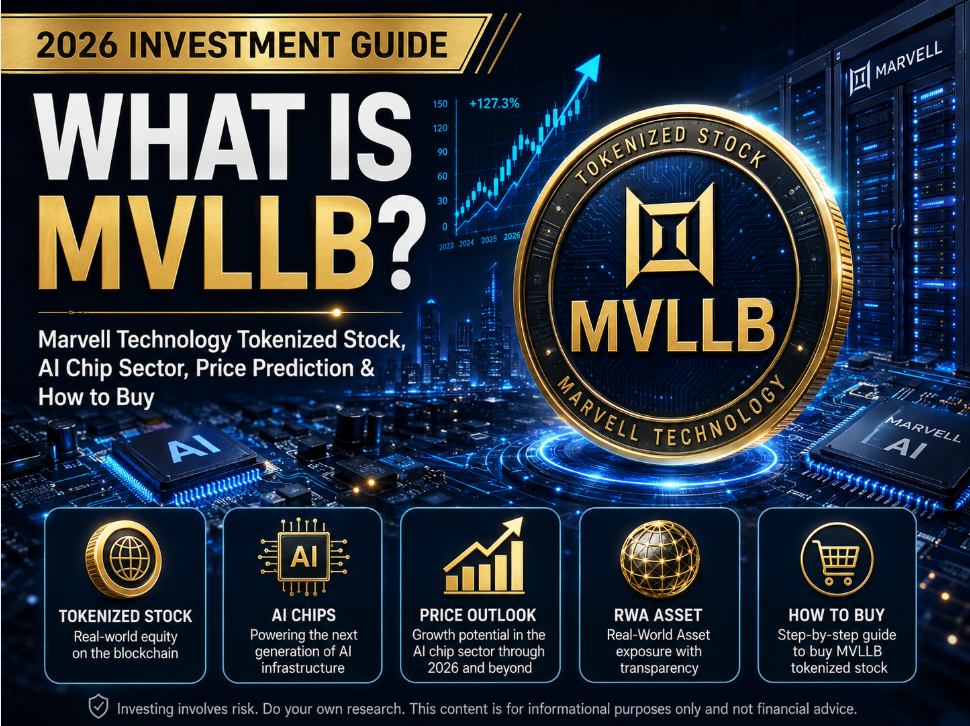
4. What Is Marvell Technology, and Why Does MVLLB Attract AI-Chip Investors?
To understand MVLLB, you must first understand Marvell Technology.
Marvell Technology is a semiconductor company spanning data centers, networking, storage, security, connectivity, and high-performance computing. As per Marvell’s official description, its data-center solutions cover AI accelerators, custom CPUs, high-speed copper and optical interconnects, high-bandwidth network switches, storage, and memory devices — all supporting AI and cloud data-center infrastructure.
That’s why Marvell draws attention from AI-chip investors.
The AI wave isn’t just about GPUs. Large-scale AI training and inference require massive data-center infrastructure. Beyond GPUs, you need high-speed networking, optical interconnects, switch chips, storage controllers, data transport, and custom silicon.
Think of the AI value chain:
- AI models need training and inference.
- Training/inference need compute power.
- Compute needs data centers.
- Data centers need high-speed networking and interconnects.
- Networking/interconnects need semiconductor chips.
Marvell plays a key role in these layers.
Marvell’s investor relations emphasize its networking, accelerated compute, storage, and security solutions as critical to AI applications and multiple industries. Reuters reported in May 2026 that Marvell expects its custom-chip business to exceed $10 billion in revenue by fiscal 2029, driven by cloud companies expanding AI data centers and investing in custom silicon to reduce reliance on Nvidia processors.
This shows that MVLLB’s investment thesis isn’t just “tech-stock tokenization” — it’s closely tied to AI data centers, custom chips, networking interconnects, and semiconductor infrastructure.
5. Why Does the AI Wave Impact Marvell’s Value?
Many people think “AI chips” and immediately think Nvidia. But AI infrastructure is far broader than GPUs.
Large AI systems need GPUs, but also high-speed networking chips, optical modules, switch chips, storage, data transport, custom ASICs, and data-center infrastructure. As AI models scale, data-transfer pressure within and between data centers intensifies.
Marvell’s value proposition becomes clearer in this context:
- AI data centers demand stronger interconnect capabilities.
- AI inference growth requires more efficient networking and chip designs.
- Cloud providers want custom silicon to cut costs and boost performance.
- High-speed networking and optical interconnects are becoming critical bottlenecks for AI infrastructure.
If Marvell can win more customer orders and maintain technological advantages in these areas, its stock-market performance may be supported — and tokenized assets linked to MRVL could gain attention.
However, investing in MVLLB is not the same as investing directly in AI technology itself.
Buying MVLLB is not:
- Investing directly in ChatGPT
- Investing directly in AI models
- Buying Nvidia directly
- Participating in some AI on-chain protocol
Rather, it’s a tokenized way to gain exposure to price movements in traditional MRVL-related financial assets.
6. How Does MVLLB Tokenized Stock Work? What’s the Underlying Structure?
MVLLB’s operation can’t be understood like a typical crypto project.
Typical crypto projects have a team, whitepaper, tokenomics, ecosystem, governance, staking, user incentives, and on-chain protocol revenue.
MVLLB is closer to a Tokenized Stock or Tokenized ETF. Its logic usually follows:
- A traditional financial asset exists.
- An issuer or custodian backs or maps the underlying asset.
- The platform issues a corresponding token.
- Users trade that token in crypto markets.
- The token price fluctuates based on underlying asset performance, market supply/demand, and liquidity.
If MVLLB tracks a leveraged ETF on MRVL, it adds another layer of ETF mechanics — particularly volatility amplification and compounding effects from daily rebalancing.
That makes MVLLB more complex than a plain-vanilla stock token. Investors face not just Marvell’s fundamentals, but also ETF structure, leverage, tokenization liquidity, and crypto market sentiment — all at once.
So analyzing MVLLB requires looking at four levels simultaneously:
- Marvell’s fundamentals
- AI-chip and semiconductor industry cycles
- The underlying Tokenized Stock or ETF structure
- Crypto market liquidity and RWA-sector sentiment
If you only watch price charts without understanding the asset structure, the risk is very high.
7. How Does MVLLB Price Relate to Marvell Stock?
MVLLB price is linked to Marvell Technology-related assets, but it doesn’t always track MRVL stock price perfectly.
If MVLLB tracks a plain MRVL stock token, its price should theoretically be influenced by MRVL’s stock movements.
If it tracks an MRVL-linked leveraged ETF, then it’s affected not only by MRVL stock but also by the ETF’s leverage mechanics.
At the same time, as a token traded in crypto markets, MVLLB is also influenced by trading volume, bid-ask spreads, order-book depth, USDT liquidity, and overall market sentiment.
Thus, MVLLB price can be driven by a combination of:
- Marvell stock ups and downs
- Marvell earnings reports
- AI data-center business growth
- Custom-chip order flow
- Semiconductor industry cycles
- The structure of the MRVL-related ETF
- Token issuance and custody mechanisms
- Exchange liquidity
- RWA-sector hype
- Crypto risk appetite
So newcomers can’t simply assume “Marvell goes up, so MVLLB goes up by the same percentage.” The actual performance depends on the specific asset structure.
8. What Are the Differences Between MVLLB and Traditional Marvell Stock Trading?
The biggest differences are the access point and the holding structure.
Traditional Marvell stock is traded through securities accounts. You buy MRVL common shares on equity markets, with standard trading hours, settlement, shareholder rights, disclosures, and regulatory oversight.
MVLLB trades in crypto markets. You buy with USDT through an exchange, hold it as a token, and its price is displayed in token terms. It’s designed for users already familiar with crypto trading.
Traditional stock advantages: clearer equity rights, more mature regulation, standardized information.
MVLLB advantages: easier crypto-native access, more flexible trading hours, and easier integration with RWA, Web3 finance, and digital-asset portfolios.
But MVLLB’s risks are also more layered. It may not offer full shareholder rights, and it may be constrained by issuer, custodian, platform rules, and jurisdictional restrictions.
Therefore, before buying MVLLB, you shouldn’t just ask “can it go up?” but also “what rights and exposure am I actually getting?”
9. What’s the Difference Between MVLLB and ETH?
MVLLB and ETH are not the same asset class.
ETH is the native asset of the Ethereum network. Its value comes from Ethereum network usage, gas consumption, Layer-2 ecosystems, DeFi, stablecoins, NFTs, RWA on-chain activity, and smart-contract applications.
MVLLB is an RWA asset tokenizing MRVL-related traditional tech assets. Its value derives more from Marvell’s performance, AI-chip industry trends, semiconductor cycles, Tokenized Stock structures, and crypto market liquidity.
ETH represents crypto infrastructure value.
MVLLB represents exposure to traditional tech assets entering crypto.
ETH’s risks center on blockchain ecosystem competition, market cycles, regulation, network demand, and on-chain activity.
MVLLB’s risks center on tech-stock volatility, AI-chip valuations, semiconductor cycles, RWA issuance structures, trading liquidity, and platform rules.
So ETH and MVLLB aren’t comparable by “which is better to buy.” They serve different investment roles.
If you want to understand foundational blockchain assets, check Hibt’s ETH price prediction. If you want to understand tech-stock tokenization and AI-chip RWA assets, MVLLB is a more relevant case study.
10. How Does MVLLB Differ From Other RWA Assets?
MVLLB isn’t an isolated asset. You can view it within Hibt’s broader RWA content ecosystem.
- What is CRWVB — focuses on AI cloud infrastructure, looking at how CoreWeave (an AI cloud provider) enters crypto via Tokenized Stocks.
- What is AXTIB — covers tokenized stocks of traditional industrial and materials companies, helping you understand non-tech enterprise tokenization.
- What is AIRH — focuses on AI robotics, useful for understanding how AI-robot-related assets fit into RWA and tokenized-asset frameworks.
- What is Ethereum ETF — a key example of traditional finance entering crypto via ETFs, helpful for understanding institutional capital, ETFs, ETH, and traditional finance channels.
MVLLB’s distinguishing feature is its focus on AI chips and semiconductors.
It’s not an AI-application token. Not a generic RWA yield-generating asset. Not a traditional manufacturing stock token. It’s more like a hybrid: “Marvell-related tech assets + AI data-center chip narrative + Tokenized Stock/ETF structure + crypto trading access.”
That’s MVLLB’s differentiated value within the RWA content matrix.
11. Why Does MVLLB Price Rise or Fall?
When users search “what’s the future price trend of MVLLB,” they should focus on the drivers.
MVLLB price is mainly influenced by five categories of factors.
Category 1: Marvell’s fundamentals. If Marvell posts revenue growth, strong data-center business, rising AI-related orders, and increased customer demand, the market may revalue MRVL-related assets higher. If earnings miss, margins shrink, customer orders slow, or competition intensifies, MVLLB may come under pressure.
Category 2: AI-chip and data-center demand. AI model training and inference drive data-center expansion, which in turn drives demand for high-speed networking, interconnects, storage, and custom silicon. If AI infrastructure capex continues to grow, Marvell stands to benefit.
Category 3: Semiconductor industry cycles. Semiconductors are cyclical. On the upswing, chip valuations rise; on the downswing, inventory, pricing, orders, and margins all feel the pinch.
Category 4: Tokenized Stock structure. If MVLLB tracks a plain stock token, prices mainly track MRVL-related assets. If it tracks a leveraged ETF, leverage and decay effects come into play.
Category 5: Crypto market liquidity. Since MVLLB trades in crypto markets, short-term prices are also affected by BTC/ETH trends, USDT liquidity, RWA-sector hype, order-book depth, and overall risk appetite.
Therefore, MVLLB price isn’t driven by a single factor — it’s a combination of company fundamentals, AI industry dynamics, semiconductor cycles, RWA structure, and crypto capital flows.
12. MVLLB Price Prediction: What Indicators Should Investors Watch?
MVLLB price prediction shouldn’t rely only on historical candlesticks. For this asset, predictions should combine fundamentals, industry trends, token structure, and market liquidity.
Dimension 1: Marvell’s fundamentals. Watch earnings, revenue growth, margins, data-center business, custom-chip revenue, AI customer orders, and forward guidance. Sustained growth in data-center and AI segments may provide fundamental support.
Dimension 2: AI-chip industry trends. Track AI server shipments, data-center capex, high-speed networking, optical interconnects, custom ASICs, storage, and network-switch chip demand. Continued AI infrastructure expansion could benefit Marvell-related assets.
Dimension 3: Semiconductor cycles. Look beyond long-term trends to short-term cycles — inventory, pricing, customer budgets, supply chain, interest rates, and global economic conditions all affect chip-company valuations.
Dimension 4: Token-market factors. Monitor MVLLB trading volume, bid-ask spreads, order-book depth, price deviations, and platform support. Low liquidity can hurt execution even if your directional view is correct.
Dimension 5: RWA market sentiment. If the Tokenized Stock market continues to grow, and more crypto users are willing to use USDT for traditional tech-stock exposure, MVLLB could attract more attention.
You can check the MVLLB price prediction page for trend references. But remember, predictions are not guarantees of returns and shouldn’t replace independent research.
A more prudent approach:
- First, confirm MVLLB’s underlying asset structure.
- Then, research Marvell and AI semiconductor trends.
- Then, observe MVLLB trading depth and liquidity.
- Finally, decide based on your risk tolerance.
13. How to Buy MVLLB: A Beginner’s Step-by-Step
If you’re searching “How to buy MVLLB,” here’s a general flow.
Step 1: Find a platform that supports MVLLB trading. Start at Hibt’s MVLLB/USDT quote page to see real-time prices, market data, and trading info.
Step 2: Set up a crypto trading account. Register, enable security settings, and complete any required identity verification. Note that restrictions may vary by region — always check platform rules.
Step 3: Fund with USDT. MVLLB is typically traded as the MVLLB/USDT pair. Before buying, set a budget — don’t go heavy just because AI chips and semiconductors are hot.
Step 4: Search for MVLLB/USDT. Enter the trading page, confirm the pair name, volume, market depth, and price — avoid confusing it with similarly named tickers.
Step 5: Choose your order type.
- Market orders fill quickly but may incur slippage if liquidity is thin.
- Limit orders let you control the price. For beginners, limit orders are often safer for tokenized stocks like MVLLB, especially when depth is uncertain.
Step 6: Position sizing. MVLLB involves tech-stock volatility, AI-sector valuations, RWA structures, and crypto-market risks — not suitable for large, unplanned positions. Start small to observe.
Step 7: Have an exit plan before you buy. Think ahead:
- At what price levels will you take partial profits?
- At what levels will you cut losses?
- What if trading volume dries up?
- What if Marvell earnings disappoint?
- What if RWA sentiment cools?
Investing in MVLLB isn’t just about buying — it’s equally about planning your exits and risk controls.
14. What Are the Risks of Investing in MVLLB?
MVLLB’s opportunity comes from AI chips, semiconductors, and RWA trends, but the risks are significant.
1. Stock-market risk. MVLLB’s value depends on MRVL-related asset performance. If Marvell stock drops, MVLLB may follow.
2. AI demand slowdown. Expectations for AI chips and data centers are high. If AI capex decelerates, customer orders decline, or AI commercialization underperforms, related assets could face valuation corrections.
3. Semiconductor cyclicality. Semiconductors are cyclical. Inventory buildups, price drops, demand slowdowns, supply-chain disruptions, or global economic pressures can hurt Marvell-related assets.
4. Tech-stock valuation risk. AI and semiconductors are hot sectors, often priced for perfection. If earnings growth fails to justify valuations, prices can fall fast.
5. Tokenization structure risk. MVLLB is not a traditional MRVL share. You need to understand underlying asset backing, issuer, custodian, redemption mechanisms, legal restrictions, and platform rules.
6. Liquidity risk. If MVLLB trading volume is low, bid-ask spreads may widen, making it difficult to buy or sell at desired prices.
7. Price deviation risk. Tokenized Stock prices can temporarily diverge from underlying asset values due to time-zone differences, platform depth, supply/demand, and redemption constraints.
8. Regulatory risk. Tokenized Stocks and RWA assets sit at the intersection of securities and crypto regulation. Policy changes in different jurisdictions could affect trading and holding.
9. Leverage risk (if MVLLB tracks a leveraged ETF). Leveraged ETFs are generally suited for short-term trading and high-risk-tolerant investors. Long-term holding can suffer from volatility drag, daily rebalancing, and market swings.
Therefore, MVLLB is not suitable for newcomers who don’t understand RWA mechanics, tech-stock volatility, or leveraged-ETF risks — especially not for heavy positions.
15. Is MVLLB Worth Investing In? How to Build Your Own Framework
“Is MVLLB worth it?” can’t be answered with a simple yes or no. A better approach is to build a decision framework.
Bullish cases typically focus on three angles:
- Long-term AI growth — if you believe AI model training, inference, data-center expansion, and high-performance computing will keep growing, Marvell as an AI-infrastructure semiconductor player deserves research.
- Semiconductor infrastructure trends — if you see high-speed networking, optical interconnects, custom silicon, storage, and data-center networking as critical AI enablers, MVLLB has research value.
- RWA asset development — if you believe more stocks and traditional financial assets will enter crypto via Tokenized Stocks, MVLLB is a representative case study.
But MVLLB isn’t for everyone:
- If you only want to invest in BTC and ETH and avoid traditional tech-stock exposure, MVLLB may not suit you.
- If you don’t understand stock tokenization mechanisms or whether you’re buying equity, ETF, or leveraged-ETF exposure, don’t buy impulsively.
- If you can’t handle tech-stock volatility, RWA structural risks, liquidity risks, and platform rule changes, don’t go heavy.
- If you’re tempted just because “AI chips are hot,” proceed with caution.
For beginners, MVLLB is better approached as an educational entry point into AI chips, RWA, and Tokenized Stock trends — not as a large speculative bet from day one.
16. What Metrics Should You Track for MVLLB’s Future Development?
If you plan to follow MVLLB long-term, monitor four layers.
Layer 1: Marvell corporate metrics. Earnings, data-center revenue, AI-related orders, custom-chip business, customer mix, margins, cash flow, and forward guidance.
Layer 2: AI semiconductor industry metrics. AI server shipments, data-center capex, optical-interconnect demand, high-speed networking-chip demand, custom ASIC progress, and storage/network infrastructure investment.
Layer 3: RWA metrics. MVLLB trading volume, liquidity, bid-ask spreads, order-book depth, holder count, platform support, underlying-asset disclosures, and regulatory changes.
Layer 4: Crypto market metrics. BTC/ETH trends, USDT liquidity, RWA-sector sentiment, AI-sector capital inflows, and institutional participation.
For a complete research path, place MVLLB within Hibt’s content matrix:
- Start with ETH price prediction to understand crypto base-asset trends.
- Then read What is Ethereum ETF to understand how traditional finance enters crypto.
- Then explore What is CRWVB for AI-infrastructure-related RWA assets.
- Then check What is AXTIB and What is AIRH to see different types of Tokenized Stock assets.
- Finally, return to MVLLB to understand how AI-chip and semiconductor assets enter crypto through tokenization.
17. MVLLB FAQ: Common Questions for Beginners
What is MVLLB? MVLLB is a Tokenized Stock / RWA asset linked to Marvell Technology-related assets. Public data indicates MVLLB more closely tracks the GraniteShares 2X Long MRVL ETF Tokenized bStock, so think of it as a tokenized expression of MRVL-related exposure, not a standard crypto token.
What is the MVLLB coin? Many users search “MVLLB coin,” but it’s more accurate to call it a tokenized stock or tokenized ETF asset. Although it trades as a token, its core value derives from Marvell-related traditional financial assets, not from a typical on-chain project ecosystem.
Is MVLLB Marvell stock? No, it’s not traditional MRVL common stock held in a brokerage account. It provides price exposure to MRVL-related assets. Whether it’s backed by actual stock/ETF custody, carries shareholder rights, or supports redemption depends on the specific issuance structure and platform rules.
What’s the difference between MVLLB and MRVLB? In public data, MRVLB typically refers to Marvell Technology Tokenized bStocks, while MVLLB is more aligned with the GraniteShares 2X Long MRVL ETF Tokenized bStock. Both are MRVL-related, but their underlying structures may differ — especially since MVLLB may involve leveraged ETF exposure. Always verify the product details on your exchange.
How to buy MVLLB? You can buy MVLLB on supported platforms. Start by checking the MVLLB/USDT quote page, prepare USDT funds, search for the MVLLB/USDT pair, then choose a limit or market order based on your risk tolerance.
What affects MVLLB price? MVLLB price is driven by Marvell’s performance, AI-chip trends, semiconductor cycles, MRVL-related asset movements, RWA market demand, crypto liquidity, order-book depth, and platform rules. If MVLLB tracks a leveraged ETF, leverage mechanics and volatility decay also matter.
How should I view MVLLB price predictions? Don’t rely solely on historical charts. Combine Marvell earnings, AI data-center demand, semiconductor cycles, token trading volume, market depth, and RWA-sector sentiment. Check the MVLLB price prediction page for references, but remember that predictions are not guarantees.
What’s the difference between MVLLB and ETH? ETH is Ethereum’s native asset, representing crypto infrastructure value. MVLLB is an RWA tokenizing Marvell-related traditional tech assets, with value tied more to equity/ETF performance. They are not the same asset class.
Is MVLLB worth investing in? That depends on your view of AI chips and semiconductors, your understanding of Marvell’s value, your familiarity with Tokenized Stock mechanics, and your ability to handle tech-stock volatility, RWA structural risks, and liquidity risks. For beginners, it’s wiser to research first and start with small observation positions rather than rushing in heavily.
Conclusion: MVLLB Is Not a Typical New Coin — It’s a Key Example of AI-Chip Asset Tokenization
MVLLB’s core value isn’t whether it’s a short-term hot token — it’s that it represents a larger trend: traditional tech assets are entering crypto through Tokenized Stocks and RWA formats.
It connects to Marvell Technology. It connects to AI chips and data-center infrastructure. It connects to semiconductor industry cycles. It connects to Tokenized Stocks and RWA on-chain assets. And it connects to crypto users’ desire to access traditional financial exposures via USDT.
So understanding MVLLB requires more than a “crypto hype” lens or a pure “traditional stock” lens. The more accurate view is as a hybrid asset: “AI chips + Marvell-related assets + Tokenized Stock/ETF + RWA + crypto trading access.”
For newcomers, before investing in MVLLB, answer at least six questions:
- What exactly is MVLLB?
- Does it track Marvell stock, or an MRVL-linked ETF?
- How does it differ from MRVLB and MRVL?
- What factors drive its price?
- Do AI-chip and semiconductor cycles support its investment thesis?
- Can you accept tokenization structure risks, liquidity risks, and tech-stock volatility?
Once you can answer those, combine your research with MVLLB real-time quotes, MVLLB price prediction, ETH price prediction, What is Ethereum ETF, What is CRWVB, What is AXTIB, and What is AIRH for a more comprehensive research path.
MVLLB isn’t for everyone, but it’s an excellent entry point for understanding AI chips, semiconductor RWA, Tokenized Stocks, and the on-chain evolution of traditional tech assets.