
Core Promise
By the end of this article, you will truly understand AVAX's price logic—why it was once called an "ETH killer," why it crashed so hard from its highs, how today's competitive landscape has shifted, and whether AVAX has any realistic chance of returning to its all-time high over the next five years.
AVAX is not a meme coin, nor is it an asset that moves purely on community sentiment.
It is a classic Layer 1 blockchain token. Its price is driven by technology, ecosystem health, developer activity, institutional adoption, on-chain metrics, staking, TVL, and macro market cycles.
This means analyzing AVAX requires asking more than just:
"If BTC goes up, will AVAX follow?"
The better questions are:
- Is Avalanche's subnet ecosystem actually delivering real-world usage?
- Does Avalanche9000 genuinely lower the barrier to deployment?
- Are enterprises and institutions actually building on Avalanche?
- Can AVAX staking and burn mechanics sustainably support price?
- Against Solana, Base, Arbitrum, Sui, and NEAR, what is AVAX's remaining differentiation?
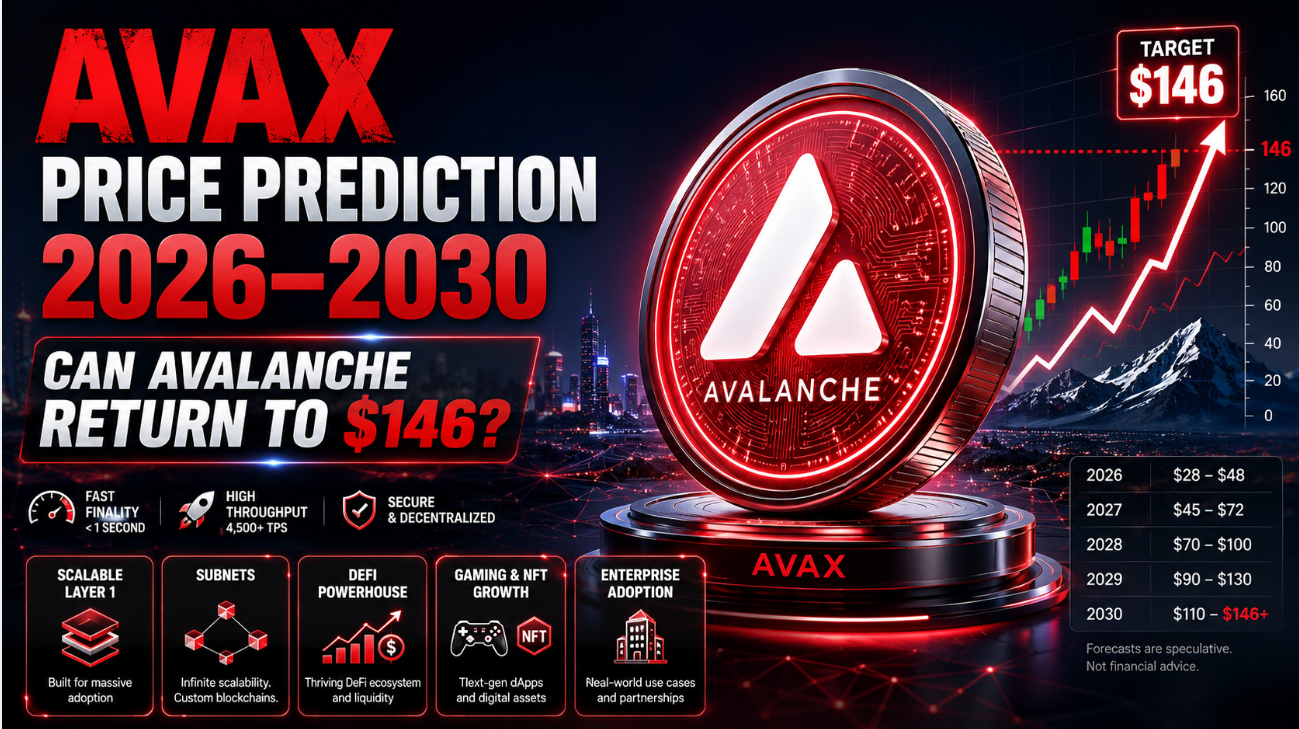
Introduction: AVAX Hit $146—How Should We View It Today?
In November 2021, AVAX reached its all-time high of approximately $146. That rally was driven by three core forces:
- A raging bull market where Layer 1 assets collectively exploded.
- Avalanche was positioned as the answer to Ethereum's congestion and high gas fees.
- Avalanche Rush and other ecosystem incentive programs attracted massive DeFi capital and projects.
At that stage, the market's positioning of AVAX was clear:
High-performance Layer 1 + Ethereum alternative + emerging DeFi hub.
But then AVAX crashed hard from its peak. The reasons are complex:
- The 2022 bear market compressed valuations across all altcoins.
- DeFi TVL collapsed industry-wide.
- Ethereum L2s rose rapidly, weakening the "ETH killer" narrative.
- Solana regained mindshare in consumer apps, memes, and high-frequency trading.
- Avalanche subnets had a clear direction, but deployment speed fell short of the market's most optimistic expectations.
So today, judging AVAX is not as simple as saying "it's outdated" or "it will definitely reclaim its highs."
The more accurate assessment is:
AVAX has transformed from the "Ethereum challenger" of 2021 into the "modular app-chain and institutional infrastructure competitor" of 2026.
This repositioning is critical.
If you analyze AVAX using 2021's "ETH killer" logic, you will misread it.
If you assume it's undervalued simply because the price dropped 80%, you will also misread it.
What actually matters is whether Avalanche can prove between 2026 and 2030 that subnets, institutional adoption, gaming chains, financial chains, and application-specific chains can generate sustained, real demand.
Chapter 1: AVAX's Technical Foundation—What Do Avalanche Consensus and Subnets Actually Solve?
Newcomers hearing about Avalanche often encounter a few keywords: high TPS, low latency, low fees, subnets.
But here's the catch:
Technical advantages only impact token price when they translate into real users, real transactions, and real revenue.
1. What Does Avalanche Consensus Solve?
Avalanche's core technology is the Avalanche Consensus Protocol. Its goal is to balance fast finality, high throughput, and meaningful decentralization.
- Compared to Ethereum: Avalanche offers faster confirmation times, making it suitable for latency-sensitive applications.
- Compared to Solana: Avalanche emphasizes multi-chain architecture and the flexibility of application-specific chains.
- Compared to Ethereum L2s: Avalanche's advantage is not "inheriting Ethereum's security," but rather giving projects a more controllable, independent execution environment.
This is Avalanche's true positioning:
It is not simply competing with Ethereum mainnet; it is competing for the "application-specific chain" and "enterprise-grade chain infrastructure" market.
2. Subnets Are Avalanche's Core Differentiator
Subnets are one of Avalanche's most unique designs.
In simple terms, subnets allow projects to launch their own dedicated blockchains within the Avalanche ecosystem. These chains can have their own rules, validators, fee models, compliance requirements, and execution environments.
As AWS describes in its overview of Avalanche subnets, the platform allows users to create application-specific blockchains with high customizability, improving speed and scalability for targeted use cases.
This design is highly attractive to enterprises and large-scale projects.
Why? Because many enterprises do not want to run all operations on a public chain. They often need:
- Custom permissions
- Custom gas models
- Compliance controls
- Dedicated performance
- Independent validators
- Data and operational isolation
- Interoperability with public-chain assets
This is the business logic behind Avalanche subnets.
3. Why Could Subnet Growth Drive AVAX Price?
Here is a critical question: Why would a subnet boom affect the AVAX main token?
There are several transmission mechanisms:
- Subnet deployment and validator requirements may increase demand for AVAX.
- More subnets raise the overall valuation of the Avalanche ecosystem.
- Developer and enterprise entry strengthens market confidence in AVAX's long-term value.
- More on-chain activity increases transactions, fees, and burns.
- Ecosystem expansion attracts DeFi, gaming, RWA, NFT, and infrastructure projects.
But none of this is automatic.
- If there are many subnets but few users, AVAX price won't necessarily rise.
- If subnets are just test chains with no real capital or users, they can't support valuation.
- If the value-capture link between subnets and AVAX is weak, the market won't assign a premium.
Therefore, judging AVAX requires looking beyond "subnet count" to metrics like:
- Subnet TVL
- Subnet transaction volume
- Subnet active addresses
- Whether subnets host real businesses
- Whether subnets generate AVAX staking, fee, or ecosystem demand
4. Avalanche9000: Why It Matters
Avalanche9000 (also known as the Etna upgrade) is one of Avalanche's most important technical upgrades in recent years. Avalanche official announcements confirm that Avalanche9000 is live, aiming to reduce costs and make launching Avalanche subnets significantly easier.
This is critical for AVAX's long-term price.
Previously, creating a subnet was relatively expensive. Many small projects, game studios, and app teams couldn't justify the deployment and maintenance costs. Avalanche9000's significance lies in reducing the cost of "launching an application chain" by orders of magnitude.
If lower costs attract more games, financial apps, and enterprises to build their own Avalanche L1s or subnets, AVAX's ecosystem upside could reopen.
But there is a risk:
Lowering costs only solves the supply-side barrier. AVAX's price ultimately depends on demand-side growth.
5. The HIBT Case Study: Tech Upgrades ≠ Long-Term Rallies
Using the HIBT research framework, technical upgrades typically trigger short-term sentiment, but long-term price depends on whether the upgrade brings real users and real revenue.
This applies to platform tokens like HIBT, and it applies equally to Layer 1 tokens like AVAX.
For HIBT, product launches and feature upgrades may cause short-term price reactions. But if user growth, trading volume, and fee revenue don't follow, price eventually reverts to fundamentals.
AVAX works the same way.
Avalanche9000, subnet upgrades, and institutional partnerships will attract attention.
But what ultimately matters is:
- Are subnets actually increasing?
- Are users growing?
- Is TVL rising?
- Are developers entering?
- Is trading volume expanding?
- Is AVAX capturing more value?
This is why you cannot buy AVAX based on headlines alone. You must watch the data that follows the headlines.
Chapter 2: The 7 Real Variables Controlling AVAX Price
AVAX does not only follow BTC. BTC sets the macro direction, but AVAX has its own independent variable set.
Variable 1: Subnet Quantity and Quality
Subnets are Avalanche's core narrative, but quantity alone is not enough.
A healthy subnet ecosystem should satisfy at least these conditions:
- Real projects deployed
- User transactions occurring
- Assets locked
- Stable developer presence
- Continuous operations
- Independent business scenarios
If many empty chains are created, the number is meaningless.
AVAX investors should focus on:
- New subnet launches
- Subnet daily transaction volume
- Subnet active addresses
- Subnet TVL
- Gaming subnet user retention
- Whether enterprise subnets have launched real products
Variable 2: TVL and DeFi Activity
Avalanche was once a DeFi hotspot. Today, DeFi TVL remains a critical health indicator.
Current DeFiLlama data shows Avalanche maintains stablecoin market cap, DEX volume, app fees, app revenue, active addresses, and new addresses. Key figures include over 600,000 24-hour active addresses, approximately $117 million in 24-hour DEX volume, and roughly $1.577 billion in stablecoin market cap.
This data proves Avalanche is not a "dead chain."
But whether it can become a hot ecosystem again depends on whether TVL, DEX volume, stablecoin supply, and app revenue are growing sustainably.
A crucial judgment criterion:
If AVAX price rises but on-chain TVL and transaction volume do not rise in tandem, the rally is likely sentiment-driven.
If AVAX price rises alongside TVL, active addresses, stablecoin supply, and app revenue, the rally is more likely fundamentals-driven.
Variable 3: AVAX Burn Mechanism
In Avalanche's fee model, transaction fees are burned. This means the more active the network, the more AVAX is destroyed.
In theory, this is bullish for price because it reduces supply.
But investors should remain level-headed:
- If network transaction volume is low, burn volume has negligible impact on total supply.
- If on-chain activity explodes, the burn mechanism becomes a genuine price support.
So AVAX's burn logic is not "burn exists, therefore price goes up." Rather:
Network activity increases → Fees increase → Burn increases → Supply pressure decreases → Price receives support.
The key variable remains network activity.
Variable 4: Institutional Adoption Progress
One of Avalanche's biggest differentiators is its emphasis on enterprise and institutional applications.
The Ava Labs and AWS partnership is a major case study. Ava Labs' official blog states plans to offer subnet deployment as a managed service on AWS Marketplace, enabling individuals and institutions to launch custom subnets more easily.
TechCrunch has also reported on the AWS–Ava Labs collaboration, with the goal of helping enterprises, institutions, and governments scale blockchain adoption.
Such partnerships are not short-term pumps. They are long-term positioning statements:
Avalanche wants to become the infrastructure for enterprises and institutions deploying customized blockchains.
If future deployments by BlackRock, Apollo, Franklin Templeton, WisdomTree, gaming companies, or financial institutions generate real business on Avalanche, AVAX's valuation logic becomes stronger than that of a generic Layer 1.
But the risks are clear:
- Pilot programs do not equal mass adoption.
- Announced partnerships do not equal on-chain revenue.
- Enterprise chains may not consume large amounts of AVAX.
- Institutional progress is typically slow.
Therefore, AVAX's institutional narrative requires long-term tracking, not FOMO buying on partnership news.
Variable 5: Staking Yield and Circulating Supply
AVAX is a PoS asset. Holders can earn yield through staking. Staking impacts price in two ways:
- It provides income to long-term holders, reducing short-term sell pressure.
- It locks up AVAX, reducing circulating supply.
But staking yield is not risk-free return.
If AVAX drops 50%, a single-digit annual yield cannot offset the principal loss.
Staking helps long-term investors with cost basis, but it cannot replace fundamental analysis.
The correct understanding:
Staking yield improves holding cost, but it does not determine AVAX's long-term direction. Long-term direction still depends on ecosystem growth.
Variable 6: Developer Activity
Blockchains ultimately compete for developers.
No developers → No apps → No users → No transactions → No fees → No token demand.
Avalanche's challenge is that it must compete with multiple strong rivals for developer mindshare:
- Ethereum and L2s have the largest developer ecosystem.
- Solana dominates consumer apps and high-performance trading.
- Base has Coinbase ecosystem backing.
- Sui and Aptos attract Move language developers.
- NEAR emphasizes account abstraction and chain abstraction.
For AVAX to win, it cannot just claim superior technology. It must make developers feel that:
- Deployment costs are low
- Tools are excellent
- Users are accessible
- Ecosystem funding is sufficient
- Projects can achieve real growth
Variable 7: Foundation Resources and Ecosystem Incentives
The Avalanche Foundation's treasury, incentive programs, and partnership resources influence whether developers and projects choose to build there.
But ecosystem subsidies are a double-edged sword.
Subsidies can drive short-term TVL and users. But if users are only there for rewards, they will leave when subsidies end.
A truly healthy ecosystem must transition from subsidy-driven to product-driven.
So when evaluating AVAX ecosystem incentives, watch whether:
- Incentives generate long-term retention
- Incentives attract high-quality projects
- Incentives push real application usage
- TVL remains after subsidies expire
Chapter 3: 2026 AVAX Price Prediction—The Layer 1 Battle in the Post-Halving Bull Market
2026 is a critical window for AVAX.
If capital rotation following the BTC halving continues, Layer 1 assets typically receive phased attention. But the 2026 Layer 1 competitive landscape is completely different from 2021.
- 2021: The market asked, "Who can replace Ethereum?"
- 2026: The market asks, "Who can find real-world use cases?"
AVAX's core question for 2026:
Can Avalanche9000 drive subnet growth and make the market re-recognize Avalanche's app-chain positioning?
1. Bull Case: Avalanche9000 Triggers Subnet Explosion
If Avalanche9000 drastically reduces subnet deployment costs, attracting games, RWA, financial institutions, and DeFi apps to create more Avalanche L1s or subnets, AVAX could be repriced higher.
Optimistic range: 80–130
This scenario requires:
- BTC and ETH in a strong cycle
- Layer 1 capital rotation kicks in
- Post-Avalanche9000 subnet count grows noticeably
- Avalanche TVL and trading volume rise steadily on DeFiLlama
- Gaming or institutional subnets show real users
- AVAX staking and burns form a positive feedback loop
2. Base Case: Ecosystem Recovery Without Explosion
The more realistic scenario is that Avalanche9000 brings moderate ecosystem improvement, but AVAX still faces intense competition from Solana, Base, Arbitrum, and Sui. The market respects Avalanche's technical roadmap but won't assign it the extreme valuations of 2021.
Base case range: 35–65
In this scenario, AVAX is not failing—it is undergoing a moderate recovery.
3. Bear Case: Capital Bypasses Layer 1 Altcoins
If 2026 market flows primarily into BTC ETFs, ETH ETFs, AI, RWA, or memecoins, while Layer 1 altcoins as a category are neglected, AVAX may continue range-bound at low levels.
Bear case range: 18–28
In this scenario, even if Avalanche's technology continues advancing, price may not rise because the market refuses to assign Layer 1 valuation multiples.
2026 Prediction Table
Scenario
Price Range
Core Conditions
Bear
18–28
Capital concentrates in BTC/ETH; Layer 1 rotation weak; subnet growth underwhelms
Base
35–65
Avalanche9000 brings moderate growth; ecosystem data recovers
Bull
80–130
Subnet explosion; institutions and games land; Layer 1 rotation strengthens
Most likely reason for 2026 prediction failure:
Avalanche9000 launches many subnets, but those subnets have no real users. The market may get excited short-term, then disappoint again.
Chapter 4: 2027—Can AVAX Transition from "Technical Concept" to "Real User Scale"?
2027 is AVAX's prove-it year.
2026 may trade on expectations. 2027 will trade on data.
The questions become direct:
- Do subnets have real users?
- Do enterprise chains have real business?
- Do gaming chains have DAU?
- Is DeFi TVL growing?
- Is AVAX being used meaningfully within the ecosystem?
1. Why Do Enterprises Choose Avalanche Subnets?
Enterprises choose Avalanche subnets because they need more controllable environments than public chains offer.
They may need:
- Permission controls
- Compliance requirements
- Independent fee models
- Custom validators
- High performance
- Interoperability with public chains
- Lower deployment barriers
This logic differs from Ethereum L2s:
- Ethereum L2s suit projects wanting Ethereum security and liquidity.
- Avalanche subnets suit projects wanting independent chain environments and customization.
So AVAX's competitive advantage is:
It does not force all apps onto one chain. It gives different apps their own chains.
2. Gaming Subnets Are the Most Likely Near-Term Winners
Gaming is perfectly suited for application-specific chains.
Games typically need:
- High-frequency transactions
- Low fees
- Independent economies
- Custom assets
- Controllable UX
- Protection from congestion caused by other on-chain apps
If Avalanche can produce real gaming subnet case studies, AVAX will regain market attention.
But past chain-gaming problems are obvious: many projects had poor user retention, unsustainable economies, and players who were only there for token farming.
So gaming subnet success cannot be judged by transaction volume alone. Watch:
- Daily active players
- Retention rates
- Game revenue
- NFT or asset trading
- Ratio of non-farming users
- Game lifecycle sustainability
3. Financial Institution Subnets Are a Longer-Term Narrative
Financial institution adoption of Avalanche may be slower than gaming, but if successful, the valuation impact is larger.
Financial institutions bring not short-term retail hype, but long-term asset management, RWA, settlement, compliance chains, and capital flows.
But institutional adoption has issues:
- Long pilot cycles
- Slow compliance processes
- Limited public data
- On-chain value capture may not be direct
- Institutional chains may not require heavy public-market AVAX trading
So AVAX holders cannot just watch for "an institution is exploring Avalanche." They must watch for:
- Real assets on-chain
- Growing transaction scale
- Long-term partnerships
- On-chain verifiable data
- Actual impact on AVAX staking, fees, and ecosystem demand
4. 2027's Biggest Threat: Ethereum L2s Catch Up on UX
If by 2027 Ethereum L2s have drastically improved user experience, fees, speed, cross-chain bridging, and account abstraction, Avalanche's technical advantages will be weakened.
Especially Base, Arbitrum, Optimism, and zkSync—if they offer deeper liquidity, larger user gateways, and richer developer ecosystems—many projects may prefer L2s over Avalanche subnets.
AVAX must prove it is not just "cheap and fast," but that:
- Subnet customization offers irreplaceable value
- Enterprises and games genuinely need independent chains
- Avalanche's developer experience is good enough
- Ecosystem support helps projects succeed
2027 Prediction Table
Scenario
Price Range
Core Conditions
Bear
12–22
Subnet deployment slow; L2s steal users and developers
Base
40–80
Gaming and enterprise subnets grow moderately; ecosystem stays active
Bull
90–160
Subnets produce benchmark cases; TVL, active addresses, and institutional adoption resonate
Most likely reason for 2027 prediction failure:
If Ethereum L2s match or exceed Avalanche on cost, experience, and enterprise tooling, AVAX's differentiation premium gets compressed.
Chapter 5: 2028—Halving Cycle Dividends and Global Regulatory Settlement
2028 has two major variables:
- BTC's fifth halving
- Global crypto regulation gradually settling
Both will impact AVAX simultaneously.
1. How Much Impact Will the Fifth BTC Halving Have?
As BTC's market cap grows, the marginal impact of each halving may diminish. But halvings still influence market expectations and capital rotation.
For AVAX, the transmission path is:
BTC halving narrative → Risk appetite rises → ETH and Layer 1 rotation → AVAX receives capital attention → If ecosystem data cooperates, price extends higher.
But if the halving is fully priced in, or if capital only wants BTC and ETH, AVAX's upside may be limited.
2. Regulatory Clarity Could Favor AVAX
Assets like AVAX fear regulatory uncertainty most.
If the US, EU, and major markets establish relatively clear crypto frameworks by 2028, AVAX could benefit.
Especially if AVAX is more clearly classified as a non-security infrastructure asset, institutional allocation barriers decrease.
Of course, this is highly uncertain. Regulatory outcomes themselves are unpredictable.
3. MiCA and Enterprise Subnets
The EU's MiCA regulation is pushing the market toward compliance. For Avalanche, this could be an opportunity or a pressure.
- Opportunity: Enterprises needing compliant, controllable chain environments may find subnets more attractive.
- Pressure: If regulatory requirements become too heavy, DeFi and open applications may be constrained.
So regulation's impact on AVAX is not simply bullish or bearish. It depends on whether Avalanche can turn "compliant, customizable chains" into a selling point.
4. Staking Lock-Up Impact on Price
If more AVAX is staked, circulating supply decreases, reducing downward price pressure.
But higher staking is not always better.
- If staking exists only because there are no other uses for AVAX, it signals weak ecosystem demand.
- If staking grows alongside ecosystem growth, validator growth, and subnet expansion, that is a healthy signal.
2028 Prediction Table
Scenario
Price Range
Core Conditions
Bear
15–30
Weak halving effect; regulation suppresses altcoins; subnet data flat
Base
55–110
Market enters new cycle; AVAX ecosystem grows steadily
Bull
130–220
Subnets, institutions, DeFi, staking, and burns resonate
Most likely reason for 2028 prediction failure:
If global regulation imposes excessive compliance burdens on app chains, DeFi, or enterprise chains, AVAX's institutional narrative may be delayed.
Chapter 6: 2029–2030—Three Possible Endgames for AVAX
Five-year predictions must acknowledge uncertainty.
By 2030, AVAX could be a top-tier Layer 1 asset, a specialized vertical infrastructure player, or it could be gradually marginalized by newer technologies and ecosystems.
We analyze three scenarios.
Scenario A: Layer 1 Dominance
This is the most optimistic scenario.
By 2030, Avalanche becomes critical multi-chain infrastructure:
- Subnet count grows massively
- Gaming chains, financial chains, and enterprise chains are widely used
- Institutional assets settle on Avalanche
- Avalanche DeFi re-flourishes
- AVAX staking rate stabilizes
- Burn mechanism strengthens with network activity
- Developer ecosystem keeps expanding
If this scenario plays out, AVAX has a chance to break its 146 all-time high and enter the **230–$380** range.
But this requires extremely demanding conditions:
- Avalanche becomes the dominant app-specific chain solution
- Subnets have real users and revenue
- TVL and stablecoin supply grow substantially
- Institutional adoption moves from pilot to scale
- ETH L2s do not fully suppress Avalanche
- Solana, Sui, and other competitors do not steal core markets
Scenario B: Vertical Specialist
This is the more realistic neutral scenario.
Avalanche does not necessarily become the #2 smart contract platform, but it builds dominance in several verticals:
- Gaming chains
- Enterprise chains
- RWA
- Financial institution subnets
- Compliant application chains
In this scenario, AVAX may not surpass Solana or Ethereum L2s across the board, but it commands a specialist sector premium.
2030 price range: 90–200
This outcome is already solid for long-term investors. But it requires Avalanche to maintain a clear positioning—not doing a little in every sector, but truly winning in at least one or two.
Scenario C: Marginalized Legacy Chain
This is the bearish scenario.
If the following occurs over the next few years, AVAX could be gradually marginalized:
- Subnet growth stalls
- Enterprise adoption stays in pilot mode
- Gaming chains have no real users
- DeFi TVL declines long-term
- Developers migrate to Solana, Base, Sui
- Foundation incentive effects weaken
- AVAX value capture remains insufficient
In this case, AVAX may linger in the 8–20 range long-term, becoming "a legacy chain from the last bull run."
2029–2030 Prediction Table
Year
Bear Case
Base Case
Bull Case
Core Judgment
2029
10–25
70–150
180–280
Whether subnets scale; whether Layer 1s are repriced
2030
8–20
90–200
230–380
Whether Avalanche becomes app-chain infrastructure
What Would It Take for AVAX to Reclaim $146?
AVAX returning to its all-time high requires at least 6 conditions:
- BTC and ETH in a strong cycle
- Layer 1 sector regains capital favor
- Noticeable subnet growth post-Avalanche9000
- At least 2–3 benchmark gaming or institutional subnets
- Sustained growth in Avalanche TVL, stablecoin supply, and trading volume
- AVAX staking, burns, and ecosystem demand forming positive feedback
Missing one or two conditions, AVAX could still rally.
But to reclaim $146, multiple variables must resonate simultaneously.
Chapter 7: AVAX Practical Playbook—How to Turn Predictions into Strategy?
Prediction numbers are maps, not marching orders.
Actually investing in AVAX requires converting analysis into position sizing, entry points, exit points, and risk controls.
1. What Type of Investor Is AVAX Suitable For?
Investor Type
Suitable for AVAX?
Reason
Complete Beginner
Cautious, small position
AVAX is volatile; Layer 1 competition is complex
Long-Term Chain Investor
Suitable to watch
AVAX has clear tech and subnet positioning
Short-Term Trader
Tradable but requires discipline
AVAX is sensitive to market sentiment
Conservative Investor
Not suitable for heavy positions
Altcoin Layer 1s can draw down deeply
Tech-Research Investor
Relatively suitable
Can track subnet, TVL, and developer data
2. Position-Building Strategies for Different Cycle Phases
Bear Market Bottom
- Small positions, batch observation
- Focus on whether TVL has stopped falling, whether subnets are still growing, whether developers are leaving
Early Bull Market
- Can increase position size moderately
- If BTC and ETH are already strong but Layer 1s haven't rotated yet, AVAX may have catch-up upside
Mid-to-Late Bull Market
- Be cautious chasing highs
- If social media starts shouting "AVAX to $300" but on-chain data isn't growing, consider taking profits in batches
3. How Does Staking AVAX Affect Strategy?
If you are long-term bullish on AVAX, consider staking for yield.
Staking benefits:
- Reduces holding cost
- Adds long-term yield
- Reduces impulse to trade short-term
But staking cannot fix a wrong directional bet.
If AVAX drops from $80 to $20, staking yield won't cover the principal loss.
Staking suits long-term believers, not those trying to hide bad entry points.
4. Subnet Data as Buy/Sell Signals
AVAX's most important leading indicator is not price—it is subnet and on-chain data.
Bullish signals:
- New subnet count consistently increasing
- Subnet active address growth
- Rising Avalanche TVL
- Increasing stablecoin supply
- Expanding DEX trading volume
- Institutional subnets with real assets on-chain
- Gaming subnets with real DAU
- Stable or rising AVAX staking rate
Bearish / Reduce-Position Signals:
- TVL declining consecutively
- Active addresses shrinking
- Subnet growth stalling
- Institutional partnerships with no follow-through
- Developers migrating to other chains
- Price surging but data not moving
- Community only discussing price targets, not ecosystem health
5. HIBT Case Study: Asset Characteristics Determine Strategy
For platform tokens like HIBT, the operational focus is platform user growth, trading volume, campaigns, listings, and platform revenue.
For Layer 1 tokens like AVAX, the operational focus is ecosystem data, developers, subnets, TVL, and on-chain activity.
You cannot use the same strategy for HIBT and AVAX.
- HIBT is a platform operations asset
- AVAX is an infrastructure asset
Platform tokens are judged by platform growth.
Chain tokens are judged by ecosystem growth.
Chapter 8: AVAX vs. SOL, ETH L2, NEAR, Sui—Why Choose AVAX?
Analyzing AVAX requires placing it in the Layer 1 / Layer 2 competitive landscape.
1. AVAX vs. Solana
- Solana's strengths: Consumer apps, memes, low fees, high performance, strong retail mindshare.
- Avalanche's strengths: Subnets, enterprise custom chains, institutional partnerships, application-specific chains.
Simple analogy:
Solana is like a high-performance public city.
Avalanche is like multi-chain infrastructure where different parks can be customized.
If consumer-grade crypto apps become the dominant narrative, Solana may outperform.
If enterprise chains, gaming chains, RWA, and institutional chains become dominant, Avalanche may benefit more.
2. AVAX vs. ETH L2s
- ETH L2s' biggest strength: Ethereum security, liquidity, and developer network.
- Avalanche's strength: Customizable chains and independent execution environments.
Reasons projects choose ETH L2s:
- Easier access to Ethereum liquidity
- Strong user familiarity
- Mature tooling
- Strong security narrative
Reasons projects choose Avalanche subnets:
- Greater customization
- Independent chain environments
- Configurable permissions and rules
- Better fit for enterprises and games
- Not dependent on Ethereum mainnet congestion
So AVAX and ETH L2s are not pure substitutes. They compete for different application architectures.
3. AVAX vs. NEAR, Sui
- NEAR emphasizes chain abstraction and user experience.
- Sui emphasizes high performance, object model, and Move language.
- Avalanche emphasizes subnets and application-specific chains.
AVAX's advantage is its earlier start, more mature ecosystem, and deeper institutional resources.
AVAX's disadvantage is that newer Layer 1s can tell fresher stories and more easily attract developer and capital attention.
So AVAX must offset "legacy chain" narrative fatigue with real-world deployment.
4. AVAX's Core Positioning
For 2026–2030, AVAX's clearest positioning should be:
Modular Layer 1 infrastructure for enterprises, games, finance, and application-specific chains.
If this positioning succeeds, AVAX has long-term value.
If this positioning fails, AVAX will be squeezed by stronger general-purpose chains and L2s.
Conclusion: Three Things You Must Know About This 5-Year AVAX Prediction
First: AVAX's biggest risk is not a crash—it is long-term sideways drift.
Many investors only fear price drops. But for infrastructure assets like AVAX, the more painful risk is: ecosystem progress is slow, price drifts sideways for years, and capital remains trapped in an inefficient asset.
If the subnet narrative deployment speed consistently lags expectations, AVAX may not collapse immediately, but it will erode investor time cost.
Second: ETH L2s are AVAX's biggest external variable.
If Ethereum L2s achieve major UX, cost, cross-chain, and account abstraction improvements by 2027, many projects may choose L2s over Avalanche subnets.
This would change AVAX's valuation model.
Therefore, AVAX investors cannot only watch Avalanche itself. They must also watch Base, Arbitrum, Optimism, zkSync, and other L2 developments.
Third: Subnet ecosystem data matters more than price predictions.
If you remember only one sentence from this article, let it be:
When investing in AVAX, watch subnet ecosystem data—not just price charts.
When you see real enterprises, real games, and real financial applications generating users, assets, and transactions on Avalanche, that is AVAX's most valuable signal.
Price predictions are only reference points.
Ecosystem data is the core.
AVAX Price Prediction Summary Table: 2026–2030

Appendix 1: AVAX Fundamental Data Quick Reference

Appendix 2: HIBT vs. AVAX Research Framework Comparison

Disclaimer
This article is for crypto asset research and market education only. It does not constitute investment advice, trading advice, or financial advice. AVAX is a high-volatility Layer 1 asset. Its price may be subject to extreme fluctuations driven by BTC cycles, Layer 1 competition, regulatory changes, technical upgrades, subnet deployment progress, institutional adoption, staking rates, and market liquidity. Any investment decision should be based on your personal risk tolerance, and you should consult a professional financial advisor when necessary.