
Preface: Why Was DOT Once a Top-5 Market Cap Token, Yet Left So Many Investors Bag-Holding?
DOT is a coin that evokes complex emotions among veteran investors.
It was once hailed as the "King of Cross-Chain," the "Ethereum Killer," and the "Core Asset of Web3 Infrastructure." During the last bull run, DOT briefly entered the upper echelons of crypto market capitalization, with market expectations running sky-high.
Yet years later, many DOT holders find themselves asking hard questions:
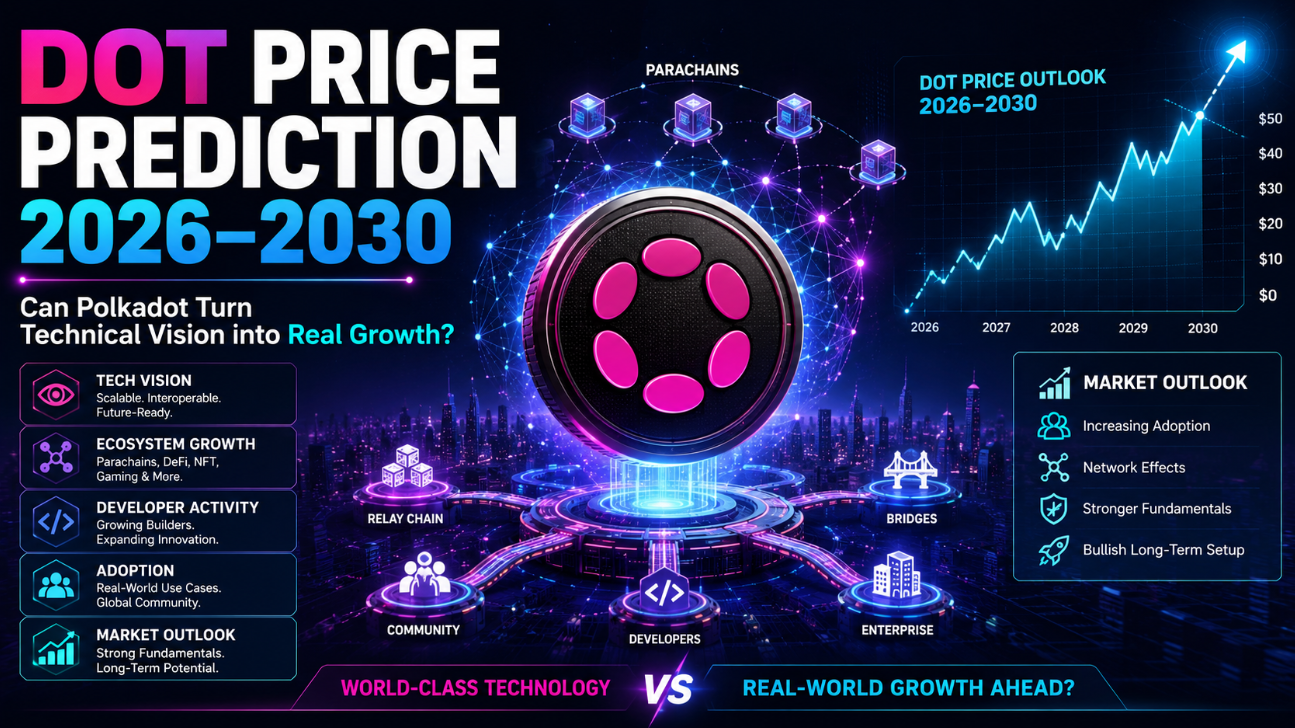
Why does the price remain depressed despite such strong technology? Why does Polkadot keep building, yet DOT underperforms SOL, ETH, and even some meme coins? Why does the project feel alive, yet the holding experience feels like being forgotten by the market?
This is precisely what makes DOT worth analyzing.
DOT isn't a simple altcoin, nor is it a failed project. It's better understood as an infrastructure asset with a grand technical vision that has struggled to find smooth market validation.
For newcomers, the biggest mistake in analyzing DOT is reducing it to merely a "cross-chain token." What Polkadot actually aims to solve goes far beyond cross-chain transfers—it seeks to enable different blockchains to operate atop shared security, unified governance, composable messaging, and unified infrastructure.
That vision is massive. And precisely because it's so massive, execution is extraordinarily difficult.
This article won't simply tell you "DOT will hit $X by 2030." The more valuable questions are:
- What problem does Polkadot actually solve?
- Why has DOT chronically underperformed the market?
- Do Polkadot 2.0 and JAM change the old logic?
- Does the inflation reform genuinely improve DOT's supply pressure?
- Where is the rational price range for DOT between 2026–2030?
- How should ordinary investors view DOT?
Within HIBT's research framework, any price prediction isn't fortune-telling—it's probabilistic推演 (deduction). Our goal isn't to blindly worship target prices, but to build a dynamically updable judgment system.
Chapter 1: Before Buying DOT, You Must Understand What Problem Polkadot Actually Solves
Polkadot's core goal can be summarized in one sentence:
Polkadot aims to become the underlying coordination network for a multi-chain world, enabling different blockchains to operate under a framework of shared security and interoperability.
That sounds abstract, so let's use a real-world analogy.
If every blockchain is a city, then the early blockchain world resembled isolated island cities:
- Bitcoin is one city.
- Ethereum is another.
- Solana is another.
- Avalanche is another.
- Cosmos is a cluster of cities.
The problem: roads, languages, laws, and security systems differ between every city. For users to move from one city to another, they need bridges, exchanges, cross-chain protocols, and complex processes. Every additional step introduces another layer of risk.
Polkadot wants to build a "multi-city high-speed rail network."
- The Relay Chain is the backbone transportation system.
- Parachains are different cities plugged into this system.
- Shared security is the unified security apparatus.
- Cross-chain messaging is the standardized communication protocol between cities.
1. Polkadot's Relay Chain and Parachain Architecture
Polkadot's original core design is "Relay Chain + Parachains."
The Relay Chain handles security, consensus, and cross-chain coordination. Parachains are independent blockchains plugged into Polkadot, each designed for different business scenarios.
The benefit of this architecture: Parachains don't need to build their own security networks from scratch—they can borrow Polkadot's shared security.
This matters enormously for developers.
If a new project builds its own chain, it must attract validators, guarantee security, maintain consensus, and draw in users all by itself. But if it plugs into Polkadot, it can offload part of the security burden to the Polkadot network.
This is Polkadot's core value proposition: making it easier for blockchain developers to build application-specific chains while sharing a larger security and interoperability network.
2. Why Did the Original Parachain Slot Model Run Into Problems?
Polkadot initially adopted parachain slot auctions. Projects seeking a parachain slot needed to lock up substantial amounts of DOT, typically for extended periods.
This design was attractive during the bull market. Projects could attract community DOT lockups via crowdloans, and the market interpreted locked supply as reduced circulating supply.
But the problems were obvious:
First, high barriers. Not every project was willing to lock up large amounts of DOT long-term.
Second, inflexible resources. Projects didn't necessarily need fixed blockspace at all times.
Third, potential sell pressure upon unlock. When crowdloan lockups ended, users got their DOT back—and many chose to sell.
Fourth, unfriendly to small projects. Many early projects lacked the capital or community scale for long-term slot auctions.
So the emergence of Polkadot 2.0 is essentially answering one question:
The original parachain model was too heavy. Polkadot needs to become more like an on-demand cloud computing marketplace for blockspace.
3. Agile Coretime: From "Renting the Whole Building" to "Booking a Meeting Room on Demand"
One of Polkadot 2.0's key changes is Agile Coretime.
As Polkadot's official Wiki explains, Coretime allows any rollup chain to access Polkadot's computational resources according to its own needs, thereby maximizing resource utilization and lowering barriers to entry for developers and rollup teams. Coretime sales are burned, creating deflationary pressure on DOT and contributing to protocol revenue.
That last sentence is crucial.
Previously, projects were like renting an entire building—long-term leases, high upfront costs. Coretime is more like booking a meeting room on demand: you buy exactly the resources you need.
This brings Polkadot's business model closer to a "blockspace marketplace."
If this marketplace actually works, DOT's value logic becomes clearer:
Projects use Polkadot resources → Buy Coretime → Generate DOT demand or burn → Reduce supply pressure → Support DOT value.
Of course, this is the ideal state. The real question is: Will enough projects actually buy?
4. The JAM Protocol: Polkadot's Next Major Surgery
JAM is one of Polkadot's most closely watched technical upgrades.
The Web3 Foundation describes JAM as the Join-Accumulate Machine, a new protocol intended to succeed the Polkadot Relay Chain, offering significantly enhanced smart contract functionality.
The JAM Gray Paper characterizes JAM as a new protocol model combining elements of Polkadot and Ethereum, providing a global permissionless object environment similar to Ethereum while incorporating Polkadot's proposed scalable parallel computation network.
Simply put, JAM isn't a minor upgrade—it's a fundamental redesign of Polkadot's underlying architecture.
For DOT, this presents two possibilities:
Possibility One: JAM succeeds, transforming Polkadot from a "complex but difficult-to-use multi-chain system" into a "more flexible, more powerful Web3 computation layer." Possibility Two: JAM continues adding cognitive complexity—strong technology, but the market still doesn't buy in.
This is DOT's core contradiction: a powerful technical vision, but the market demands users, revenue, and real demand.
HIBT Case Study: The One-Sentence Test
In HIBT's Hold It Before Trading framework, you must pass a one-sentence test before buying any asset.
For DOT, a passing answer might be:
Polkadot is a multi-chain infrastructure network attempting to enable different blockchains to access unified security and computational resources on demand through shared security, Coretime, and the JAM protocol.
If all you can say is "DOT is a cross-chain coin made by Gavin Wood," you don't truly understand it yet.
Chapter 2: DOT's Hidden Tokenomic Bomb—Inflation, Staking, and Supply Pressure
DOT's chronic underperformance against the market has one very important cause: tokenomics.
Historically, one of DOT's biggest problems was high inflation.
Many investors only looked at DOT's price decline from its all-time high without realizing: If a token sustains high inflation while demand fails to grow in tandem, long-term price suppression is the natural result.
1. DOT's Historical Inflation Problem
Early DOT had no fixed maximum supply, relying on inflationary rewards to incentivize validators and stakers. This helped network security, but was deeply unfriendly to non-staking holders.
If annual inflation hovered around ~10%, then non-staking holders were diluted by new supply every single year.
This is the real experience of many DOT holders:
The price doesn't rise, yet supply keeps increasing. Even if the project continues developing, the token price struggles to show strength.
2. The 2026 Inflation Reform: DOT's Supply Logic Changes
In 2026, DOT's tokenomics underwent significant changes.
Polkadot's official platform states that new DOT is issued as rewards to those helping secure the network; starting March 2026, issuance decreases every two years until a supply cap is reached.
Market coverage also indicates that Polkadot pushed important tokenomic changes around March 2026, with the market widely focused on DOT's supply cap and reduced issuance. Phemex's interpretation notes that DOT's annual inflation rate dropped from roughly 10% to approximately 3.11%, with a 2.1 billion DOT cap introduced.
This is major positive news for DOT—but it must not be over-interpreted.
Lower inflation ≠ guaranteed price increase. It merely reduces supply-side pressure.
What truly drives prices higher remains the demand side:
- Is Coretime being purchased?
- Is the Polkadot ecosystem active?
- Is JAM attracting developers?
- Is DOT forming real economic utility?
- Are parachains and applications bringing users?
If demand doesn't improve, reduced inflation only lessens downward pressure—it doesn't necessarily trigger a reversal.
3. Staking Yields: High Yield ≠ High Return
Many people see DOT's attractive staking yields and conclude DOT is suitable for long-term holding.
But staking yield must be net of inflation.
If nominal annual yield is 10%–15% but inflation is also high, real returns may not be ideal. If inflation drops while staking yields remain attractive, the DOT holding experience improves.
But investors must still note:
- Staking involves lock-up periods;
- Poor validator selection can hurt returns;
- Token price volatility dwarfs staking yields;
- Staking cannot offset long-term fundamental deterioration.
Therefore, DOT staking suits users who are genuinely long-term bullish on Polkadot—not those treating staking yield as risk-free yield farming.
4. Treasury Spending: Ecosystem Building or Disguised Sell Pressure?
Polkadot's treasury system holds substantial DOT, used to support ecosystem projects, development, community activities, and governance spending.
This is a double-edged sword.
If treasury funds flow to high-quality developers, infrastructure, and user growth, that's ecosystem investment. If spending efficiency is low, or funds flow to initiatives without measurable growth, the market treats it as potential sell pressure.
For DOT investors, don't just look at treasury balances—look at treasury spending efficiency:
- Does it attract developers?
- Does it bring real users?
- Does it boost Coretime demand?
- Does it grow Polkadot ecosystem projects?
- Does it improve DOT's value capture?
HIBT Case Study: Tokenomic Health Checklist
When HIBT analyzes infrastructure tokens like DOT, we examine five metrics:
- Is annual inflation too high?
- Does staking yield cover inflation?
- Does the token have real consumption scenarios?
- Does treasury spending enhance ecosystem value?
- Does the supply reform coincide with demand growth?
DOT's historical problem was supply-side pressure. Post-2026, supply-side issues improve. What truly needs validation next is the demand side.
Chapter 3: Seven Variables Affecting DOT's Price
Variable 1: Parachain Ecosystem Activity
DOT's most fundamental metric isn't Twitter hype or founder speeches—it's whether the Polkadot ecosystem actually has users.
Trackable metrics include:
- Parachain TVL;
- Active addresses;
- Transaction volume;
- Developer count;
- Core application user numbers;
- Cross-chain message volume;
- Coretime purchase volume.
If the Polkadot ecosystem fails to develop high-frequency usage scenarios, DOT will struggle to find long-term valuation support.
Variable 2: Whether the Coretime Market Actually Works
Coretime is the key business model of Polkadot 2.0.
Its success or failure can be judged by several questions:
- Are projects consistently buying Coretime?
- Is Coretime revenue growing?
- Does the burn mechanism have real impact on DOT supply?
- Are small projects entering Polkadot because Coretime lowers barriers?
- Is using Polkadot resources more cost-effective than alternatives?
If the Coretime market is active, DOT's demand logic becomes clearer. If Coretime demand is weak, Polkadot 2.0's business loop remains incomplete.
Variable 3: JAM Protocol Progress
JAM is Polkadot's biggest technical narrative.
If JAM proceeds on schedule and significantly improves developer experience and smart contract capabilities, Polkadot could regain market attention. If JAM remains stuck in the technical vision stage, the market may gradually lose patience.
Crypto's patience for technical narratives is limited. Especially when Solana, Base, Ethereum L2, and other ecosystems are attracting real users, Polkadot cannot sustain its valuation on "it will be stronger in the future" alone.
Variable 4: BTC and ETH Macro Cycles
DOT is a high-beta asset.
In bull markets, capital may flow from BTC and ETH into infrastructure tokens. In bear markets, complex assets like DOT are often the first to be sold off.
Thus, DOT's long-term predictions cannot be divorced from market cycles.
If a strong bull run emerges between 2026–2028, DOT may see a significant rebound even if fundamental improvements are limited. If the market enters a prolonged downturn, DOT may not rise even with technical upgrades.
Variable 5: Competitor Strength
Polkadot's competitors aren't a single project—they're an entire spectrum of infrastructure approaches:
- Cosmos: Modular app-chain ecosystem;
- Avalanche: Subnet and enterprise blockchain solutions;
- Ethereum Layer 2s: Rollup scaling and cross-rollup ecosystems;
- Solana: High-performance monolithic chain;
- Celestia and other modular DA projects;
- LayerZero, Wormhole, Chainlink CCIP and other cross-chain messaging protocols.
Polkadot's biggest problem: Its technical roadmap is comprehensive, but does the market still need such a comprehensive system?
If Ethereum L2s and cross-chain protocols already satisfy most needs, Polkadot's differentiation weakens. If a multi-chain world truly requires shared security and unified coordination layers, Polkadot regains its position in the main narrative.
Variable 6: Ecosystem Project Performance
DOT's price cannot decouple from ecosystem projects.
The development of projects like Moonbeam, Astar, Acala, Hydration, and Bifrost directly shapes outside perception of the Polkadot ecosystem.
If ecosystem projects lack breakout applications, DOT struggles to attract new capital. If the Polkadot ecosystem produces something on the scale of Uniswap, Aave, Jupiter, or Pump.fun, DOT's narrative improves dramatically.
Variable 7: Gavin Wood and Web3 Foundation Influence
Gavin Wood is one of Polkadot's soul figures. His technical reputation is a net positive for Polkadot.
But founder influence is also a double-edged sword.
If the market perceives Polkadot as overly dependent on a few core individuals, long-term resilience of decentralized governance comes into question. If the Web3 Foundation, Parity, OpenGov, and ecosystem teams form efficient collaboration, Polkadot's governance advantage becomes more evident.
HIBT Case Study: Signal vs. Noise Filter
When HIBT evaluates DOT, the three variables most worth tracking long-term are:
- Coretime usage and revenue;
- Polkadot ecosystem activity;
- Real demand changes for DOT following supply reform.
Other news—short-term price moves, community arguments, KOL shilling—is mostly noise.
Chapter 4: 2026 DOT Price Prediction—Year of JAM: Can Technical Breakthroughs Translate to Price Breakthroughs?
2026 is DOT's critical revaluation window.
Three reasons:
- DOT's tokenomic reform reduces long-term inflation pressure.
- Polkadot 2.0 and Coretime begin reshaping the business model.
- JAM becomes the core narrative for the market to re-evaluate Polkadot's technical roadmap.
But 2026 also carries substantial risks.
Because technical upgrades do not automatically equal price increases. What the market truly cares about is: After the upgrade, are there users? Revenue? Demand?
2026 Bear Case: 3–6
If JAM progress is delayed, Coretime market demand is insufficient, the Polkadot ecosystem continues lacking strong applications, and the broader market enters a bear phase, DOT may remain depressed.
Even with reduced inflation, the market may conclude Polkadot still lacks a growth story.
**Bear range: **3–6
2026 Base Case: 8–16
If JAM progresses steadily, the Coretime mechanism is gradually adopted by projects, the Polkadot ecosystem sees mild recovery, and market sentiment improves, DOT has a chance to enter a valuation repair zone.
This range represents "technical confidence restoration," not a full breakout.
**Base range: **8–16
2026 Bull Case: 20–38
If JAM becomes a market hotspot, Polkadot 2.0 is viewed as a major multi-chain infrastructure upgrade, and BTC and ETH drive broader market risk appetite upward, DOT may see a strong rebound.
But this scenario requires technology, ecosystem, and market cycles to align simultaneously.
**Bull range: **20–38
HIBT Case Study: Technical Milestones ≠ Price Catalysts
HIBT divides Polkadot's good news into two categories:
- Technical milestones: JAM, Coretime, governance upgrades.
- Price catalysts: User growth, revenue growth, DOT burns, ecosystem TVL increases.
Only when technical milestones convert into price catalysts can DOT truly be revalued.
Similar logic applies to long-term infrastructure assets. If you want to compare with a more "veteran cyclical asset," you can read HIBT's LTC (Litecoin) Price Prediction 2026–2030 . LTC and DOT operate on completely different logic, but both require distinguishing "historical status" from "future demand."
Chapter 5: 2027 DOT Price Prediction—Can the Coretime Business Model Validate Itself?
By 2027, DOT's central question shifts from "is the technology upgrading?" to "is the business model working?"
If Coretime succeeds, Polkadot becomes more like a decentralized cloud computing resource marketplace. Projects buy resources on demand, Coretime sales generate revenue, and a portion of DOT is burned—forming a supply-demand closed loop.
But whether this loop forms depends on real demand.
1. Is Coretime Demand Large Enough?
DOT's supply pressure has decreased, but still requires demand-side support.
If Coretime sales volume is small, the impact on DOT price is limited. If Coretime sales grow consistently and create measurable deflationary pressure on DOT, the market will reprice Polkadot's economic model.
2. Does Agile Coretime Dilute DOT Value?
Agile Coretime lowers usage barriers—that's positive for the ecosystem. But from an investor perspective, we must judge whether it also reduces projects' long-term lock-up demand for DOT.
Previously, slot auctions locked up large amounts of DOT. Now, on-demand resource purchases may reduce long-term lock-ups while improving resource utilization efficiency.
So this is a question of "old demand decreasing, can new demand fill the gap?"
2027 Bear Case: 4–9
If Coretime demand is weak, JAM still hasn't significantly improved developer experience, ecosystem application growth is slow, DOT may continue oscillating at low levels.
**Bear range: **4–9
2027 Base Case: 14–28
If the Coretime market gradually works, Polkadot ecosystem activity improves, DOT burns and demand begin gaining market recognition, DOT has a chance to enter a more pronounced valuation repair phase.
**Base range: **14–28
2027 Bull Case: 35–65
If multi-chain interoperability re-emerges as a dominant market narrative, Polkadot's Coretime and JAM are widely adopted by developers, and the ecosystem produces a star application, DOT has a chance to challenge the previous cycle's core high range.
**Bull range: **35–65
HIBT Case Study: Business Model Validation Checklist
To judge whether DOT's business model is working, HIBT asks three questions:
- Are projects consistently paying for Polkadot resources?
- Does that payment lead to DOT burns or real demand?
- Is ecosystem growth outpacing DOT's new supply pressure?
If all three answers are negative, Polkadot 2.0 remains merely a technical narrative. If answers gradually turn positive, DOT may enter a new valuation cycle.
Chapter 6: 2028 DOT Price Prediction—BTC Halving Cycle: Can DOT Return to Its All-Time High?
2028 approaches the next BTC halving cycle, making it a critical year for determining whether DOT re-enters the mainstream asset视野 (view/scope).
Historically, infrastructure tokens tend to perform stronger in the mid-to-late stages of bull markets. Capital flows into BTC first, then ETH, then diffuses into public chains, DeFi, AI, memes, and other high-beta assets.
If DOT completes fundamental repair during 2026–2027, 2028 may enjoy cyclical dividends.
But if the Polkadot ecosystem still lacks strong applications, DOT may only track the broader market's rebound rather than independently outperforming.
What Would It Take for DOT to Return to $55?
DOT once approached its ~$55 all-time high. But returning to that level isn't merely a price question—it's a market cap and supply question.
If DOT's supply is higher than the previous cycle, the same price corresponds to a larger market cap. This means DOT needs stronger demand, higher ecosystem activity, and clearer value capture.
So "returning to the all-time high" is not automatic.
It requires at minimum:
- A strong macro bull market;
- Clear Polkadot ecosystem recovery;
- A working Coretime business model;
- Developer growth from JAM;
- Controllable DOT supply pressure;
- At least one ecosystem application breaking out of the crypto bubble.
2028 Bear Case: 5–12
If DOT merely tracks the market's rebound but ecosystem growth remains limited, prices may stay in the mid-to-low range.
**Bear range: **5–12
2028 Base Case: 22–45
If 2028 enters a bull market, Polkadot's technical upgrades regain market recognition, and Coretime and JAM generate some growth, DOT has a chance to approach the zone below its previous cycle high.
**Base range: **22–45
2028 Bull Case: 55–95
If the Polkadot ecosystem sees clear breakout growth, DOT becomes a core multi-chain infrastructure target, and market sentiment is strong, DOT has a chance to break its all-time high.
**Bull range: **55–95
HIBT Case Study: All-Time High Stress Test
HIBT doesn't treat "returning to the all-time high" as a target—we treat it as a test:
If DOT is to return to $55, do current ecosystem revenue, users, supply, and narrative support a higher market cap?
If the answer is no, the all-time high is merely a psychological anchor, not a rational target.
Chapter 7: 2029 DOT Price Prediction—Internet Infrastructure, or Has-Been?
By 2029, the blockchain infrastructure赛道 (track/sector) will likely be more mature.
The market will no longer reward "technical vision" alone. It will reward real usage, revenue, developer ecosystems, and network effects.
1. Polkadot's Biggest Problem: Technical Leadership ≠ Market Leadership
Polkadot has long been considered technologically advanced. But crypto markets have repeatedly proven that the ultimate winner isn't necessarily the technically optimal solution—it's the ecosystem with the strongest comprehensive experience.
- Solana's advantage is speed and user experience.
- Ethereum's advantage is security, developers, and liquidity.
- Cosmos's advantage is flexible app-chain ecosystems.
- Base's advantage is Coinbase's user onramp and Ethereum ecosystem connectivity.
Polkadot must prove it isn't "strong technology that nobody uses."
2. OpenGov: Decentralized Governance—Advantage or Burden?
Polkadot's OpenGov is a highly decentralized governance system.
This benefits community participation, but may also introduce governance complexity and decision-making inefficiency.
By 2029, the market will have a clearer read on OpenGov's results:
If governance is efficient, fund usage is transparent, and ecosystem growth is evident, OpenGov becomes an advantage. If governance is chaotic, spending is inefficient, and community infighting is severe, it becomes a discount factor.
2029 Bear Case: 6–15
If the Polkadot ecosystem remains stagnant, developers and users flow to other ecosystems, DOT may become a legacy infrastructure asset lacking growth premium.
**Bear range: **6–15
2029 Base Case: 30–65
If Polkadot becomes an important choice for enterprise-grade, application-specific, and cross-chain infrastructure, with steady ecosystem growth, DOT has a chance to enter the mature infrastructure valuation range.
**Base range: **30–65
2029 Bull Case: 80–150
If a true multi-chain world takes shape, Polkadot carries large volumes of cross-chain applications, enterprise chains, and high-value application chains, DOT could become one of the core infrastructure主线 (mainline) assets.
**Bull range: **80–150
HIBT Case Study: Infrastructure Valuation Method
HIBT doesn't recommend comparing infrastructure projects solely by market cap ranking.
A better approach:
Theoretical Value = Usage × Unit Value × Value Capture Rate
For DOT:
- Usage = Coretime usage, parachain activity, cross-chain message volume;
- Unit Value = Revenue generated per unit of blockspace or security resource;
- Value Capture Rate = Impact of revenue on DOT supply/demand and burns.
If usage is very low, even the grandest vision struggles to support high valuation.
Chapter 8: 2030 DOT Price Prediction—In a Multi-Chain World, Where Does Polkadot Stand?
By 2030, DOT faces three possible outcomes.
Outcome One: Polkadot becomes an important infrastructure layer in a multi-chain world. Outcome Two: Polkadot survives, but remains a niche technical community. Outcome Three: Polkadot is marginalized by Ethereum L2s, Cosmos, Solana, or new modular infrastructure.
Thus, DOT's 2030 prediction range must be very wide.
1. 2030: "One Chain to Rule Them All" or "Many Chains Coexisting"?
If the future is "one chain dominant"—for example, Ethereum L2s or Solana capturing most applications—Polkadot's space gets compressed.
If the future is "multi-chain coexistence," where different applications need different execution environments, shared security, and cross-chain coordination, Polkadot's endgame thesis becomes more valuable.
DOT's long-term investment logic is essentially a bet that the multi-chain world will materialize.
2. Coretime Revenue Determines DOT's Mature Valuation
By 2030, DOT's valuation cannot rely on stories alone—it must be explainable by revenue.
If Coretime annual revenue reaches substantial scale and consistently creates DOT burns or demand, DOT can receive valuation closer to infrastructure revenue assets.
If Coretime revenue remains limited, DOT will still be treated as a high-volatility infrastructure token, not a mature network asset.
2030 Bear Case: 4–12
If the multi-chain narrative weakens, Polkadot becomes a niche ecosystem, Coretime revenue is low, JAM fails to significantly expand users, DOT may remain depressed long-term.
**Bear range: **4–12
2030 Base Case: 50–120
If a multi-chain world takes shape, Polkadot occupies a middle-layer infrastructure position, Coretime revenue grows steadily, ecosystem applications are active, DOT has a chance to enter the 50–120 range.
**Base range: **50–120
2030 Bull Case: 160–350
If Polkadot becomes the core routing layer of the blockchain internet, JAM successfully lands, the Coretime market is highly active, and enterprise chains, app chains, and Web3 services widely adopt Polkadot, DOT could enter the extreme bull scenario.
**Bull range: **160–350
But it must be emphasized—this is not a base expectation. It is a high-end scenario requiring multiple optimistic conditions to align simultaneously.
HIBT Case Study: Endgame Valuation Three-Step Method
HIBT's endgame valuation method works like this:
Step 1: Set a 2030 target price. Step 2: Judge the probability of that target being achieved. Step 3: Use time discounting and risk discounting to reverse-engineer a reasonable current cost basis.
For example, if you believe DOT's 2030 base price is 80 but the probability of achieving it is only 40%, with long wait times and high volatility, then whether it's worth buying today cannot be judged by the "80" number alone.
Truly mature investors don't just look at target prices—they look at probability and path.
Chapter 9: DOT vs. ATOM, AVAX, ETH Layer 2: Four Questions Newcomers Ask Most
1. DOT vs. ATOM: Whose Cross-Chain Route Is Better?
Polkadot emphasizes shared security and unified coordination. Cosmos emphasizes sovereign app-chains and IBC interoperability.
DOT's advantage: security and standardization. ATOM/Cosmos's advantage: flexibility and ecosystem freedom.
If you believe in multi-chain shared security, DOT has stronger logic. If you believe in sovereign app-chains growing freely, Cosmos has stronger logic.
2. DOT vs. AVAX: Who Is Better for Enterprise Chains?
Avalanche's subnet narrative leans more toward enterprise, gaming, and custom chain deployment. Polkadot's parachains and Coretime lean more toward shared security and multi-chain coordination.
AVAX's advantage: market execution and more direct user perception. DOT's advantage: more complete technical architecture, but higher cognitive cost.
3. DOT vs. ETH Layer 2: Who Has the Long-Term Edge?
Ethereum Layer 2's biggest advantage is inheriting ETH's liquidity, developers, and security consensus.
Polkadot's advantage is being designed for multi-chain architecture from day one, rather than extending a single chain.
But the real question is: Where do developers and users prefer to go?
If ETH L2 ecosystems are cheap enough, usable enough, and secure enough, Polkadot's differentiation gets compressed. If L2 fragmentation becomes severe, Polkadot's unified multi-chain coordination capability becomes more valuable.
4. If You Could Only Hold One Until 2030?
HIBT won't directly say "buy this one." Instead, we compare across five dimensions:

DOT's advantage: large endgame imagination. DOT's disadvantage: slow market validation, heavy tokenomic historical baggage, high cognitive barrier.
Chapter 10: DOT Investment Playbook
1. What Type of Investor Is DOT Suitable For?
DOT suits three types of people:
- Those who understand infrastructure long cycles;
- Those who can accept years of volatility and stagnation;
- Those willing to track ecosystem data rather than just watching prices.
DOT does not suit three types of people:
- Those who only want short-term parabolic pumps;
- Those who cannot tolerate long-term sideways action;
- Those who don't understand inflation, staking, and multi-chain architecture.
2. Direct Holding vs. Staking DOT
Direct holding is simplest, but misses staking yield. Staking DOT earns network rewards, but requires bearing lock-up, validator selection, and price volatility risks.
For long-term Polkadot bulls, staking can mitigate inflation dilution. For short-term traders, staking lock-ups may reduce flexibility.
3. Five Core Monitoring Metrics
If you follow DOT, check regularly:
- DOT staking rate;
- Coretime utilization rate;
- Polkadot ecosystem TVL;
- Parachain active addresses and transaction volume;
- JAM development progress and developer adoption.
Among these, Coretime utilization and ecosystem activity matter most.
4. How Large Should a DOT Position Be?
Reference framework:
- Conservative: DOT = 0–2% of crypto portfolio;
- Balanced: DOT = 2–5%;
- Aggressive: DOT = 5–10%.
We do not recommend treating DOT as a sole core position for ordinary investors.
A more rational allocation:
- BTC / ETH: Core positions;
- SOL, major L2s, infrastructure assets: Medium positions;
- DOT, ATOM, AVAX and other high-uncertainty infrastructure tokens: Small-to-medium positions;
- DeFi, AI, Memes: Satellite positions.
If you want to compare with a DeFi infrastructure asset, you can also read HIBT's LQTY Price Prediction 2026–2030 . LQTY and DOT occupy different sectors, but both require judging from the perspective of mechanism, demand, and value capture—not just price.
If you want to see analysis of a more AI and identity-narrative long-term asset, you can also read HIBT's WLD Price Prediction 2026–2030 .
5. How to Design a DOT DCA Strategy?
If you're bullish on DOT but uncertain about price levels, consider a tiered approach:
- Tier 1: Observation position at undervalued levels. When prices are low but fundamentals unconfirmed, build only a small position.
- Tier 2: Data-confirmation position. When Coretime usage, ecosystem activity, and JAM progress improve, add to the position.
- Tier 3: Trend-confirmation position. When DOT strengthens relative to ETH and the market refocuses on Polkadot, build a trend position.
Profit-taking should also be tiered:
- Reduce partially when returning to the previous cycle's key resistance zone;
- Reduce partially when reaching the base prediction range;
- Don't fantasize about selling the exact top when entering extreme bull scenarios.
HIBT Case Study: Complete Investment Decision Flow
From "I want to buy DOT" to "I know what to do," the HIBT flow is:
- Explain what problem Polkadot solves.
- Judge whether DOT tokenomics are improving.
- Track Coretime, JAM, and ecosystem activity.
- Set three-scenario price ranges.
- Decide position sizing.
- Set prediction failure conditions.
- Update judgments based on data, not stubborn faith.
Conclusion: Five Uncomfortable Truths You Must Face Before Investing in DOT
Truth 1: Technical leadership does not guarantee price appreciation.
Polkadot's technology is strong, but the market ultimately rewards users, revenue, and demand.
Truth 2: The DOT holding experience is harder than many mainstream coins.
Long-term sideways action, high volatility, technical complexity, and a slow-heating ecosystem make it easy for ordinary investors to lose patience.
Truth 3: JAM is both an opportunity and a risk.
If JAM succeeds, Polkadot may be revalued. If JAM is delayed or the market doesn't buy in, DOT may continue under pressure.
Truth 4: The multi-chain world may not develop according to Polkadot's vision.
The future may be multi-chain coexistence, or ETH L2s and a few high-performance chains may dominate user attention.
Truth 5: DOT requires prediction failure triggers.
If the following occur, re-evaluate DOT:
- Coretime usage remains chronically weak;
- JAM sees no substantive adoption for an extended period;
- Polkadot ecosystem TVL and users continue declining;
- DOT underperforms ETH for years with no improvement;
- Treasury spending fails to generate ecosystem growth.
Summary: DOT Is Not a Dead Coin, But Neither Is It a Blind-Faith Coin
DOT's greatest opportunities lie in:
- Polkadot remains one of the few infrastructure projects with a complete multi-chain architecture;
- Polkadot 2.0 lowers resource usage barriers;
- Coretime brings DOT's value capture logic closer to a real business model;
- JAM may redefine Polkadot's technical capabilities;
- Post-2026, inflation pressure improves;
- If the multi-chain world materializes, Polkadot still has endgame imagination.
But DOT's greatest risks are equally obvious:
- High technical complexity and user comprehension cost;
- Ecosystem lacking breakout applications;
- Historical inflation damage to market confidence;
- Very strong competitors;
- Technical upgrades don't automatically convert to user growth;
- DOT's value capture still requires Coretime and ecosystem demand validation.
Therefore, DOT's most rational positioning is neither "a must-buy mainstream coin" nor "a failed old coin."
It is better understood as a high-uncertainty infrastructure observation target.
If Polkadot 2.0, JAM, Coretime, and ecosystem applications can form synergy, DOT has a chance to regain market pricing between 2026–2030. If these variables fail to materialize, DOT may remain stuck in the awkward state of "strong technology, weak price."
The truly mature investor doesn't just ask:
"How high can DOT go by 2030?"
But rather asks:
"If DOT is to reach that price, how much real usage, revenue, and token demand must Polkadot generate?"
That question is the truly valuable starting point for DOT price prediction.
FAQ: Frequently Asked Questions About DOT Price Predictions
1. What is DOT? DOT is the native token of the Polkadot network, used for staking, governance, network security, and ecosystem resource usage. Polkadot is a multi-chain infrastructure network aiming to enable different blockchains to operate under a framework of shared security and interoperability.
2. What is Polkadot 2.0? Polkadot 2.0 is a major upgrade direction for Polkadot, centered on Agile Coretime, on-demand blockspace purchases, resource allocation optimization, and the future evolution of the JAM protocol. It attempts to shift Polkadot from a fixed parachain slot model toward a more flexible blockspace marketplace.
3. Is the JAM protocol bullish for DOT? JAM is a major technical upgrade for Polkadot. If successfully deployed and attracting developers, it could become a long-term positive for DOT. But if progress falls short of expectations or fails to bring real user growth, the market may not award DOT a premium valuation.
**4. Can DOT reach $100 by 2030?** It's possible, but requires clear Polkadot ecosystem growth, a working Coretime business model, successful JAM deployment, controllable DOT supply pressure, and a strong macro cycle. $100 is not a base expectation—it's a relatively optimistic scenario.
5. Is DOT still worth holding long-term? DOT suits investors willing to research infrastructure, accept high volatility, and understand long cycles. It is not suitable for newcomers who completely lack understanding of Polkadot's architecture and only want short-term parabolic gains with heavy positions.
6. What is DOT's biggest risk? The biggest risks include insufficient ecosystem user growth, weak Coretime demand, JAM delays, competitive挤压 (squeeze/pressure), governance inefficiency, and DOT chronically underperforming ETH and other mainstream assets.
7. What matters most when judging whether DOT is worth buying? The five most important metrics are: Coretime utilization rate, Polkadot ecosystem TVL, parachain activity, JAM development progress, and DOT supply/burn dynamics.
Author: Luke | Web3 SEO & Crypto Research Contributor
Long-term focus on cryptocurrency trading platforms, DeFi protocols, Web3 infrastructure, on-chain data, and SEO growth research. Specializes in dissecting complex crypto assets' business models, token value capture, risk structures, and long-term valuation logic from an ordinary investor's perspective. This article is for informational and educational purposes only and does not constitute investment advice.
Risk Disclosure & Disclaimer
This content is for cryptocurrency knowledge (popularization) and market research only. It does not constitute investment advice, financial advice, or trading recommendations. DOT is a high-volatility crypto asset subject to market cycles, protocol upgrades, ecosystem development, regulatory policy, tokenomic changes, and competitive landscape shifts. All price predictions carry substantial uncertainty. Readers should exercise independent judgment based on their own risk tolerance and conduct thorough research before investing.
References & Data Sources
- https://polkadot.com/platform
- http://wiki.polkadot.com
- http://jam.web3.foundation
- http://graypaper.com
- https://phemex.com/blogs/polkadot-halving-tokenomics-explained