
Preface: Why RPL Price Prediction Is Difficult—Yet Worth Studying
In crypto, "price prediction" is the most abused content category.
You’ve seen the headlines:
- "This coin will 100x."
- "This DeFi token could be the next LDO."
- "RPL will hit $500 by 2030."
They grab attention, but they rarely tell you why.
For newcomers, the real danger of price predictions isn’t that they might be wrong—it’s treating them as certainty. A valuable prediction doesn’t tell you RPL will hit a specific price. It gives you a framework:
- Why would RPL rise?
- Under what conditions would it fall?
- Which metrics actually matter?
- Which catalysts are just short-term noise?
- If the thesis breaks, how do you adjust?
This article builds that framework around Rocket Pool’s business logic, RPL’s token value, the ETH staking landscape, the Saturn upgrade, competitive dynamics, and multi-scenario price ranges for 2026–2030.
Disclaimer: This is not investment advice. RPL is a high-volatility, high-uncertainty DeFi asset. Any price prediction can be invalidated by market cycles, protocol upgrades, regulatory shifts, or security incidents.
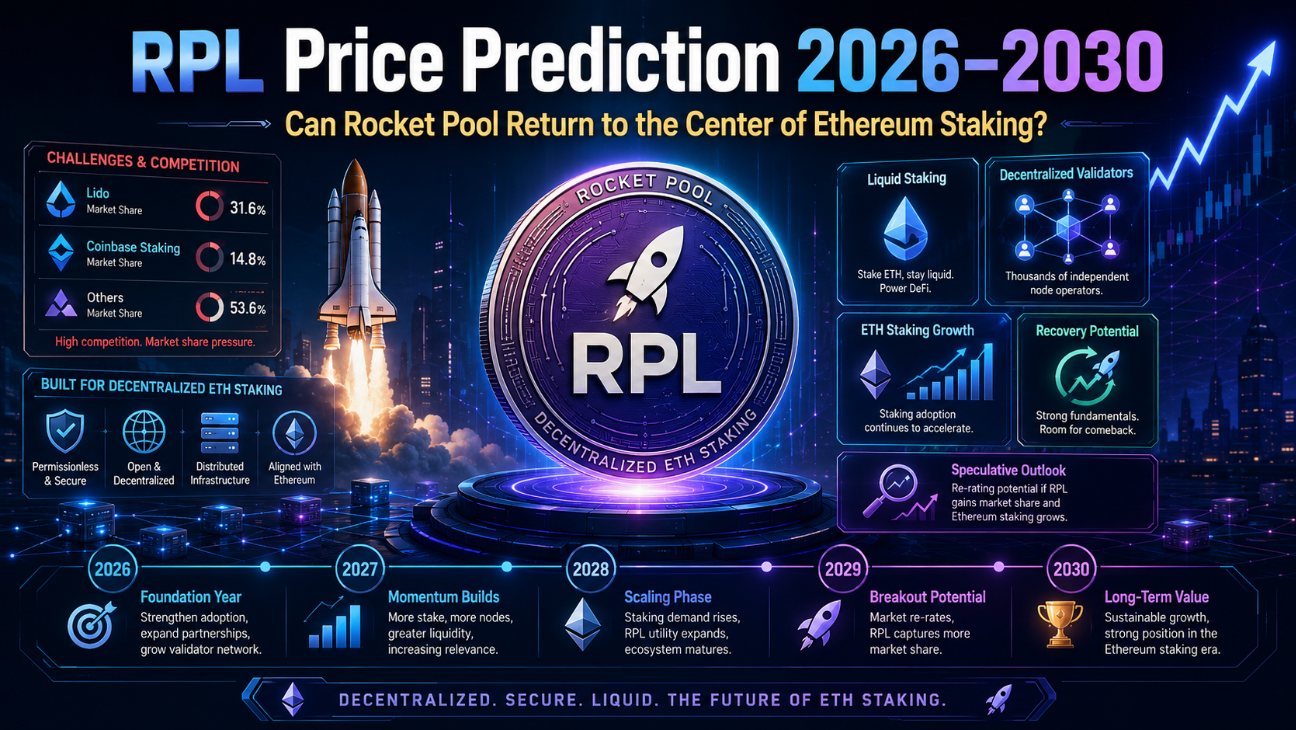
1. What Is RPL? How Does It Relate to Rocket Pool?
RPL is the native token of the Rocket Pool protocol.
Rocket Pool is a decentralized ETH staking protocol in the Ethereum ecosystem. Its core mission: let users earn staking rewards without needing 32 ETH or running their own validator node. The protocol offers both liquid staking and node staking products.
Rocket Pool connects two types of users:
Type 1: Regular ETH holders.
They deposit ETH into Rocket Pool and receive rETH—a liquid staking token representing their share of staked ETH that appreciates relative to ETH as rewards accrue. Coinbase describes rETH as the liquid staking token of Rocket Pool, representing ETH actively participating in Ethereum PoS and accumulating rewards.
Type 2: Node operators.
They run validators and earn protocol rewards. A key feature of Rocket Pool is lowering the barrier for individuals to operate Ethereum validator nodes.
RPL sits at the incentive and governance layer. Historically, node operators were required to stake RPL as collateral to receive protocol rewards. After the Saturn 0 and Saturn 1 upgrades, RPL’s role shifted: it is no longer purely a "node collateral token," but is evolving into an ETH-accrual revenue-sharing asset.
This shift is the most critical variable for analyzing RPL’s future price.
2. Why Is Attention Returning to RPL? The Saturn Upgrade Is the Key
Looking at RPL’s price history alone, you’ll see strong bull cycles and deep drawdowns.
But price is not the point. The question is: has the fundamental logic changed?
Rocket Pool’s Saturn upgrade series is the core variable affecting RPL’s future valuation.
According to official Rocket Pool documentation, Saturn 0 aimed to improve RPL’s tokenomics in the short term and unlock protocol growth. After Saturn 0, the protocol no longer requires a minimum RPL holding. Previously, node operators had to hold RPL equivalent to at least 10% of borrowed ETH value.
This change cuts both ways.
Bearish view: Removing the minimum RPL staking requirement weakens "forced buying demand." In the past, running a Rocket Pool node meant you had to acquire RPL; that rigid demand is now gone.
Bullish view: Lowering the barrier for node operators could expand Rocket Pool’s node network and improve protocol competitiveness. RPL loses some rigid demand, but the protocol itself may gain larger growth potential.
Saturn 1 is more critical. Official docs state that in Saturn 1, RPL becomes an ETH-accrual revenue share token. Node operators staking eligible RPL on the megapool can receive a proportional share—9% of protocol revenue in ETH.
This means RPL’s valuation logic is shifting from "collateral demand" to "protocol revenue capture."
That is a massive change.
In the past, you analyzed RPL by asking whether node operators had to buy it.
In the future, you should analyze RPL by asking whether Rocket Pool can grow protocol revenue, and whether RPL holders capture real value from it.
3. Five Core Variables for RPL Price
3.1 ETH Staking Ratio: How Big Is the Market Ceiling?
Rocket Pool’s base market is ETH staking.
If the ETH staking ratio keeps rising, it means more ETH holders are willing to lock ETH for yield. This is a sector-level tailwind for Rocket Pool, Lido, Coinbase Staked ETH, StakeWise, and others.
As of 2026, public market reports show Ethereum’s staking ratio approaching or exceeding the 30% range. Yahoo Finance cited Token Terminal data noting that the ETH staking ratio hit a record high above 30% in April 2026.
But here is the key point many beginners miss: A rising ETH staking ratio does not guarantee RPL will rise.
A bigger cake helps everyone, but whether RPL rises depends on how much slice Rocket Pool gets, and whether RPL captures that growth.
This is like the EV industry: sector growth doesn’t mean every EV stock goes up.
3.2 Rocket Pool’s Market Share
RPL’s long-term price depends not only on how large the ETH staking market is, but on Rocket Pool’s share of it.
Liquid staking is fiercely competitive. DefiLlama’s LST page tracks staked ETH, TVL, market share, APR, and fees across protocols.
- Lido remains the strongest competitor.
- Coinbase and centralized platforms compete for retail users.
- EigenLayer and restaking ecosystems have reshaped the ETH yield landscape.
Rocket Pool’s advantages are decentralization, community ethos, and node distribution. Nansen’s 2025 overview noted that Rocket Pool has over 2,500 global node operators, reducing centralization risks common in large staking providers.
But can the decentralization narrative translate into market share? That’s a separate question.
For RPL investors, the metrics to track are:
- Is Rocket Pool TVL growing?
- Is rETH supply expanding?
- Is the number of node operators increasing?
- Is Rocket Pool’s LST market share improving?
- Has protocol revenue improved post-Saturn?
Without these, the "decentralized staking" narrative alone cannot support a sustained RPL rally.
3.3 RPL/ETH Ratio, Not Just RPL/USD
New investors often focus only on RPL/USD—whether RPL is $2, $10, or $50.
The more professional approach is to watch the RPL/ETH ratio.
Why? Rocket Pool is an ETH staking protocol. RPL’s value should be tied to the ETH ecosystem. If RPL rises in USD terms but consistently underperforms ETH, the opportunity cost of holding RPL may not be justified.
Example:
- ETH rises from $3,000 to $6,000 (+100%).
- RPL rises from $2 to $3 (+50%).
RPL looks like it went up, but it actually lost to ETH.
To judge whether RPL is genuinely strong, watch:
- RPL/USD
- RPL/ETH
- RPL market cap / Rocket Pool TVL
- RPL market cap / protocol revenue
This is why the later sections of this article use multi-scenario analysis.
3.4 Revenue Capture After Saturn
Saturn 1’s biggest change is RPL’s shift toward ETH revenue-sharing.
The Defiant, in covering Rocket Pool’s Saturn One upgrade, noted that the upgrade activated RPL’s "fee switch," moving the token from an inflationary rewards model to an ETH-accrual revenue token.
This is critical for valuation.
If a token relies only on narrative, its valuation ceiling is unstable.
If a token captures real protocol revenue, it can be valued using metrics closer to traditional finance:
- Protocol annual revenue
- Revenue share allocated to RPL
- RPL staking yield
- Revenue growth rate
- Market cap / revenue multiple
Of course, this doesn’t mean RPL will automatically rise. The key questions are whether protocol revenue is large enough, and whether the distribution mechanism attracts long-term capital.
3.5 Competition: Lido, Frax, EigenLayer, and CEX Staking
Rocket Pool’s competition is not a single project—it’s an entire ETH yield infrastructure stack.
- Lido: liquidity, brand, and market share.
- Coinbase & CEXs: user onboarding and convenience.
- Frax, StakeWise: alternative yield mechanisms.
- EigenLayer: extends ETH staking into the "restaking yield" narrative.
If users only care about yield and convenience, Rocket Pool’s decentralization advantage may not be strong enough.
But if regulation, centralization risk, and Ethereum community values around decentralization become more important, Rocket Pool could regain a valuation premium.
This is RPL’s complexity: it is not a simple DeFi token, but a composite asset caught between Ethereum security, staking yield, decentralization narrative, and protocol revenue.
4. RPL Price Prediction 2026: A Year of Protocol Restructuring—Expect High Volatility
2026 is a critical re-evaluation year for RPL.
Three reasons:
- Saturn 1 has pushed RPL’s value-capture logic into a new phase.
- The ETH staking market is still expanding, but competition is intensifying.
- After a prolonged decline, market confidence in RPL has not fully recovered.
From a price perspective, RPL’s biggest issue in 2026 is not "whether there is good news," but "whether the market believes the new model actually works."
2026 Bear Case: 8–15
If post-Saturn TVL growth is weak, rETH demand fails to recover, and RPL’s revenue-sharing yield is unattractive, the market may continue treating RPL as a marginal DeFi token.
Even if there are periodic rallies, selling pressure could cap gains.
**Bear range: **8–15
2026 Base Case: 20–35
If Rocket Pool achieves steady growth post-Saturn, node operator numbers rise, rETH supply recovers, and the market gradually understands RPL’s ETH revenue-sharing mechanism, RPL could recover from undervalued territory.
It may not become the strongest DeFi asset, but it could regain a fair valuation.
**Base range: **20–35
2026 Bull Case: 45–70
If ETH continues strengthening in 2026, staking becomes a hot narrative again, and Rocket Pool’s protocol revenue grows meaningfully, RPL could see a strong re-rating.
Especially if the market re-prices "decentralized ETH staking infrastructure," RPL would have significant elasticity.
**Bull range: **45–70
HIBT Case Study: Don’t Just Look at the Upgrade—Look at Post-Upgrade Data
In HIBT’s research framework, a protocol upgrade is not a direct buy signal.
What matters is post-upgrade data:
- Are users growing?
- Is revenue growing?
- Is the token capturing value?
This is HIBT’s core principle: Hold It Before Trading—not blind long-term holding, but understanding the asset’s logic before trading.
If you’re interested in long-term valuation frameworks for other crypto assets, you can also read HIBT’s LTC (Litecoin) Price Prediction 2026–2030 . LTC and RPL are completely different asset types, but both require analysis across cycle, market positioning, and long-term demand.
5. RPL Price Prediction 2027: Will Institutional Staking Become a Real Catalyst?
In 2027, the core question for RPL becomes: When institutional capital enters ETH staking, does Rocket Pool benefit—or get sidelined?
If ETH ETFs or institutional custody products more broadly support staking yields, the ETH staking market will expand further. But institutional users typically prioritize compliance, custody, security, and liquidity—factors that may favor centralized providers.
This is both an opportunity and a pressure point for Rocket Pool.
- Opportunity: If the market places greater importance on decentralized Ethereum staking, Rocket Pool becomes a key alternative.
- Pressure: Institutional capital may not flow directly into Rocket Pool, nor directly into RPL.
2027 Bear Case: 12–22
If institutional staking growth flows mainly to Lido, Coinbase, or compliant custody products, and Rocket Pool’s market share does not improve, RPL could continue underperforming ETH.
**Bear range: **12–22
2027 Base Case: 35–60
If Rocket Pool maintains its position as the representative decentralized staking protocol, and achieves steady growth in node count, TVL, and revenue, RPL could enter a healthier valuation range.
**Base range: **35–60
2027 Bull Case: 80–120
If ETH staking becomes standard for institutions, and the market simultaneously assigns higher valuation premiums to decentralized protocols, Rocket Pool could become the "decentralized beta" of the ETH staking sector. In that scenario, RPL’s elasticity would amplify significantly.
**Bull range: **80–120
HIBT Case Study: Sector Tailwinds ≠ Token Tailwinds
Many beginners see "ETH staking market growing" and immediately buy RPL.
That is not rigorous enough.
HIBT’s variable-filtering method breaks catalysts into three layers:
- Layer 1: Is the sector growing?
- Layer 2: Is the project capturing share?
- Layer 3: Is the token capturing value?
Only when all three layers hold true is it a high-quality catalyst.
Similar logic applies to AI, identity, and Web3 narratives. If you want to see how narrative-driven assets are valued long-term, refer to HIBT’s WLD Price Prediction 2026–2030 .
6. RPL Price Prediction 2028: On the Eve of the Next Cycle—Can RPL Re-Enter the Mainstream?
2028 is a critical period around the next Bitcoin halving cycle.
While RPL is not a BTC-ecosystem asset, the broader crypto market remains influenced by BTC cycles. Historically, DeFi assets tend to outperform in the mid-to-late stages of a bull market, as risk appetite rises and capital rotates from BTC and ETH into higher-beta tokens.
Whether RPL can break out in 2028 depends on two conditions:
- Is Rocket Pool still a significant player in ETH staking by then?
- Has RPL’s revenue-sharing model been validated by the market?
2028 Bear Case: 18–35
If RPL merely follows the broader market rally without meaningful protocol data improvement, it may just be an average DeFi rebound asset.
**Bear range: **18–35
2028 Base Case: 55–90
If ETH enters a new cycle and yield-bearing assets regain attention, and Rocket Pool maintains stable share, RPL could return to a higher valuation range.
**Base range: **55–90
2028 Bull Case: 110–180
If the market treats ETH staking infrastructure as a core DeFi sector, and RPL’s ETH revenue-sharing mechanism delivers attractive real yields, RPL could see a significant re-rating.
**Bull range: **110–180
HIBT Case Study: Use Cycle Position, Not Emotion, to Guide Decisions
In HIBT’s cycle-anchoring method, whether a token is worth positioning is determined not just by current price, but by its historical valuation percentile:
- Current market cap / all-time high market cap
- Current RPL/ETH ratio / historical range
- Current protocol revenue / historical revenue peak
- Current TVL / historical TVL peak
If the price is low and protocol data is deteriorating, it is not undervalued—it may be a value trap.
If the price is low and protocol revenue and market share are recovering, it may be a genuine re-rating opportunity.
7. RPL Price Prediction 2029: Mature Market Competition—Can RPL Defend Market Share?
By 2029, the ETH staking market may be highly mature.
At this stage, RPL’s core question is no longer "does Rocket Pool have a story?" but "does Rocket Pool have stable cash flow and an irreplaceable position?"
In mature markets, narrative premiums fade, and revenue quality becomes paramount.
If Rocket Pool establishes stable rETH use cases, a strong node network, and sustainable protocol revenue, RPL will behave more like an Ethereum infrastructure yield asset.
If Rocket Pool is continuously squeezed by Lido, CEXs, restaking protocols, and new yield products, RPL’s valuation space will compress.
2029 Bear Case: 25–50
If Rocket Pool still exists but with limited market share, RPL may trade in a mid-to-low valuation range, behaving more like a cyclical volatility asset.
**Bear range: **25–50
2029 Base Case: 80–140
If Rocket Pool maintains a core position in decentralized staking and generates stable revenue, RPL could enter a more mature valuation band.
**Base range: **80–140
2029 Bull Case: 160–280
If the Ethereum ecosystem expands further, ETH staking ratios continue rising, and Rocket Pool becomes one of the mainstream decentralized staking entry points, RPL could achieve higher valuations.
**Bull range: **160–280
HIBT Case Study: Market Share × Unit Value
When analyzing infrastructure tokens, HIBT uses a simple model:
Theoretical Value = Addressable Market × Protocol Market Share × Token Value Capture Rate
For RPL:
- Addressable Market = ETH staking market
- Protocol Market Share = Rocket Pool’s share of the LST market
- Token Value Capture Rate = Share of protocol revenue flowing to RPL
This model is imperfect, but it is far closer to real investment analysis than simply shouting "RPL to $100."
8. RPL Price Prediction 2030: Infrastructure Token—or Replaced by a New Protocol?
By 2030, RPL faces two completely different outcomes.
Outcome A: Rocket Pool becomes critical infrastructure in the Ethereum staking ecosystem, and RPL becomes a core asset sharing protocol revenue.
Outcome B: Rocket Pool is marginalized by newer staking protocols, restaking products, or compliant institutional offerings, and RPL gradually becomes a niche governance token.
This is why the 2030 prediction range is so wide.
2030 Bear Case: 30–70
If Rocket Pool continues operating but with declining market share and insufficient RPL revenue capture, the price may only sustain cyclical rebound levels.
**Bear range: **30–70
2030 Base Case: 120–250
If Rocket Pool becomes a stable decentralized staking protocol, RPL sustainably shares ETH revenue, and protocol revenue keeps growing, then 120–250 is a relatively reasonable long-term valuation band.
**Base range: **120–250
2030 Bull Case: 300–600
If ETH becomes a mainstream global on-chain settlement asset, staking ratios reach much higher levels, Rocket Pool captures meaningful share, and RPL becomes the core asset for protocol revenue capture, only then could RPL enter the extreme bull case of 300–600.
But it must be emphasized: this range requires multiple conditions to hold simultaneously. It cannot be achieved by bull market sentiment alone.
9. Beginner’s Action Guide: What Should You Do After Reading This Prediction?
9.1 Don’t All-In on a Single Narrative
RPL is a DeFi staking-sector asset. It should not be treated as low-risk.
Even if you are bullish on Rocket Pool, you should not allocate a disproportionate share of capital to RPL. A more reasonable approach is to treat it as a high-risk satellite position.
A prudent reference framework:
- BTC / ETH: Core positions
- Major infrastructure tokens: Medium positions
- RPL, LQTY, WLD and other high-volatility narrative assets: Small positions
- Meme coins, short-term hype tokens: Minimal or no exposure
If you want to understand long-term valuation of DeFi infrastructure assets, you can also read HIBT’s LQTY Price Prediction 2026–2030. Like RPL, LQTY is not purely emotion-driven; its core lies in protocol mechanics, revenue logic, and long-term demand.
9.2 Use Probability-Weighted Scenarios, Not Just the Highest Target
Suppose you judge RPL in 2030 as follows:
- Bear case: $50, probability 30%
- Base case: $180, probability 50%
- Bull case: $450, probability 20%
Expected price = $50 × 30% + $180 × 50% + 450 × 20% = **195**
This is not a price target—it is a risk/reward tool.
If the current price is far below your expected value and fundamentals are improving, it may merit research.
If the current price has already discounted future expectations, even long-term bullishness may not justify chasing.
9.3 Track These 5 Metrics
If you follow RPL, don’t stare at candlestick charts daily. Track these indicators periodically:
- Rocket Pool TVL
- rETH supply
- Node operator count
- RPL/ETH ratio
- RPL staking yield vs. protocol revenue
The RPL/ETH ratio is especially important. It tells you whether RPL is genuinely outperforming ETH, or merely riding a broad market rally.
9.4 DCA or Timing?
For an asset like RPL, pure dollar-cost averaging (DCA) is not necessarily optimal.
Its risk is higher than BTC and ETH, and its fundamentals depend heavily on protocol upgrades and market share. A better approach may be "research-based tranche building":
- Tranche 1: Small exploratory position after confirming the fundamental thesis.
- Tranche 2: Add after protocol data improves.
- Tranche 3: Continue adding after market confirms the trend.
- Take-profit: Exit in batches based on valuation ranges and cycle positioning.
This suits high-volatility DeFi tokens better than a one-time lump-sum purchase.
10. Under What Conditions Would All These Predictions Fail?
Every prediction needs invalidation criteria.
For RPL, the following scenarios would require a full reassessment of this article.
10.1 Major Security Incident at Rocket Pool
If Rocket Pool’s smart contracts or node mechanisms suffer a serious security breach, the trust foundation of RPL would be shaken.
For DeFi assets, the worst risk is not a short-term price drop—it is protocol credibility destruction.
10.2 Stagnation in ETH Staking Market Growth
If ETH staking yields continue declining, or user demand for liquid staking weakens, Rocket Pool’s growth ceiling compresses.
10.3 RPL Fails to Effectively Capture Protocol Revenue
Post-Saturn, RPL’s narrative centers on revenue-sharing. If future RPL yields are insufficient, participation is overly complex, or the market rejects the new model, RPL’s valuation recovery will be constrained.
10.4 Major Regulatory Shock to DeFi Staking Protocols
If major markets impose strict restrictions on decentralized staking protocols, both Rocket Pool and RPL will face significant pressure.
10.5 New Protocols Replace Rocket Pool
Crypto moves fast. Before 2030, new ETH staking or restaking protocols could emerge offering better efficiency, higher yields, and stronger liquidity.
If Rocket Pool fails to keep innovating, RPL’s long-term value will erode.
Conclusion: RPL Is Worth Watching, but Don’t Be Blindly Optimistic
RPL is a textbook example of a high-elasticity, high-uncertainty asset.
Its opportunities lie in:
- Rocket Pool being an important decentralized protocol in the Ethereum staking ecosystem.
- Long-term growth potential in the ETH staking market.
- The Saturn upgrade changing RPL’s value-capture logic.
- RPL’s potential shift from a collateral token to an ETH revenue-sharing asset.
- Significant elasticity if the market re-prices decentralized staking infrastructure.
Its risks are equally clear:
- Rocket Pool does not hold absolute market share dominance.
- After the removal of forced RPL demand, the token must prove value through real revenue.
- Intense competition from Lido, CEXs, EigenLayer, and new protocols.
- Extreme valuation volatility inherent to DeFi assets.
- Any security incident or regulatory shock could alter the long-term thesis.
For beginners, RPL is not a "set-it-and-forget-it" hold. It belongs on a research watchlist, where data validates the thesis before any small-position participation.
The mature investor does not ask, "How high will RPL definitely go?"
They ask:
"What conditions must all hold true for RPL to reach that price? And if they don’t, when should I admit I was wrong?"
That is the real value of price prediction.
FAQ: Common Questions About RPL Price Predictions
Q1: What is RPL?
RPL is the native token of the Rocket Pool protocol. Rocket Pool is a decentralized liquid staking protocol in the Ethereum ecosystem. RPL is primarily tied to node incentives, governance, and post-Saturn protocol revenue capture.
Q2: What is the difference between RPL and rETH?
rETH is Rocket Pool’s liquid staking token, representing a yield-bearing claim on staked ETH. RPL is the protocol token, used for governance, node incentives, and the revenue-sharing mechanism introduced in the Saturn upgrade.
Q3: Will RPL reach $100?
It is possible, but requires multiple conditions: Rocket Pool TVL growth, rETH demand recovery, market acceptance of RPL revenue-sharing, continued ETH staking sector expansion, and a strong overall crypto market cycle. Never look at the target price alone—look at whether fundamentals support it.
**Q4: Can RPL hit $500 by 2030?**
$500 is an extreme bull-case scenario. It would require Rocket Pool to become a major player in Ethereum staking infrastructure, and for RPL to sustainably capture protocol revenue. If market share or revenue growth is limited, reaching this price would be extremely difficult.
Q5: Is RPL suitable for beginners?
RPL is not suitable for beginners with no understanding of DeFi, ETH staking, or protocol revenue models to hold in large size. Newcomers should first learn Rocket Pool’s core mechanics, then use a small or observation position to understand its volatility characteristics.
Q6: What is RPL’s biggest risk?
The greatest risks include declining Rocket Pool market share, RPL revenue capture underperforming expectations, protocol security incidents, regulatory shocks, and displacement by other ETH staking or restaking protocols.
Author
Luke | Web3 SEO & Crypto Research Contributor
Long-term focus on cryptocurrency trading platforms, Web3 infrastructure, SEO growth, and on-chain data research. This article dissects crypto assets from a retail investor perspective, analyzing business logic, risk structure, and long-term valuation frameworks. This article does not constitute investment advice and is for informational and educational purposes only.
Risk Disclosure & Disclaimer
This content is for cryptocurrency education and market research only. It does not constitute investment advice, financial advice, or trading recommendations. Crypto assets are highly volatile. DeFi tokens such as RPL carry liquidity risk, smart contract risk, protocol governance risk, regulatory risk, and extreme market volatility risk. Readers should make independent judgments based on their own risk tolerance and conduct thorough research before investing.
References & Data Sources
- https://rocketpool.net/
- https://docs.rocketpool.net/upgrades/saturn-0/whats-new
- https://www.coinbase.com/en-sg/price/rocket-pool-eth
- https://sg.finance.yahoo.com/news/ethereum-staking-ratio-hits-record-172237117.html
- https://defillama.com/lst
- https://thedefiant.io/education/defi/rocket-pool-s-saturn-one-upgrade